


Air Audits

Air Audits
- Reduce operating costs by 25% to 50%.
- Decrease maintenance costs by 10% to 80%.
- Provide accurate data on current system conditions.
- Offer documentation on power usage and system interrelationships.
- SystemWizard™: Analyzes cost and efficiency, compares compressor alternatives, and calculates investment paybacks.
- SysteMate™: Provides real-time measurements of air usage, generating reports without production interruption.
- LogAir™: Logs system parameters like power, flow, and pressure, offering comprehensive data analysis for financial evaluation.
Catalog excerpts
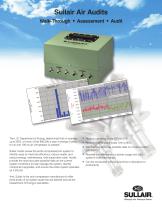
Sullair Air AuditsWalk-Through ■ Assessment ■ •20MA The U.S. Department of Energy determined that on average up to 50%, or more, of the $40,000 a year in energy it takes to run one 100 hp air compressor is wasted! Sullair Audits review the entire compressed air system to identify ways to maximize efficiency; reduce waste; and reduce energy, maintenance, and equipment costs. Audits provide the most accurate possible data on the current system conditions to help manage the system, identify component upgrades, and ensure the entire system operates as it should. ■ Reduce operating costs 25% to 50% ■ Reduce maintenance costs 10% to 80% ■ Get the most accurate possible data on current system ■■■ii' liii' 'ii ■ Receive documentation on power usage and your system's interrelationships ■ Can be conducted without downtime or disruption to productivity And, Sullair is the only compressor manufacturer to offer three levels of air system audit that are tailored around the Department of Energy's standards. Always air. Always thara."
Open the catalog to page 1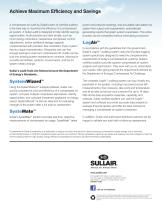
A compressed air audit by Sullair's team of certified auditors is the best way to maximize the efficiency of a compressed air system. A Sullair audit is designed to help identify savings opportunities. Audit solutions are often simple, such as minor piping corrections, inexpensive compressor control adjustments, and/or additional storage capacity complemented with precision flow controllers. Every system has its unique characteristics. Frequently one can find enough savings to even turn compressors off. Audits can be built into existing system maintenance contracts, allowing for re-audits as...
Open the catalog to page 2All SULLAIR catalogs and technical brochures
 Sullair 260 Series
4 Pages
 LS Series
20 Pages
 AWF® All Weather Fluid
2 Pages
 The SULLAIR 900H
2 Pages
 Sullair SRF 1/4000®
2 Pages
 Pristine FG™
2 Pages
 SULLAIR Two-stage
12 Pages
 The SULLAIR 425H
2 Pages
 The Sullair 1600
2 Pages
 The SULLAIR 375HH
2 Pages
 900XHH/1150XH
2 Pages
 ES-6 S-energy
8 Pages
 S-energy_2019
8 Pages
 SULLAIR Air Treatment_2017
19 Pages
 The Sullair 1300H
2 Pages
 The Sullair 375H
2 Pages
 MBT-6 Backfill Tamper
16 Pages
 OFS series
8 Pages
 SULLAIR FD1550
4 Pages
 SRL series
8 Pages
 DSP series
8 Pages
 Sullair SRF 1/4000
2 Pages
 SULLAIR Single-stage
8 Pages
 Centrifugal compressors
12 Pages
 Flowlogic
8 Pages
 S-energy_2015
16 Pages
 S energy
16 Pages
 900XHH-1150XHDL
2 Pages
 Heat Recovery—S-energy® EES
8 Pages
 Sullair Vacuum System
8 Pages
 1150XHH/1350XHDL
2 Pages
 750XHH/900XHDL
2 Pages
 TSR-20
2 Pages
 TSR-32
2 Pages
 DR-13
DR-132 Pages


Archived catalogs
 Desiccant Regenerative Dryers
12 Pages
 TSR20
TSR202 Pages
 DR13
DR132 Pages
 DE18
DE182 Pages
 RDHL
RDHL2 Pages
 SSL10
SSL1016 Pages
 2016 ShopTek
4 Pages
 SULLAIR Air Treatment_2016
30 Pages
 ShopTek
8 Pages




- Stationary compressor
- Positive-displacement compressor
- Industrial compressor
- Management software solution
- Electrically-powered compressor
- Real-time software
- Oil-free compressor
- Lubricated compressor
- Monitoring software solution
- Screw compressor
- Industrial software
- Compact compressor
- Liquids separator
- Mobile compressor
- Tank-mounted compressor
- Gas compressor
- Cooled compressor
- Compressed air dryer