


- Company
- Products
- Catalogs
- News & Trends
- Exhibitions
Synchronous tailstock

Synchronous tailstock
- The tailstock is synchronously driven to the workhead, increasing drive torque through the friction of the centers in the workpiece.
- Allows for complete machining in a single clamping, enhancing form and position accuracy.
- Facilitates easy setup for automated workpiece changes.
- Programmable stroke of 120 mm and reference length definition enable efficient grinding of part families with varying workpiece lengths.
- Axial positioning via servomotor with an NC drive ensures high position repeatability.
- Individually controllable positioning, center-search, and clamping speeds.
- Programmable clamping force with exchangeable springs for progressive adjustment.
- Includes an air lift for easy movement.
- The synchronous tailstock is integrated into the StuderWIN operating software.
- Certified under ISO 9001 and VDA6.4 standards.
- Swiss-made by Fritz Studer AG.
- Compatible with STUDER machines S22, S33, S31, S41.
- Height of centers: 175 mm (225 mm with intermediate plate).
- Max workpiece weight: 80 kg.
- Spindle drive max: 1.6 kW.
- Fitting taper: MT4.
- Stroke (W-axis): 120 mm.
- Travel speed: 0–6 m/min.
- Clamping principle: Electromechanical with springs.
- Clamping force: 250–4000 N, adjustable progressively.
- Spindle speed: 1-1500 rpm, optionally with motor brake.
- Fine adjustment for cylindricity corrections: ± 80 μm.
- Can be used with stationary centers, rotating centers, and spring collets.
- Usable distance between centers is reduced depending on machine type and wheelhead variant.
- Mounting of dressers on the tailstock is not possible.
Catalog excerpts

SYNCHRONOUS TAILSTOCK GREATER FLEXIBILITY, GREATER PRODUCTIVITY WITH A SYNCHRONIZED TAILSTOCK DRIVE A member of the UNITED GRINDING Group
Open the catalog to page 1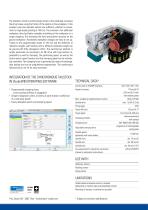
The tailstock, which is synchronously driven to the workhead, increases the drive torque using the friction of the centres in the workpiece. In the simplest case two standard centers are sufficient, whether in conventional or high-speed grinding at 140 m/s. The omission of an additional workpiece drive facilitates complete machining of the workpiece in a single clamping. This increases the form and position accuracy on the ground workpiece. Automated workpiece changes are easy to set up. Thanks to the programmable stroke of 120 mm and the definition of reference lengths, part families with a...
Open the catalog to page 2All STUDER catalogs and technical brochures
 ecoLoad
2 Pages
 roboLoad
2 Pages
 insertLoad
2 Pages
 S33
S3313 Pages
 easyload
2 Pages
 favoritCNC
11 Pages
 smartLoad
2 Pages
 favorit
13 Pages
 S30
S309 Pages
 S100
S10011 Pages
 S36
S3613 Pages
 uniLoad
2 Pages
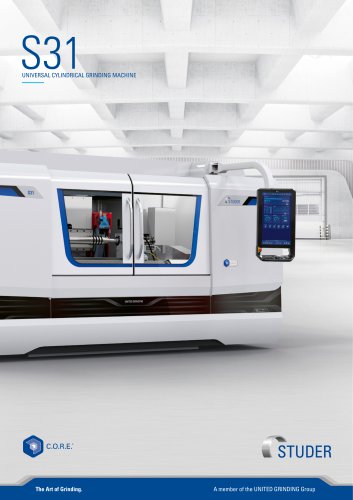 S31
S3113 Pages
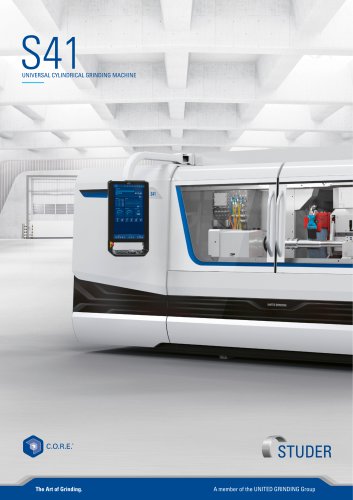 S41
S4115 Pages
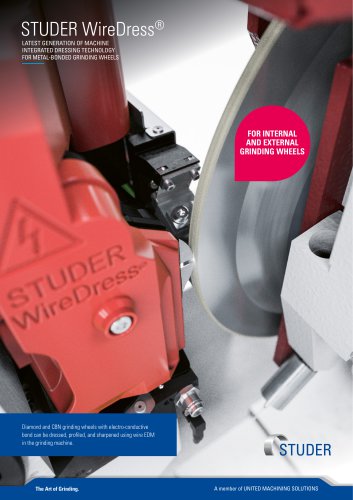 WireDress®
4 Pages
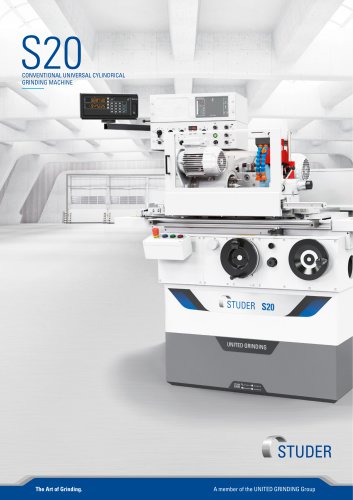 S20
S209 Pages
 S11
S1120 Pages
 S122
S1224 Pages
 S121 / S131 / S141
15 Pages
 S131 / S141 / S151
15 Pages
 S121
S12111 Pages
 S22
S2220 Pages
 S110 / S120
20 Pages
Archived catalogs
 S121 / S131 / S141 Radius
15 Pages
 Customer Care STUDER
7 Pages
 Customer Care UGG
13 Pages
 Software
20 Pages
 LaserControl™
2 Pages
 StuderControl
4 Pages
 Product Range
16 Pages
 A Axis
2 Pages
- Automation software solution
- Windows software
- STUDER CNC grinding machine
- Measurement software
- STUDER precision grinding machine
- Simulation software solution
- Programming software solution
- STUDER workpiece grinding machine
- Surface grinding machine
- STUDER cylindrical grinding machine
- EDM software
- STUDER high-precision grinding machine
- Creation software
- Surface treatment wheel
- Tool grinding machine
- Data management software
- Charging machine
- Cylindrical grinding wheel
- Graphic software