
- Catalogs
- STS - Bespoke Handling Equipment
- Drum Tipper - STM01-DRU01 - Operation Manual (Manual drum lifter STM01-DRU01)


- Company
- Products
- Catalogs
- News & Trends
- Exhibitions
Drum Tipper - STM01-DRU01 - Operation Manual (Manual drum lifter STM01-DRU01)
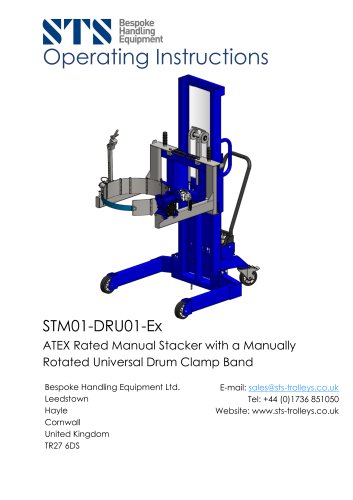
Drum Tipper - STM01-DRU01 - Operation Manual (Manual drum lifter STM01-DRU01)
- General: The unit must be used according to instructions to prevent damage or injury. It complies with BS EN ISO 17050-1:2010 and the EC Machinery Directive 2006/42/EC.
- Foreseeable Misuse: Avoid exceeding the maximum safe working load, traveling with a raised load unnecessarily, or altering the unit's specifications. Unauthorized modifications void the warranty.
- Approved Application Conditions: Operate in dry environments, within 5°C to 40°C, on secure, level surfaces. Proper PPE is mandatory.
- Proprietor Responsibilities: Ensure safe use and conduct risk assessments. Ensure all users understand the instructions.
- Adding Attachments: Requires manufacturer’s written permission and possibly local authority approval.
- Safety Regulations: Only trained personnel should operate the unit. Report any damage immediately and use original parts for repairs.
Details the components and features of the unit, emphasizing the importance of understanding each part for safe operation.
- Pre-start Inspections: Conduct thorough checks before use.
- Moving the Unit: Follow guidelines for safe maneuvering, especially with raised loads.
- Operating Functions: Instructions for lifting, lowering, clamping, and rotating drums.
- Maintenance Checklist: Regular checks are essential for safety and performance.
- Troubleshooting: Guidance on addressing common issues.
- Consumables: Use only specified parts and dispose of them according to environmental regulations.
Provides detailed technical data and arrangement of the unit.
- Decommissioning: Follow procedures for safe decommissioning and disposal.
- Recommissioning: Safety tests are required after unusual incidents or before recommissioning.
Catalog excerpts
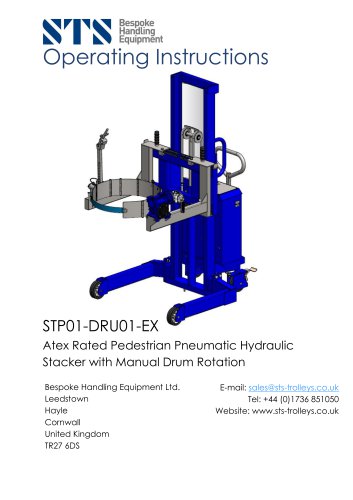
ATEX Rated Manual Stacker with a Manually Rotated Universal Drum Clamp Band Bespoke Handling Equipment Ltd. E-mail: [email protected] Hayle Website: www.sts-trolleys.co.uk United Kingdom
Open the catalog to page 1
The unit described in the present operating instructions must be used, operated and serviced in accordance with the present instructions. Any other type of use is beyond the scope of application and can result in damage or injury to personnel, the unit or property. The unit described in the present operating instructions complies with BS EN ISO 17050-1:2010 and the EC Machinery Directive 2006/42/EC. Foreseeable Misuse of the Unit Personnel must take care when operating the unit. The following actions must be adhered to: • The maximum safe working load (SWL) must not be exceeded. • Do not travel...
Open the catalog to page 3
Proprietor Responsibilities For the purposes of the present operating instructions the “proprietor” is defined as any natural or legal person who either uses the unit themselves, or on whose behalf it is used. In special cases (e.g. leasing or renting) the proprietor is considered the pers on who, in accordance with existing contractual agreements between the owner and user of the unit, is charged with operational duties. The proprietor must ensure that the unit is used only for the purpose for which it is intended and that there is no danger to life or limb of the user and third parties. Furthermore,...
Open the catalog to page 4
Servicing and repairs All unit parts and consumables are available from STS. The unit must be fitted with original STS parts and consumables unless otherwise stated. Any deviation from non original parts and consumables may result in injury to personnel or damage to the unit and will invalidate the warranty. The operator must never disable, remove or adjust safety mechanisms or switches. The unit should only be serviced and repaired by a competent individual as selected by the company the equipment is intended for use with. Safety devices and warning decals Safety devices, warning decals and...
Open the catalog to page 5
Personal protective equipment (PPE) PPE must be worn at all times. A minimum of safety shoes must be worn while operating the unit. Safety shoes, safety glasses, protective gloves, hearing protection and protective overalls are to be worn when carrying out servicing, repairs and maintenance. When operating overhead loads, a hard hat must be worn. End user health and safety procedures and best practices should be followed in addition to the above recommendations. Consumables and Parts Environmental hazards Parts and oils must be disposed of in accordance with the relevant environmental protection...
Open the catalog to page 6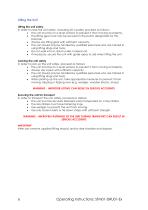
In order to raise the unit safely, including off a pallet, proceed as follows: • The unit must be on a level surface to prevent it from moving accidently. • The lifting gear must only be secured to the points designated for this purpose. • Always use lifting gear with sufficient capacity. • The unit should only be handled by qualified personnel who are trained in using lifting slings and tools. • Do not walk into or stand under a raised unit. • If necessary, secure the unit with guide ropes to aid when lifting the unit. In order to jack up the unit safely, proceed as follows: • The unit must...
Open the catalog to page 7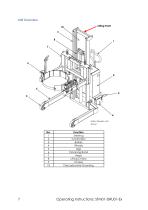
Unit Overview
Open the catalog to page 8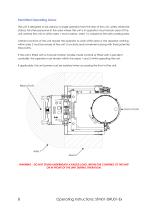
Permitted Operating Zones The unit is designed to be used by a single operator from the rear of the unit, unless otherwise stated. All other personnel in the area where the unit is in operation must remain clear of the unit, behind the unit or within area 1 shown below. Area 1 is classed as the safe working area. Certain functions of the unit require the operator to work within area 2, the operator working within area 2 must be aware of the unit’s functions and movements along with their potential trap points. If the unit is fitted with a manual rotation handle, head controls or fitted with a...
Open the catalog to page 9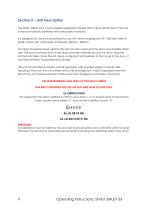
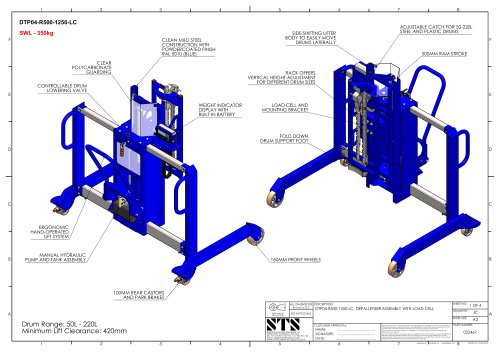
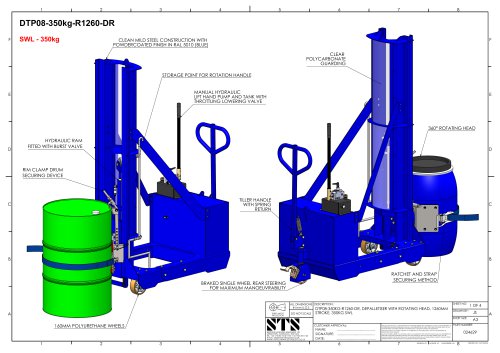
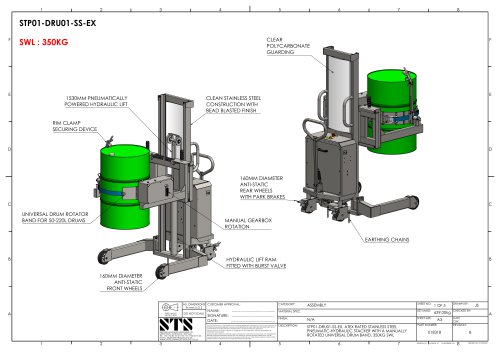
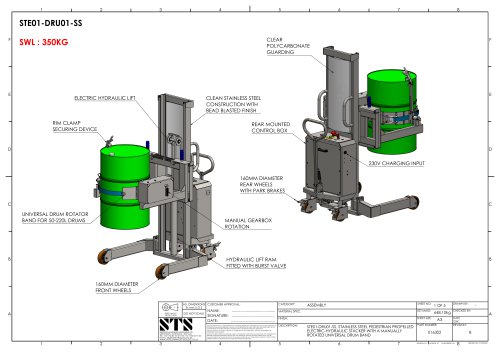
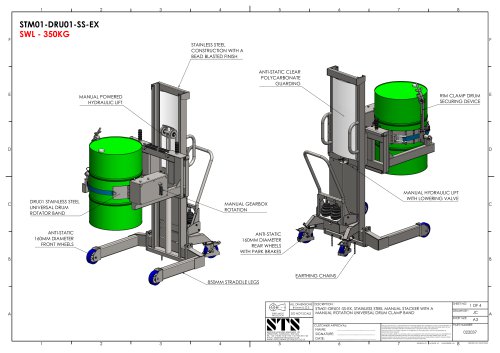
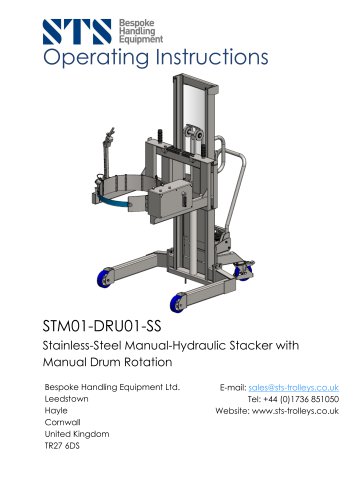
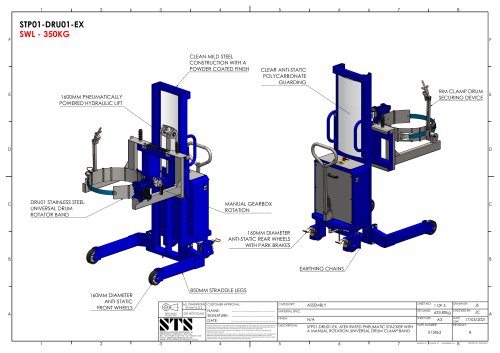
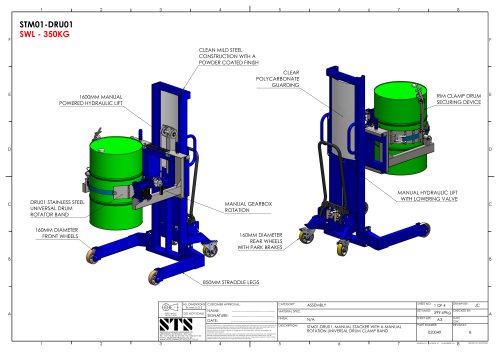
Section II – Unit Description The STM01-DRU01-Ex is a four-wheeled pedestrian stacker with a drum rotator band. The unit is manual-hydraulic powered with manual drum rotation. It is designed for use on level surfaces for use with drums ranging from 50 - 220 litres, steel or plastic drums with a diameter of between 350mm - 600mm. The drum should be stood vertical; the unit can then approach the drum and straddle either side. The band is pushed flush to the drum and then fastened around the drum using the ratchet and strap. Once the rim clamp is adjusted and fastened to the top lip of the drum,...
Open the catalog to page 10
Before using this unit, operators must read and understand this instruction manual. Failure to observe the instructions in this manual will invalidate the warranty. NOTE: Personal Protective Equipment (PPE) must be worn at all times, see ‘Section I - Correct Use and Application' for more information. • Check the whole of the outside of the unit for signs of damage and leaks. Any damaged hoses must be replaced immediately. • Check the unit for visible signs of damage such as cracks, bent or severely worn parts. • Check all wheels for damage. • Check that the markings and labels are present, clean...
Open the catalog to page 11
- If loaded, the load must not exceed the unit's capacity. - If loaded, load undamaged. - Load at correct height for transport (< 500mm). - Flat and level ground conditions. • Disengage the rear parking brakes. • The unit can then be manoeuvred to the desired location. • Steering is controlled from the rear of the stacker using the handles. • Travel at a constant speed. • Adapt your travel speed to the conditions of the route and the load you are transporting. • Always transport loads at as low a height as possible to retain the stability of the unit. • When finished manoeuvring, the rear parking...
Open the catalog to page 12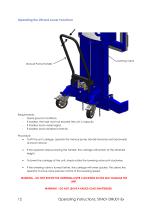
- Good ground conditions. - If loaded, the load must not exceed the unit's capacity. - If loaded, load undamaged. - If loaded, load clamped correctly. • To lift the unit carriage, operate the manual pump handle forwards and backwards as shown above. • If the operator stops pumping the handle, the carriage will remain at the attained height. • To lower the carriage of the unit, simply rotate the lowering valve anti-clockwise. • If the lowering valve is turned further, the carriage will lower quicker. This allows the operator to have more precise control of the lowering speed. WARNING - DO NOT...
Open the catalog to page 13All STS - Bespoke Handling Equipment catalogs and technical brochures

- Dynamic agitator
- Batch agitator
- Metal cart
- Transport trolley
- Liquid homogenizer
- Agitator for the food industry
- Stacker truck
- Lifting system
- Vertical homogenizer
- Homogenizer for the chemical industry
- Stainless steel homogenizer
- Handling cart
- Electric stacker truck
- Materials handling manipulator
- In-line mixer
- Solid mixer
- Solid/liquid agitator
- Walk-behind stacker truck
- Manipulator for industrial applications
- Powder kneader