


- Company
- Products
- Catalogs
- News & Trends
- Exhibitions
Ebook: 3D printing for medical innovation

Ebook: 3D printing for medical innovation
The document explores the transformative role of 3D printing, particularly the Stratasys J750 3D Printer, in the medical field. It emphasizes the enhancement of patient outcomes and healthcare efficiency through advanced 3D printing technologies.
The Stratasys J750 is the first full-color, multi-material 3D printer, offering biomedical engineers and researchers the ability to create realistic anatomical models. It provides a wide range of material choices and fine resolution, overcoming previous technological limitations.
- Medical Models: Capable of producing realistic models with both rigid and flexible materials, simulating hard bone and soft tissue in a single print.
- Prototype Parts: Enables rapid prototyping with materials like Digital ABS™, creating concept models that closely resemble production versions.
- Research and Manufacturing Tools: Allows for the quick production of customized fixtures and equipment with precision and multi-part print capability.
The printer offers true full-color capability with over 360,000 colors, using the CMYK color process. This enables detailed and realistic models with high surface quality.
With six base resins, the printer creates a vast array of colors and material properties, reducing the need for multiple technologies and extensive post-processing.
Utilizing GrabCAD Print™ software, the Stratasys J750 simplifies the printing process, minimizing downtime and material waste, and is suitable for hospital environments.
Biomedical Models, Inc. uses the printer to create surgical planning models and training simulators with realistic colors and textures, enhancing surgical training and education.
3D printing accelerates medical device development, allowing for faster and more cost-effective production, which speeds up market entry and clinical trials.
3D printing creates detailed replicas of patient anatomy for surgical preparation, training, and education, improving surgical planning and outcomes.
3D printing streamlines the production of lab tools, reducing costs and development cycles, and enhancing versatility and efficiency.
3D printing allows for faster product development and iteration, leading to optimal designs and shorter development cycles.
Nidek Technologies uses PolyJet additive manufacturing to create functional prototypes for ophthalmology equipment, reducing development time by 50% and costs by 75%.
Institutions like Kaleida Health’s Gates Vascular Institute use 3D printing to advance vascular healthcare, providing realistic models for surgical practice and device testing.
3D printing offers new paradigms for medical training with patient-specific models that enhance surgical skills in a risk-free environment.
The Jacobs Institute uses 3D printing to improve medical device design and preclinical testing, enabling faster design iterations.
3D printing aids in planning complex surgical procedures by providing physical models that help anticipate complications.
A surgical team used a 3D model to evaluate a treatment plan for a brain aneurysm, identifying potential complications and devising a more effective solution.
Ciprian Ionita, Ph.D., uses 3D printing to create custom fixtures for scientific equipment, saving time and costs.
The Jacobs Institute collaborates with GVI and CTRC to integrate 3D printing in healthcare, enhancing training, device design, and surgical preparation.
The printer's multi-material, multi-color capabilities provide realistic anatomical models for training and surgical planning.
- Training Models: The J750 provides detailed, flexible models for effective training.
- Device Testing: The J750 creates accurate 3D models for better testing.
- Device Development: The J750 allows for complex designs with unique material properties.
Investing in 3D printing technology like the Stratasys J750 can reduce development cycles, improve patient outcomes, and offer financial benefits.
The Stratasys J750 is a versatile tool supporting medical innovation, offering significant benefits in terms of time, cost, and patient care. It is recommended for adoption by medical device companies, healthcare providers, and research institutions.
Catalog excerpts
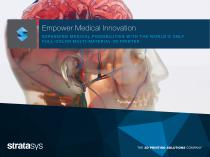
Empower Medical Innovation E X PA N D I N G M E D I C A L P O S S I B I L I T I E S W I T H T H E W O R L D ’ S O N LY F U L L - C O L O R M U LT I - M AT E R I A L 3 D P R I N T E R
Open the catalog to page 1
Ask anyone in the medical community what their top objectives are and they’ll probably say that everything boils down to improving patient outcomes while making the healthcare system more efficient. Having the right tools to do the job is one crucial element in solving problems and becoming more effective and productive. Additive manufacturing, widely known as 3D printing, is one of those tools that has helped inventors, educators, and researchers improve how they design, manufacture, teach and perform research. The same technology has also benefitted health care providers, with tools that can...
Open the catalog to page 2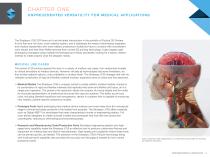
The Stratasys J750 3D Printer isn’t just the latest introduction in the portfolio of PolyJet 3D Printers. It’s the first-ever full-color, multi-material system, and it addresses the needs of biomedical engineers and medical researchers who want realistic anatomical models but have to contend with inconsistent color results and less-than-lifelike textures from current 3D printing technology. It also targets rapid prototyping managers using multiple technologies and messy processes, looking for a leaner, cleaner method to create exactly what the designer needs. MEDICAL USE CASES The advent of 3D...
Open the catalog to page 3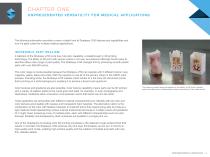
The following information provides a more in-depth look at Stratasys J750 features and capabilities and how it’s aptly suited for multiple medical applications. I N C R E D I B L E PA R T R E A L I S M A hallmark of the Stratasys J750 is its true, full-color capability, a breakthrough in 3D printing technology. The ability to 3D print with various colors is not new, but previous offerings forced users to sacrifice either color range or part quality. The Stratasys J750 changes this by producing smooth plastic parts with over 360,000 colors. This color range is made possible because the Stratasys...
Open the catalog to page 4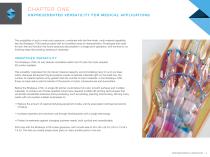
The availability of such a wide color spectrum, combined with the fine-finish, multi-material capability, lets the Stratasys J750 produce parts with an incredible array of characteristics. Prototypes that need to look, feel and function like future products are possible in a single print operation, with minimal to no finishing steps like painting, sanding or assembly. U N M AT C H E D V E R S AT I L I T Y The Stratasys J750 not only delivers incredible realism but it’s also the most versatile 3D printer available. This versatility originates from its robust material capacity, accommodating input...
Open the catalog to page 5
For rapid prototyping programs, this versatility is an opportunity to meet the diverse demands of your operation without the inefficiencies associated with material changes or the need to invest in, operate and maintain a variety of technologies. You can print realistic prototypes, presentation models, Digital ABS injection molds, jigs, fixtures, educational and promotional pieces, production parts – or all of the above, with one system. FA S T, E F F I C I E N T W O R K F L O W A N D E A S E O F U S E Using the printer is easy, starting with GrabCAD Print™ software, which lets you import native...
Open the catalog to page 6
Some 3D printing processes must run in a dedicated facility because of the materials, chemicals and post-processing steps involved. In contrast, the Stratasys J750 3D Printer uses a clean, easy process, with no hazardous chemicals to handle, a particularly important consideration in a hospital setting. It’s compatible with soluble support material that can be removed in a solution bath. This lets users focus on other duties while the support material is being removed and also makes it easier and less problematic to clean delicate parts and internal cavities, an important feature for intricate...
Open the catalog to page 7
For another example of how realistic modeling plays a role in advancing health care, view this video to see how the Centre for Biomedical and Technology Integration uses the Stratasys J750 to create realistic patient-specific anatomical models for physician training. A 3D printer with this capability is a powerful tool, enabling creative solutions for diverse challenges that impact the healthcare industry. In the following chapters, we’ll look at how 3D printing benefits the development and delivery of healthcare products and services and how the Stratasys J750 fits. EMPOWER MEDICAL INNOVATION...
Open the catalog to page 8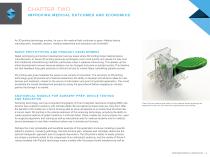
CHAPTER TWO IMPROVING MEDICAL OUTCOMES AND ECONOMICS As 3D printing technology evolves, its use in the medical field continues to grow. Medical device manufacturers, hospitals, doctors, medical researchers and educators can all benefit. RAPID PROTOTYPING AND PRODUCT DEVELOPMENT Rapid prototyping and product development are key areas where 3D printing helps medical device manufacturers. In-house 3D printing produces prototypes much more quickly and usually for less cost than traditional manufacturing methods, particularly when it replaces outsourcing. This speeds up the entire development process...
Open the catalog to page 9
CHAPTER TWO IMPROVING MEDICAL OUTCOMES AND ECONOMICS appearance. Doctors use these models to plan the best surgical approach resulting in shorter operating times and better post-operative results. 3D printed models also help train doctors to perform medical procedures and use new devices, and educate medical students on general anatomical structures. The Stratasys J750 in particular offers complex geometries and blends of material properties that would be difficult or impossible to produce with conventional manufacturing methods. Training models can mimic the look and feel of living tissue and...
Open the catalog to page 10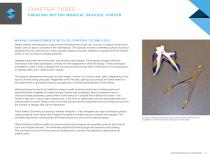
M A K I N G A D VA N C E M E N T S W I T H 3 D P R I N T I N G T E C H N O L O G Y Medical device manufacturers must provide the best product they can, not only to support advances in health care but also to compete in the marketplace. This typically involves a relentless pursuit of product development and improvement, which typically requires physician feedback to assess what the market wants or how to improve existing products. Designers assimilate this information and develop initial designs. Prototyping managers take this information and create prototypes, working with the designers to refine...
Open the catalog to page 11All Stratasys catalogs and technical brochures
 Fortus 450mc
8 Pages
 TECH STYLE J850™
8 Pages
 J3 DentaJet 3D printer
2 Pages
 Neo800
2 Pages
 TECHSTYLE
8 Pages
 J5 MediJet™
8 Pages
 Origin One Dental
8 Pages
 F770
F7708 Pages
 J8 Series Brochure
8 Pages
 J35 Pro
4 Pages

Archived catalogs
 3D printing for dental
4 Pages
 FDM Material: Nylon 12CF
2 Pages
 Surgical Planning
8 Pages
 ABOUT 3D PRINTING
6 Pages
 J720 Dental
4 Pages
 J5 DentaJet
8 Pages
 J700 Dental
4 Pages
 Stratasys J4100
2 Pages
 PolyJet Materials and Systems
16 Pages
 Objet 260 Connex 3
2 Pages
 Objet 30 Prime
2 Pages
 Objet 500 Connex 1
2 Pages
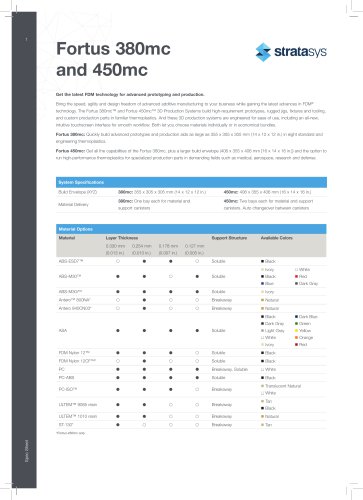 Fortus 450mc - 380 mc
2 Pages
 Stratasys H350
8 Pages
 Origin One
8 Pages
 Objet 30 V.5.
1 Page
 F123 Series Brochure
4 Pages
 FDM Materials and Systems
12 Pages
 Stratasys J55-Prime
8 Pages
 F900
F9008 Pages
 F123 Composite-Ready
6 Pages


- Industrial 3D printer
- Plastic additive manufacturing machine
- Prototyping 3D printing machine
- FDM 3D printer
- High-performance 3D printer
- Large-format 3D printer
- High-speed 3D printer
- ABS 3D printer
- PLA 3D printer
- Resin 3D printer
- Desktop 3D printer
- Medical 3D printing machine
- Dental additive manufacturing machine
- PA 3D printer
- 3D printer for the aerospace industry
- TPU 3D printer
- 3D printer for the automotive industry
- Nylon 3D printer
- Continuous operation 3D printer