
- Catalogs
- STMicroelectronics
- Audio solution guide for analog home systems

- Products
- Catalogs
- News & Trends
- Exhibitions
Audio solution guide for analog home systems

Audio solution guide for analog home systems
STMicroelectronics offers a comprehensive range of analog audio solutions for home stereo and multi-channel audio systems, including Class AB and Class D amplifiers and audio processors. These products are recognized for their high reliability, outstanding audio quality, and support for turnkey solutions.
These processors control advanced features in home audio systems such as tone controls, surround modes, and bass boost. They communicate with the main application microprocessor via a 2-wire I2C bus interface. Key models include TDA7430, TDA7439, and TDA7449, each offering various input configurations and control features.
Class AB amplifiers are known for their excellent clarity and signal fidelity, offering a warm, full-bodied tone. They are less power-efficient compared to Class D amplifiers but are preferred for high-quality audio systems. Models like TDA7293 and TDA7294 provide output power ranging from 18W to 100W per channel, with features such as mute, standby, and thermal protection.
Class D amplifiers provide high efficiency by using pulse width modulation to amplify audio signals. They can achieve up to 90% efficiency and are suitable for applications requiring high power output with minimal heat dissipation. Models such as TDA7492 and TDA7498H offer output power from 3W to 100W per channel, with features like selectable gain and filterless operation.
The document includes typical application circuits and block diagrams for various amplifiers, highlighting their flexibility and ease of integration into audio systems. The STA540, for example, offers multiple configuration options, making it suitable for diverse audio applications.
STMicroelectronics provides a robust portfolio of analog audio solutions that cater to a wide range of home audio applications, ensuring high-quality sound and reliable performance.
Catalog excerpts

Audio solution guide for analog home systems Audio processors, Class AB and Class D amplifiers
Open the catalog to page 1
Leveraging its long experience in audio devices, STMicroelectronics has a wide analog device portfolio that addresses home stereo and multi-channel audio equipment, such as home cinema systems. Our large Class D and Class AB portfolio is recognized by customers worldwide as the most complete offering for analog 2.0/2.1 multi-channel systems. High reliability, outstanding audio quality, turnkey solution support and design resources contribute to our leadership as an analog audio solution provider. This brochure presents a simple selection guide for our analog amplifiers and audio processors to...
Open the catalog to page 2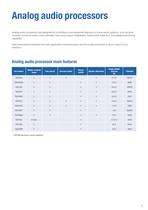
Analog audio processors Analog audio processors are designed for controlling more advanced features on home audio systems, such as tone controls, surround mode, voice canceller, input and output multiplexers, bass boost, bass ALC and headphone driving capability. Data transmission between the main application microprocessor and the audio processor is via a 2-wire I2C bus interface. Analog audio processor main features Speaker attenuation Supply voltage min/max [V] Part number Tone control Surround modes Volume control Number of stereo inputs TDA7469 also drives a stereo headphone
Open the catalog to page 3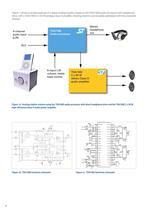
Figure 1 shows a simple example of a stereo analog solution based on the TDA7469 audio processor with headphone drive, with a TDA7492 (2 x 50 W) analog Class D amplifier. Docking stations can be easily addressed with the proposed solution. 6-input L/R volume, treble bass control TDA7492 2 x 50 W stereo Class D audio amplifier Figure 1a. Docking station schema using the TDA7469 audio processor with direct headphone drive and the TDA7492 2 x 50 W high-efficiency Class D audio power amplifier. Half_wave rectifier Figure 1b. TDA7469 technical schematic Figure 1c. TDA7492 technical schematic
Open the catalog to page 4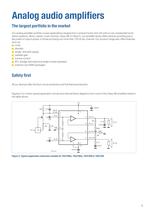
Analog audio amplifiers The largest portfolio in the market Our analog amplifier portfolio covers applications ranging from compact home mini-hifi units to very substantial home stereo systems. Mono, stereo, multi-channel, Class AB or Class D, our amplifier family offers devices providing just a few watts of output power, to those pumping out more than 100 W per channel. Our product range also offers features such as: n mute n standby n single- and split supply n variable gain n volume control n BTL (bridge-tied load) and single-ended operation n insertion and SMD packages Safety first All our...
Open the catalog to page 5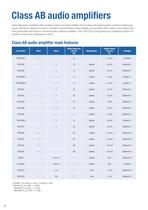
Class AB audio amplifiers Class AB audio amplifiers offer excellent clarity and signal fidelity. Pure analog, this signal quality is paid for with lower power efficiency, relative to Class D amplifiers. Nevertheless, these reliable components offer a warm, full-bodied tone that guarantees their place in the best audio systems available. The TDA729x is recognized as a preferred solution for systems made with audiophiles in mind. Class AB audio amplifier main features Part number Output power per channel [W] 18 Supply voltage min/max [V] STA540: Pout (2 x 26 W, 2 x 12 W + 1 x 26 W, 4 x 12 W) TDA7497:...
Open the catalog to page 6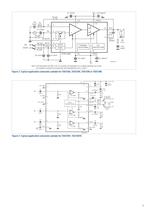
THERMAL SHUTDOWN -Vs Note: The Boucherot cell R6, C10, is normally not necessary for a stable operation but could be needed in presence of particular load impedances at VS <±25 V. Figure 3. Typical application schematic suitable for TDA7293, TDA7294, TDA7295 or TDA7296 MUTE PROTECTIONS Figure 4. Typical application schematic suitable for TDA7497, TDA7497S
Open the catalog to page 7
The flexible solution: STA540/STA540SA The STA540 is a Class AB audio power amplifier that offers extreme flexibilty. This smart device can be used in the following configurations: In addition to offering three output configurations, the STA540 is easy to use and only requires an extremely low component count. DIAGNOSTIC OUTPUT Figure 5. Block diagram for the STA540 P-GND S-GND Figure 6. Three different configurations possible for the STA540 Figure 7. The STA540SA demonstration board for the 2/1 channel configuration
Open the catalog to page 8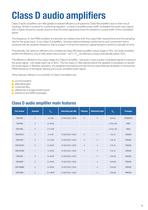
Class D audio amplifiers Class D audio amplifiers can offer greatly increased efficiency compared to Class AB amplifiers due to their circuit topology. Similar in scheme to a switching regulator, a Class D amplifier pulse width modulates the audio input signal with a higher frequency square wave so that the audio signal becomes the variations in pulse width of this modulated signal. The frequency of the PWM oscillator is important as it determines both the output filter requirements and the sampling rate for the audio input. In our Class D amplifiers, the best balance between performance and...
Open the catalog to page 9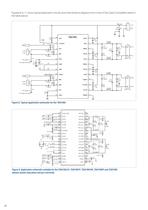
Figures 8 to 11 show typical application circuits and internal block diagrams from most of the Class D amplifiers listed in the table above. J2 SMD Type C20 16 V 10 µF C3 The jumper J5 For single end input Figure 8. Typical application schematic for the TDA7493 Figure 9. Application schematic suitable for the TDA7491LP, TDA7491P, TDA7491HV, TDA7492P and TDA7492 (device shown slug down and pin-mirrored)
Open the catalog to page 10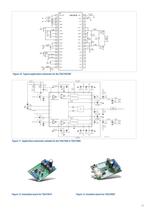
Figure 10. Typical application schematic for the TDA7491MV R1 10K Figure 11. Application schematic suitable for the TDA7490 or TDA7490L Figure 12. Evaluation board for TDA7491P Figure 13. Evalution board for TDA7492P
Open the catalog to page 11
© STMicroelectronics - March 2009 - Printed in Italy - All rights reserved The STMicroelectronics corporate logo is a registered trademark of the STMicroelectronics group of companies. All other names are the property of their respective owners. For more information on ST products and solutions, visit www.st.com ^ ^fij
Open the catalog to page 12All STMicroelectronics catalogs and technical brochures
 STGW30NC60KD
14 Pages
 STGB14NC60K STGD14NC60K
16 Pages
 HD1750FX
8 Pages
 TDA75610SLV
42 Pages
 TDA7391
13 Pages
 TDA7376B
15 Pages
 TDA7375V
15 Pages
 TDA2005
25 Pages
 L4989D, L4989MD
19 Pages
 L4938ED L4938EPD
20 Pages
 L4949ED-E L4949EP-E
19 Pages
 L4925
L492514 Pages
 FDA903U
80 Pages
 FDA803U
76 Pages
 FDA903D
82 Pages
 FDA803D
78 Pages
 BALF-SPI2-02D3
13 Pages
 LIS2DTW12
65 Pages
 VL53L0X
40 Pages
 LPS22HH
59 Pages
 Standard products offer overview
13 Pages
 M40SZ100W
20 Pages
 A1C15S12M3
17 Pages
 TSX923
32 Pages
 TS1851
24 Pages
 LMV321
17 Pages
 Serial real-time clock (RTC) ICs
16 Pages
 TDA2003LG
8 Pages
 HCF4541 Programmable Timer
10 Pages
 STA8058 GPS multi-chip module
14 Pages
 TDA7410ND Signal Processor
34 Pages
 TDA7410ND Signal Processor
34 Pages
 TSA1204 DUAL CHANNEL
31 Pages


Archived catalogs
 NEATSwitch
6 Pages
 Power MOSFETs for metering
2 Pages


- Single-pole switch
- Acceleration sensor
- Pressure probe
- Technology switch
- Piezoelectric accelerometer
- Signal amplifying integrated circuit
- Multipole switch
- Transceiver module
- Electronic filter
- Electromechanical switch
- Membrane pressure sensor
- Rotary electric switch
- Analog pressure sensor
- Triaxial acceleration sensor
- Distance sensor
- Diode
- STMicroelectronics transistor
- Low-pass electronic filter
- Absolute pressure sensor