
- Catalogs
- steute Schaltgeräte
- Wireless Switchgear


Wireless Switchgear

Wireless Switchgear
Steute Schaltgeräte GmbH & Co. KG is a medium-sized company based in East Westphalia, specializing in innovative switchgear solutions for over 50 years. The company focuses on wireless automation, providing a wide range of wireless technologies for industrial automation and building services. Steute is committed to sustainable growth and maintaining high standards through international certifications.
The catalogue details a comprehensive range of wireless switchgear products, including wireless receivers and repeaters using SWAVE® and ENOCEAN® technologies, wireless position switches, command devices, hand controls, multifunction handles, foot switches, pull-wire switches, magnetic sensors, inductive sensors, optical sensors, and universal transmitters. Accessories and safe wireless systems under the SWAVE®-SAFE and SWAVE® 2.4 GHz technologies are also included.
Steute's wireless technology is designed for industrial applications, offering high reliability and minimal interference. The company has developed its own wireless standards to meet specific industrial needs, focusing on energy harvesting and low power consumption.
Steute's SWAVE® technology operates on 868/915 MHz and 2.4 GHz frequencies, providing solutions for various applications. The sWave® 868/915 MHz offers self-sufficient, bi-directional communication for movable machine parts, with features like high sensing range and non-contact sensors. The sWave® 2.4 GHz utilizes the license-free 2.4 GHz band, ensuring high reliability and coexistence with other wireless technologies like WLAN and Bluetooth. It is optimized for low power consumption and fast link-up times.
Steute's wireless solutions are suitable for demanding industrial environments, offering features such as high protection against environmental factors, energy harvesting capabilities for maintenance-free operation, bi-directional communication, long battery life, and compatibility with existing automation systems.
Steute continues to innovate in the field of wireless switchgear, expanding its product range and adapting to new industrial applications. The company emphasizes customer collaboration to develop tailored solutions for specific needs.
The sWave® 2.4 GHz-safe wireless system is designed for industrial environments, offering low energy consumption, fast connection, and long battery life. It meets high safety standards, achieving Performance Level PL d according to EN ISO 13849-1, ensuring reliable signal transmission even in adverse conditions.
The system operates on the IEEE 802.15.1 standard, utilizing Frequency Hopping Spread Spectrum (FHSS) on 79 channels for high reliability and interference resistance. It is optimized for a sensing range of 15 meters and operates on the license-free 2.4 GHz ISM frequency band.
- Mobile wireless transmitter with integrated electronics and rechargeable battery.
- Wireless receiver with parameterizable evaluation electronics.
- High EMC interference resistance and wireless approval for North America.
Typical applications include operation of machines with movable parts, mobile operation during robot servicing, and maintenance on machines.
EnOcean technology is used for green, intelligent buildings and industrial applications requiring interoperability with the EnOcean standard ISO/IEC 14543-3-10. It supports self-sufficient wireless paths with a high sensing range and fail-safe transmission in the 868 MHz frequency range.
The document provides a detailed comparison of various wireless technologies, including frequency, transmission channels, redundancy, and power consumption. The sWave® 2.4 GHz-safe system is noted for its high interference resistance and low power consumption.
Several models of wireless receivers are detailed, including those with RS232 interfaces and TCP/IP communication capabilities. These receivers support multiple channels and are designed for DIN rail mounting with various protection standards.
The sWave® 2.4 GHz-safe wireless system offers a robust solution for industrial wireless communication, with high safety standards and adaptability to various applications.
- Material: Enclosures are made from thermoplastic, specifically Polyamide PA 66, and glass-fibre reinforced thermoplastic for enhanced durability.
- Protection: All devices have a protection degree of IP 67 according to IEC/EN 60529, ensuring resistance to dust and water.
- Temperature Range: Operates effectively between -20°C and +65°C.
- Mechanical Life: Exceeds 1 million operations, ensuring long-term reliability.
- Battery Life: Supports over 800,000 operations with a replaceable Lithium battery CR2032.
- Protocols: Utilizes EnOcean® and sWave® protocols for wireless communication.
- Frequency: Operates at 868.3 MHz for European standards and 915 MHz for USA, Canada, and Australia.
- Transmission Power: Varies between <10 mW to <25 mW depending on the model and region.
- Data Rate: EnOcean® supports 120 kbps, while sWave® supports 66 kbps.
- Sensing Range: Maximum range of 450 m outdoors and 50 m indoors for sWave®; 200 m outdoors and 20 m indoors for EnOcean®.
- Devices are self-sufficient, requiring no external power supply or wiring.
- Easy programming and configuration of output signals at the receiver.
- Various actuator types available, including roller plungers, ball plungers, and levers, each with specific features like watertight collars and repositionable actuators.
- Standards compliance includes EN 60947-5-1, EN 61000-6-2, and others, ensuring compatibility and safety.
- Actuating speed for most devices is capped at 0.5 m/s, with some allowing up to 2.5 m/s.
- Vertical actuating angles vary, with common angles being 25º, 30º, 40º, and 45º.
- Actuators can typically be repositioned by 90º or 180º, with some allowing repositioning by 4 x 90º.
- Materials include wear-resistant plastic and metal, with options for watertight collars to prevent dirt penetration.
- EnOcean® and sWave® technologies eliminate the need for power supply, wiring, and pipe laying, offering easy receiver programming and multi-network capabilities.
- Enclosures are made from metal or thermoplastic, with protection degrees of IP 65 or IP 67.
- Operating temperature ranges from -20 °C to +65 °C.
- Switching frequency is approximately 9000 to 12000 telegrams per hour.
- Transmission frequencies are 868.3 MHz and 915 MHz, with varying transmission power and data rates.
- Mechanical life exceeds 1 million operations for most devices.
- Devices comply with standards such as EN 60947-5-1, EN 61000-6-2, and EN 301 489 series.
- Specific models have approvals for use in the USA and Canada.
- Actuation from the left is generally discouraged to preserve mechanical life.
- Metal rollers are available on request for enhanced durability.
- Some devices offer adjustable lever angles in 10° steps for precise control.
- EnOcean® Technology: Utilized in products like RF 95 WH/90° EN868 and RF 41 Z EN868, featuring no wiring requirement, integrated solar cells, and easy receiver programming. Standards include EN 60947-5-1 and EN 61000-6-2.
- sWave® Technology: Found in products like RF 95 WH/90° SW868/SW915, offering long-range capabilities and lithium battery power supply. Standards include EN 60947-5-1 and EN 61000-6-2.
- Enclosures: Made from glass-fibre reinforced thermoplastic or aluminium die-cast, providing IP 65 to IP 67 protection.
- Frequency and Transmission: Operate at 868.3 MHz or 915 MHz with transmission power up to 25 mW and data rates of 66 to 120 kbps.
- Multi-network capability and configurable output signals.
- Mechanical life exceeding 1 million operations.
- Ambient temperature range from -25 °C to +70 °C.
- Wireless Pull-Wire Switches: Include models like RF 95 WH/90° with options for Ex zones 1 and 21.
- Wireless Magnetic Sensors: Available in series like RF RC 10 and RF RC M30, featuring reed contact or GMR effect sensors.
- Wireless Optical Sensors: RF 96 LT EN868, actuated by light reflection, with a sensing range of up to 300 m outside.
- Wireless Frequency: 868 MHz and 915 MHz for different regions.
- Enclosure: Thermoplastic, glass-fibre reinforced, shock-proof, self-extinguishing UL 94-V0.
- Connection: Plug-in connector M12 x 1, 4 poles.
- Degree of Protection: IP 67 according to IEC/EN 60529.
- Protocol: EnOcean® and sWave®.
- Ambient Temperature: –20 °C to +65 °C.
- Transmission Power: SW868: <25 mW, SW915: <10 mW.
- Data Rate: 66 kbps for sWave®.
- Sensing Range: Max. 450 m outside, max. 40 m inside.
- Thermoplastic enclosure with mounting details to EN 50 047.
- No wiring and pipe laying required.
- Power supply by replaceable Lithium battery or external power supply (24 VDC).
- Easy programming of receiver with configurable output signals.
- Multi-network capability and individual configuration at the receiver.
- Switching Frequency: Approx. 12,000 telegrams at repetitions/h.
- Operating Cycles: Max. 5 Hz.
- Standby Current: 1.5 μA for sWave®.
- Battery Life: Varies with switch frequency, up to 1400 days.
- Actuating Time: Min. 80 ms.
- Field strength indicators for link range testing.
- Various antennas and mounting brackets for enhanced signal reception.
- Connectors and extension cables for flexible installation.
- Complies with EN 60947-5-1, EN 61000-6-2, EN 301 489-1, EN 301 489-3, EN 300 220-1, EN 300 220-2.
- USA: FCC, XK5-RFRXSW915; Canada: IC: 5158A-RFRXSW915.
- Output Power: -6 dBm e.i.r.p (0 dBm at 50 Ω)
- Input Sensitivity: Max. -98 dBm (-104 dBm at 50 Ω)
- Transmission Power: 1 mW
- Ambient Temperature Range: -20 °C to +65 °C
- Mechanical Life: > 1 million operations
- Wireless Frequency: 2.4 GHz
- Degree of Protection: IP 67 for foot switches, IP 54 for hand controls, IP 20 for receivers
- Wireless Foot Switches: Metal enclosure, pressure point, frequency hopping, easy receiver programming, battery power transmission.
- Wireless Hand Controls: Thermoplastic enclosure, keypad with four push-buttons, LED display, shock protection, lanyard loop, configurable output signal.
- Wireless Receivers: 4 relay outputs, LEDs for switching state, SMA plug-in connector for external antenna, DIN rail mounting.
- Accessories: RF SMA antenna socket, RF magnet antenna, antenna extension cables, 24 VDC power supply.
- Complies with various EN standards and FCC, RSS-210 for USA and Canada.
- steute develops switchgear for demanding applications, including wireless, automation, extreme, and medical technology.
- Headquartered in Löhne, Germany, with global sales through subsidiaries and partners.
Catalog excerpts

// CABLE FREE SWITCH CONTROL
Open the catalog to page 1
Wireless receivers / Wireless repeaters SWAVE® Wireless receiver RF Rx SW868/SW915-1W Wireless receiver RF Rx SW868/SW915-2W-RS232 Wireless receiver RF Rx SW868/SW915-4S Wireless receiver RF Rx SW868/SW915-TCP/IP Wireless receiver / Wireless repeater RF RxT SW868/SW915-USB Wireless repeater RF RxT SW868/SW915-1K Wireless repeater RF RxT SW868/SW915-2K Wireless receivers / Wireless repeaters ENOCEAN® Wireless receiver RF Rx EN868-1W Wireless receiver RF Rx EN868-2W-RS232 Wireless receiver / Wireless repeater RF RxT EN868-USB Wireless receiver RF Rx EN868-4W Wireless receiver RF Rx EN868 TCP/IP...
Open the catalog to page 3
Wireless multifunction handles Wireless foot switches 96 Series RF GFI EN868 97 Series RF GFI SW868/SW915 98 Series RF GFSI EN868 99 Series RF GFSI SW868/SW915 100 Wireless pull-wire switches Wireless magnetic sensors Wireless inductive sensors Series RF IS M8 Series RF IS M12 Series RF IS M18 Series RF IS M30 Wireless optical sensors Wireless universal transmitters Series RF 96 ST EN868 Series RF 96 ST SW868/SW915 Series RF 96 ST SW868/SW915-Vcc extern Series RF I/O SW868/SW915 Series RF I/O SW868/SW915-Vcc extern
Open the catalog to page 4
WIRELESS TECHNOLOGY SWAVE®-SAFE Safe wireless system sWave®-safe Series RF GFI SW2.4-safe Series RF GFSI SW2.4-safe Series RF GF SW2.4-safe Series RF GFS SW2.4-safe Series RF GF 2 SW2.4-safe Series RF GFS 2 SW2.4-safe WIRELESS TECHNOLOGY SWAVE® 2.4 GHZ Wireless foot switches Series RF GFI SW2.4 Series RF GFSI SW2.4 Series RF GFI D SW2.4 Series RF GFSI D SW2.4 Wireless hand controls Wireless receiver
Open the catalog to page 5
SAFE SWITCHGEAR FOR DEMANDING AND CRITICAL APPLICATIONS // »Safe switchgear for demanding and critical applications«. True to this motto, steute has been providing its customers with innovative, practical and durable switchgear solutions – for over 50 years. When our customers are successful, so are we. Because we always focus on our customers, our company has grown steadily and sustainably over the last decades. Steute is committed to continuing this growth – in close cooperation with our customers. We are situated in East Westphalia, a key region for machine building and electrical goods manufacturing....
Open the catalog to page 7
STEUTE WIRELESS – RELIABLE, MANAGEABLE AND PRACTICE ORIENTATED WIRELESS TECHNOLOGY − WORLDWIDE APPLICABLE
Open the catalog to page 8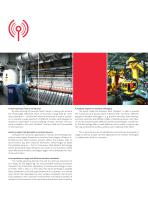
A new business field is introduced By restructuring its business fields, steute is taking into account the increasingly important share of its product range held by "wireless automation" – and the fact that the enterprise is now in a position to provide a large selection of different wireless technologies for industrial automation and the building services industry. The products included in this new "Wireless" business field are all presented in this brochure. A modular system for wireless switchgear The result: today the business field "Wireless" is able to provide the machinery and process...
Open the catalog to page 9
SURFING THE RIGHT WAVE
Open the catalog to page 10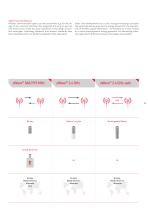
sWave® by steute Wireless Wireless communication opens up new possibilities e.g. for the design of man-machine interfaces. We recognised this early on and can now look back on nearly ten years’ experience in the design of wireless switchgear. Technology platforms and wireless standards have been developed which are perfectly adapted to their application fields. One development focus is the »Energy Harvesting« principle: the switching devices generate the energy required for the transmission of wireless signals themselves – for example via a solar module or a robust electrodynamic energy generator....
Open the catalog to page 11
steute Wireless sWave® 868/915-e/b sWave® 868 / 915-e MHz self-sufficient, bi-directional Wherever movable parts of machines and plants need to be positioned, controlled and monitored, cables are undesirable or a hinderance, reducing the viability of the plants. The solution: wireless, selfsufficient command devices which are applied to authorise solenoid interlocks on safety fences and protective guards. Wireless position switches which position, control and monitor machines and plants. sWave® 868 / 915-b MHz battery-operated, bi-directional Application field wireless technology Industrial sensors,...
Open the catalog to page 12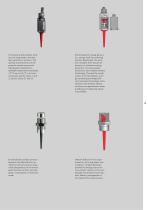
The antenna and wireless module are integrated in the wireless switches or sensors. The special characteristics of the products remain preserved: high degree of protection, low/high temperature durability -25 °C up to +65 °C, corrosion resistance, gas Ex zones 1 and 2, dust Ex zones 21 and 22. Electrodynamic energy generator, energy from the switching process (keystroke): the wireless modules from steute are based on a miniature energy generator, ultra low-power electronics and reliable wireless technology. Through the combination of miniaturisation, energy harvesting and highly efficient wireless...
Open the catalog to page 13
steute Wireless sWave® 2.4 GHz sWave® 2.4 GHz Application field wireless technology Wireless foot switches have many advantages in machine and plant engineering, for different reasons. On the one hand, cables are dangerous tripping hazards; on the other hand, cables restrict ergonomic comfort because the operator cannot position the foot switch freely in front of the machine. This technology, operating on the licensefree 2.4 Ghz frequency band, offers high reliability and robustness. Wireless Coexistence Most of the wireless technologies in use today operate on the 2.4 GHz frequency band. Devices...
Open the catalog to page 14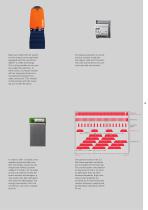
Nearly all industrial foot switches from steute can be optionally equipped with the new steute sWave® 2.4 GHz technology. This is also possible for one and two-pedal foot switches. In these cases, a compact module with an integrated antenna is incorporated instead of the cable connection. This module communicates with the receiving unit inside the device. The signal evaluation is carried out by a receiver inside the switchgear cabinet of the plant. Thus two transmitters can communicate with one receiver. Bluetooth / sWave® 2.4 GHz-safe IEEE 802.15.4 ZigBee sWave® 2.4 GHz In order to offer a reliable,...
Open the catalog to page 15All Steute Schaltgeräte catalogs and technical brochures
 Extreme Product overview
58 Pages
 wireless_sWave
12 Pages
 SAFE WIRELESS SYSTEM SWAVE®-SAFE
12 Pages
 Extreme Product overview
57 Pages
 Multifunctional handles
40 Pages

Archived catalogs
 Product overview
44 Pages
 Wireless Catalogue
107 Pages
 Product_overview
6 Pages
 RF GFI SW2.4-safe
4 Pages
 RF Rx - 4S
1 Page
 RF RxT - USB
1 Page
 RF HB
RF HB2 Pages
 Explosive topics from steute
68 Pages
 The Wireless book
218 Pages
 Ex switchgear to ATEX Catalogue
312 Pages
 RF RxT EN868-USB
1 Page
 Switchgear with radio tehnology
83 Pages
 Door handle switch TG
40 Pages


- Proximity switch
- Single-pole switch
- Cylindrical proximity sensor
- Technology switch
- Inductive proximity sensor
- Multipole switch
- IP67 proximity sensor
- Metal handle
- Control pedal
- Electromechanical switch
- Safety electric switch
- Single pedal pedal
- Rotary electric switch
- Electronic pedal
- Limit switch
- IP67 switch
- Polymer handle
- Door handle
- Metal switch
- Control station box