
- Catalogs
- Steinmeyer Mechatronik GmbH
- Technology


Technology

Technology
This document provides comprehensive technical details on ball screws, focusing on precision, lead accuracy, friction torque, geometric tolerances, and more. It is structured to guide users in understanding the specifications and standards applicable to ball screws, particularly those defined by DIN, ISO, and JIS standards.
The document explains the precision requirements for ball screws, including lead accuracy, friction torque, and critical tolerances. It emphasizes the importance of adhering to DIN/ISO standards and the need for agreement on acceptance criteria between manufacturers and customers.
Lead accuracy is categorized into classes (1, 3, 5, 7, 10) per ISO/DIN standards, with additional classes to match JIS standards. The document details how lead errors are measured and compensated, emphasizing the importance of non-cumulative error specifications.
Friction torque is defined for preloaded ball screws with double nuts, influenced by accuracy class, preload value, and the diameter/length ratio. The permissible torque fluctuation is expressed as a percentage of the nominal idling torque.
Geometric tolerances, including roundness, concentricity, and squareness, are crucial for ensuring the proper function of ball screws. The document outlines the acceptance criteria for these tolerances.
Service life calculations consider preload, duty cycle, equivalent load, and fatigue life. The document provides guidelines for calculating these factors to ensure the longevity and reliability of ball screws.
Load capacities are discussed in terms of maximum load, buckling load, and fracture load, with references to ANSI standards for comparison.
Rotational speed considerations include critical speed, maximum speed, and DN value, which are essential for the safe and efficient operation of ball screws.
The document covers lubrication methods, including oil and grease, and the importance of proper maintenance to extend the service life of ball screws.
Materials and manufacturing processes are briefly discussed, emphasizing the need for high-quality materials to meet technical demands.
The document concludes with a reminder of the importance of understanding ball screw technology to meet technical and commercial demands effectively.
The document provides detailed specifications for friction torque and run-out tolerances of ball screws. It includes tables for friction torque variation for both short and long screws, categorized by accuracy class and nominal diameter. The run-out tolerances are specified for different nominal diameters and accuracy classes, with recommendations for supporting the screw during inspection to ensure measurement repeatability.
The document outlines test methods for friction torque, including the ISO/DIN standard method and alternative methods upon agreement. It also describes the process for checking the alignment and mounting tolerances of ball screws to ensure proper operation and longevity.
Steinmeyer recommends using V-blocks for geometric tolerance inspections and provides guidelines for maintaining mounting tolerances. The document emphasizes the importance of proper alignment to prevent excessive side loads and ensure the long service life of ball screws.
The document discusses different nut designs and their preload mechanisms, including single nuts with 4-point contact and double nuts with UNILOCK coupling. It explains the impact of preload on rigidity and provides guidelines for setting preload levels to balance rigidity and service life.
Various technical tips are provided throughout the document, such as the impact of preload on rigidity and the importance of comparing rigidity values based on the same preload settings. The document also highlights the advantages and disadvantages of different nut designs, including cost-effectiveness, compactness, and ease of preload adjustment.
- Friction torque variation is detailed for different screw lengths and accuracy classes.
- Run-out tolerances are specified for various nominal diameters and accuracy classes.
- Preload settings and their impact on rigidity are discussed, with specific values provided for different nut designs.
The document discusses the dynamics and stiffness of ball screws, noting that current ISO and DIN standards do not yet reflect recent advancements. The stiffness of a screw is influenced by the material's elasticity modulus, cross-sectional area, and unsupported length. Calculations for screw stiffness are provided for different mounting configurations.
The total rigidity of a linear drive includes the elastic deformations of thrust bearings, ball screw shafts, and ball nuts. The document provides formulas for calculating the rigidity of these components and emphasizes the importance of considering torsion in screws with large lead/diameter ratios.
Installing thrust bearings at both ends of a screw increases axial shaft stiffness. Pre-tensioning is necessary to avoid compressive loads from thermal expansion. The document explains how preload affects internal forces and service life calculations.
Ball screws are typically loaded with axial forces, and service life is determined by material fatigue. The document outlines how to calculate modified loads for nuts with different contact points and provides guidance on estimating service life using ISO/DIN standards.
The document compares load capacity standards between ISO/DIN and ANSI, explaining how to convert between them. It also discusses the reliability of ball screws and the factors affecting their service life.
The document identifies five failure modes for ball screws, including excessive dynamic loading and buckling. It provides methods for calculating buckling loads and advises on safe load ranges for ball screws.
The document discusses the DIN ISO 4762 standard for ball screws with a strength of 8.8, emphasizing a 90% load with a safety factor of 0.8 and a friction coefficient (μ) of 0.14. The highest permissible load is determined by the minimum of static capacity C0a and fracture load, requiring proper alignment and concentric load application. Additional limitations such as buckling may apply.
For aerospace applications, the structural strength of ball screws is predicted using analytical methods like FEM analysis, with tests conducted during development to ensure safety. Final qualification involves tests under aircraft-specific conditions, including static and fatigue tests.
The document outlines maximum permissible loads for flange nuts according to DIN 69051, with specific values for dynamic and static bolt tension, bolt torque, and axial load for various nominal diameters. It also discusses critical speed, which is the first resonant frequency of the rotating shaft, and provides guidelines for operating speeds based on bearing configurations.
Critical speed should not exceed 80% of the maximum speed, and pre-tensioning does not alter the critical frequency. The document advises on journal design and pre-tensioning to compensate for thermal expansion, emphasizing the importance of proper bearing selection to handle axial and side forces.
The document includes tables detailing maximum speeds for UltraThrust ball screws and nominal diameters, highlighting the importance of considering ball size and internal construction for speed limits. DN values are used to estimate maximum rotational speed, but the document advises checking specific speed tables for accuracy.
The document discusses the selection of support bearings for ballscrews, recommending INA support bearings. It provides a table of typical ballscrew/bearing assemblies but advises consulting engineering services for specific combinations. The importance of selecting bearings suitable for the lubrication method (grease/oil) and equipped with proper seals is emphasized. Speed ratings must align with the selected lubricant.
The document outlines the importance of fresh lubricant supply and wipers, which depend on environmental conditions, loads, and speeds. It discusses the use of plastic, felt, and combination wipers, each suited for different environments and contamination levels. The choice between grease and oil lubrication is explored, with grease offering better protection at slow speeds and oil outperforming grease when an EHD lubrication film can be established.
A test conducted by the tribology lab of CSEM is described, comparing various lubricants under conditions simulating ball screw operation. Results indicate that while oils can form a hydrodynamic film at high speeds, greases provide moderate wear protection across speeds but cannot form a perfect fluid film.
The document explains the theory of EHD lubrication, which is crucial for ball screw life calculations. It describes the conditions necessary for forming a fluid film and the importance of maintaining a high viscosity ratio to ensure separation of contact partners.
Recommendations for oil lubrication include using an oil port in the nut and wipers, with specific oil quantities and viscosities provided for different nominal diameters. The document advises against using way oils or hydraulic oils and recommends CLP grade gear oil.
Guidelines for manual re-lubrication with compatible grease are provided, including intervals based on wiper type. Automatic re-lubrication options include using a lubrication pump or cartridge, with recommendations for grease types and intervals.
Various technical tips are provided throughout the document, emphasizing the importance of proper lubrication, the effects of lubricant degradation, and the need for regular re-lubrication to maintain ball screw performance.
The document provides detailed specifications for aerospace actuator screws, focusing on grease application and hybrid ball screw technology. It includes a table listing nominal diameters and corresponding grease quantities for single and double nuts, emphasizing the importance of filling the nut completely to prevent water ingress.
Various types of grease are recommended based on temperature limits and base oil viscosity. These include general-purpose greases, long-term greases with and without felt wipers, low friction greases, high-temperature greases, low-temperature greases, vacuum greases for clean rooms, and food-grade greases.
Hybrid ball screws are designed with steel screws and nuts, and ceramic balls, typically made from Silicon Nitride. They require minimal lubrication and are suitable for high-load applications due to the material's hardness and modulus. However, they require careful application review due to the load distribution among the balls.
The document describes various ball return systems, including track-to-track (internal return), through-the-nut (external return), and end cap return systems. Each system's design affects the maximum operational speed, expressed by the DN-value, with higher values indicating better handling of mass forces.
Materials used in aerospace applications are listed with their respective designations, including shafts, nuts, and balls. The document also outlines certified processes such as heat treatment, induction hardening, chemical processes, and surface treatments.
A comprehensive list of technical definitions is provided, covering terms related to load capacities, speed values, rigidity, and lead errors, among others.
The document explains the numbering system for ball screws, detailing the components such as nut type, thread type, lead, nominal diameter, thread length, and tolerance class.
Catalog excerpts

T e c h n i c a l i n f o r m at i o n The following chapters only show a small portion of the wide field of applications for ball screws. In order to meet all the technical and commercial demands for such a wide variety of different tasks, a deep understanding of the technology of ball screws is absolutely necessary. We have collected extensive information about ball screws in this section of this catalogue and hope that you will find it useful. Please be aware that although we edited this information as carefully as possible, we cannot be held responsible for missing or incorrect information....
Open the catalog to page 2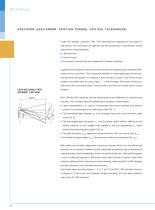
Precision (Lead Error, Friction Torque, Critical Tolerances) Under the headline „precision" DIN / ISO standards are explained as they apply to ball screws, how accuracies are defined, and the acceptance or specification criteria derived from these standards. Lead accuracy Friction torque Roundness, concentricity and squareness of relevant surfaces In general, all acceptance criteria should be reviewed and agreed upon between Steinmeyer and our customer. This is especially relevant for those applications where special demands are required, for example a lead accuracy of class 5 but friction torque...
Open the catalog to page 3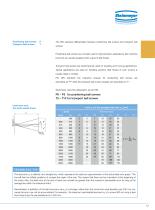
Positioning ball screws P Transport ball screws T The DIN standard differentiates between positioning ball screws and transport ball screws. Positioning ball screws are normally used in high-precision applications (like machine tool) and are usually equipped with a ground ball thread. Transport ball screws are predominantly used for travelling and moving applications. Typical applications are axes for handling systems. Ball thread of such screws is usually rolled or whirled. Per DIN standard the tolerance classes for positioning ball screws are described as "P" while the transport ball screws...
Open the catalog to page 4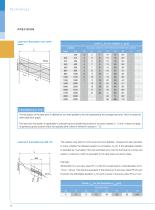
Lead error fluctuation over entire travel Accuracy class [¹ n/a for rolled and whirled ball screws] Technical Tip The fluctuation of the lead error is defined by two lines parallel to the line representing the average lead error, which include the entire lead error graph. The lead error fluctuation is applicable to precision ground positioning screws in accuracy classes 0 - 5 only. It does not apply to general purpose screws which are typically either rolled or whirled in classes 5 - 10. Lead error fluctuation per 300 mm The variation over 300 mm is the most common definition. However it is also...
Open the catalog to page 5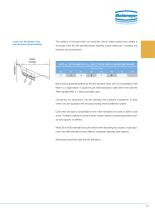
Lead error fluctuation over one revolution (lead wobble) The variation of the lead within one revolution, the so-called wobble-error usually is sinusoidal. Here the DIN standard allows relatively coarse tolerances. If needed, this tolerance can be restricted. Limit v2πp for the lead error v2πa [µm] [¹ n/a to rolled or whirled ball screws] Accuracy class Ball screws are globally defined by the ISO standard 3408, which is compatible to DIN 69051 to a large extent. In Japan the JIS 1902 standard is valid while in the USA the ANSI standard B92.1 is still occasionally used. Concerning nut dimensions,...
Open the catalog to page 6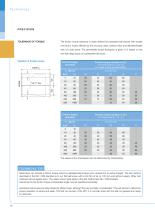
The friction torque tolerance is solely defined for preloaded ball screws with double nuts and is mainly affected by the accuracy class, preload value and diameter/length ratio of a ball screw. The permissible torque fluctuation is given in % based on the nominal idling torque of a preloaded ball screw. Variation of friction torque Friction torque (nominal) Friction torque variation in [%] Accuracy class For short screws (L ≤ 40 · dN) For longer screws see table below! Friction torque (nominal) Friction torque variation in [%] Accuracy class The values of the interclasses can be determined by...
Open the catalog to page 7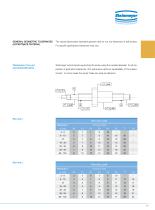
GENERAL GEOMETRIC TOLERANCES The values listed below represent general rules for run-out tolerances of ball screws. (ACCEPTANCE CRITERIA) 1 ' For specific applications tolerances may vary. Tolerances of run-out Steinmeyer recommends supporting the screw using the outside diameter for all ins- pection of geometric tolerances. This will ensure optimum repeatability of the measu- rement. In some cases the center holes are used as reference. Accuracy class
Open the catalog to page 8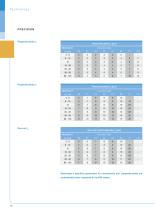
Accuracy class Accuracy class Run-out of pilot diameter t6 [µm] Nominal-∅ Accuracy class Steinmeyer‘s specified parameters for concentricity and perpendicularity are considerably lower compared to the DIN val
Open the catalog to page 9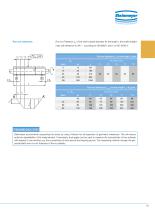
Run-out Tolerance t5p of the shaft outside diameter for the length l5 (the shaft straight- Run-out tolerances ness with reference to AA') - according to DIN 69051 part 3 or ISO 3408-3. Run-out tolerance t 5 p for the length l5 [µm] dN Accuracy class l1 Run-out tolerance t 5 max for the length l1 ≥ 4l5 [µm] l5 Accuracy class Technical Tip Steinmeyer recommends supporting the screw by using V-blocks for all inspection of geometric tolerances. This will ensure optimum repeatability of the measurement. If necessary, dual gages can be used to measure the concentricity of two surfaces with respect...
Open the catalog to page 10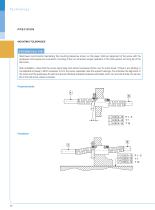
Mounting Tolerances Technical Tip Steinmeyer recommends maintaining the mounting tolerances shown on this page. Optimum alignment of the screw with the guideways and square and concentric mounting of the nut will ensure proper operation of the drive system and long life of the ball screw. After installation, check that the screw spins freely and without excessive friction over its entire travel. If there is any binding or considerable increase in effort necessary to turn the screw, especially near the support bearings, this indicates the alignment of the screw and the guideways should be improved....
Open the catalog to page 11
This section deals with the various nut types and their preload. We also explain the different rigidity (stiffness) values. Technical Tip Preload primarily serves to eliminate play. But at the same time preload increases rigidity, which means the displacement of the nut under load is reduced. Another reason why preload may be necessary is to prevent balls from skidding during high acceleration, or to ensure better load distribution if side loads on the ball nut cannot be avoided. There are a number of ways to preload a ball nut. For a discussion of preload and its effects we have to first distinguish...
Open the catalog to page 12All Steinmeyer Mechatronik GmbH catalogs and technical brochures
 DT65
DT651 Page
 PLT320-DLM
1 Page
 LA340
LA3401 Page


- Positioning table
- Translation stage
- Motorized positioning table
- Precision positioning table
- Technology positioning stage
- Single-axis positioning stage
- 2-axis positioning table
- Linear axis
- Compact positioning table
- XY positioning table
- Multi-axis positioning table
- Rotary positioning table
- Electric linear axis
- Aluminum positioning table
- High-accuracy positioning table
- Piezoelectric stage
- Ball screw positioning table
- Industrial positioning table
- Vertical positioning stage
- 3-axis positioning table