
- Catalogs
- Steinmeyer Mechatronik GmbH
- ROLLED BALL SCREWS – THE ALTERNATIVE IN LINEAR TECHNOLOGy


ROLLED BALL SCREWS – THE ALTERNATIVE IN LINEAR TECHNOLOGy

ROLLED BALL SCREWS – THE ALTERNATIVE IN LINEAR TECHNOLOGy
- Screw Shafts: Available in diameters from 16mm to 80mm and lengths up to 6m. Standard accuracy class is T7, with options for T5, T9, and T10.
- Nuts on Mounting Sleeves: Includes cylindrical single nuts with connecting threads and flange nuts, available in various diameters and leads.
- Manufacturing Process: Involves thread rolling, heat treatment, alignment, polishing, and measuring.
- Accuracy Classes: Classified according to ISO 3408 part 3, with tolerance classes T5 to T10.
- Lead Error: Defined by tolerance classes with specific limits for average lead error.
- Shape and Position Tolerances: Specifies tolerances for functional surfaces, measured using Vee-block supports.
- Bearing Journals and Recommendations: Discusses bearing selection criteria and commonly used bearings, emphasizing compatibility with ball screw drives.
- Ball Return: Various designs for ball returns, avoiding tubes.
- Order Code and Availability: Details on how to order and availability of products.
- Flange Nuts and Nuts with Connecting Thread: Various configurations available.
- Screw Shafts: Detailed specifications provided.
- Service Life and Load Capacity: Guidelines for selecting load capacity and understanding dynamic and static axial load capacities.
- Radial Loads and Stiffness: Information on handling radial loads and ensuring stiffness.
- Critical Column Load and Speeds: Details on managing critical loads and speeds.
Ball screws require a mechanism to recirculate balls, ensuring the ball circuit is closed. The design of the ball return system is crucial for determining the maximum operational speed, expressed by the DN value. Higher DN values indicate better handling of mass forces, with values ranging from 60,000 for basic systems to 160,000 for advanced systems like Steinmeyer's UltraSpeed return.
- Multiliner (Internal Return): Compact design suitable for small ball sizes and leads, guiding balls over the shaft's outer diameter.
- Through-the-Nut Return (External Return): Utilizes deflectors to guide balls through the nut body.
- End Cap Return (External Return): Similar to through-the-nut but uses an integrated cap for ball deflection, ideal for large lead/diameter ratios.
- Critical Speed: The lowest speed at which the shaft resonates, influenced by shaft diameter and support configuration.
- Maximum Speed: Limited by the mass forces on balls, dependent on the ball nut's internal construction.
- DN Value: A measure for comparing ball screw designs, correlating directly to ball velocity.
Steinmeyer offers ball screws with single nuts having axial clearance of approximately 0.01 mm to 0.06 mm. Pre-tensioned versions are available upon request. The maximum axial load is determined by the smaller value between the static load rating and the specified maximum axial force.
- Wipers: Prevent dirt penetration while allowing lubricant leakage, enhancing operational safety.
- Lubrication: Regular re-lubrication is essential, with specific grease types recommended for different conditions.
Proper handling, storage, and cleaning are crucial for maintaining ball screw integrity. Installation requires careful alignment and adherence to positional tolerance guidelines to prevent misalignment and ensure longevity.
Standard and custom ball screw dimensions are available, with specific order codes for different configurations. Special industry solutions and corrosion-resistant options can be requested.
Catalog excerpts

ROLLED BALL SCREWS – THE ALTERNATIVE IN LINEAR TECHNOLOGY
Open the catalog to page 1
STEINMEYER I ROLLED BALL SCREWS 2.5 Rotation speed values 20 4.1 Flange nuts on mounting sleeves 30 - 33 4.2 Nuts with connecting thread 5.1.2 Dynamic axial load capacity 38 - 39
Open the catalog to page 2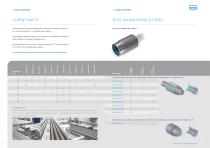
SCREW SHAFTS Steinmeyer delivers the following product range of screw shafts on short no- tice. Those marked with * are available upon request. The maximum available length of screw shafts is specified here. Different shaft lengths are available at additional cost. The standard accuracy class for rolled screw shafts is T7. Tolerance classes T5, T9 and T10 are available upon request. For information on ground ball screws please visit: www.steinmeyer.com Maximum available total length in meters. Different shaft lengths available for extra charge. Standard accuracy class T7 (T5, T9, T10 upon reguest)....
Open the catalog to page 3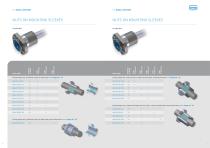
Flange single nut, multiliner, wiper on both sides | >>> Pages 30 – 33 Order code Order code NUTS ON MOUNTING SLEEVES NUTS ON MOUNTING SLEEVES Flange single nut, end cap return, wiper on both sides, two thread-starts | >>> Pages 30 – 33 Flange single nut, external through-the-nut return , wiper on both sides, two thread-starts | >>> Pages 30 – 33 Flange single nut, multiliner, wiper on both sides, two thread-starts | >>> Pages 30 – 33 8446/20.50.7,5.6
Open the catalog to page 4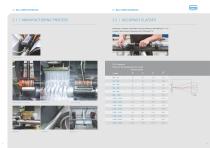
2 | BALL SCREW TECHNOLOGY 2 | BALL SCREW TECHNOLOGY 2.2 | ACCURACY CLASSES Steinmeyer classifies rolled ball screws according to ISO 3408 part 3 – as transport ball screws in tolerance class T5 through T10. Thread rolling 2.2.1 | Lead error Limit ep for the average lead error e0a [µm] T10 280 Heat treatment: annealing ...
Open the catalog to page 5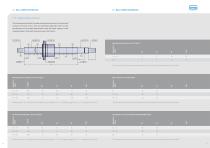
2 I BALL SCREW TECHNOLOGY 2.2.2 I Shape and position tolerances The following values define the shape and position tolerances of the functional surfaces of the ball screws. They are specifically applicable when no other specifications are provided. Measurement using Vee-block supports at the outside diameter of the shaft at points A and A' and D and D'. Bearing journal concentric run-out Y1 [urn] Measurement E 6.1 according to ISO 3408 for journal length > ^ L. The following applies for L6>L: tolerance value *L6/L Drive journal concentric run-out Y2 [urn] Measurement E 6.1 according to ISO 34-08...
Open the catalog to page 6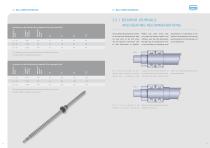
2 | BALL SCREW TECHNOLOGY 2 | BALL SCREW TECHNOLOGY 2.3 | BEARING JOURNALS AND BEARING RECOMMENDATIONS Concentric run-out of shaft exterior diameter Y6 for short shafts [µm] The mounting should allow for rotation of the shaft and simultaneously pass very high load bearing capacity and shaft that is adequate for the axial and the axial force on the ball screw stiffness, such that only high-quality prestressing force of this bearing is of into the adjacent construction with bearings that are optimized for drive crucial importance. as little deformation as possible. screw mounting can adequately...
Open the catalog to page 7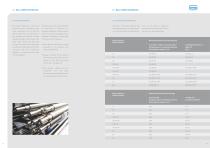
2 I BALL SCREW TECHNOLOGY The support bearing of a ball screw should be able to absorb the axial lateral forces from the belt drive. It can sometimes be difficult to find a suitable bearing for ball screws with large cycle criteria, and high load rating. At the same time, the bearing should have a sufficiently small inner ring bore hole and a supporting diameter no larger than the shaft nominal diameter. This discussion thus only represents an initial point of reference for selection of bearings. It is by no means meant to be universally applicable or complete. The following criteria apply •...
Open the catalog to page 8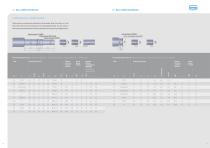
2 I BALL SCREW TECHNOLOGY 2.3.3 Bearing journals - standard machining Shaft ends are machined as specified in the drawing. Enter the letter »Z« into the order reference and include the corresponding drawing. You will also be able to choose between the following fixed and loose bearing configurations. Thread recess DIN76 short Fixed bearing journals: A I Machining options: K - hexagonal socket, G - internal thread, N - keyway groove hole incl. drive journal) Cut-in for retaining ring DIN471 Loose bearing journals: B | Machining options: K - hexagonal socket, G - internal thread hole incl.
Open the catalog to page 9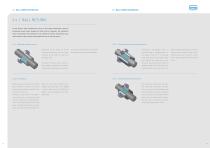
2 | BALL SCREW TECHNOLOGY 2 | BALL SCREW TECHNOLOGY 2.4 | BALL RETURN As the world‘s only manufacturer never to use tubes, Steinmeyer uses all commonly known other designs for ball returns. However, the multiliner return represents the standard for all rolled ball screws. Steinmeyer also uses external return either as through-the-nut or end cap return. 2.4.1 | Multiliner (internal return) 2.4.3 | Through the nut return (external return) Multiliners lift the balls out of the It is also the ball return of choice for Steinmeyer‘s UltraSpeed return is where a similar piece guides the balls track...
Open the catalog to page 10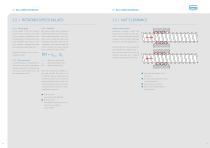
2 | BALL SCREW TECHNOLOGY 2 | BALL SCREW TECHNOLOGY 2.5 | ROTATION SPEED VALUES Single nut with backlash Critical speed is the first (lowest) DN values allow easy comparison speed at which the ball screw shaft between different ball screw designs. screws with a single nut with clea- is in resonance. In applications with More sophisticated ball return sys- rance. This axial clearance amounts rotating shafts it limits the rpm of the tems result in higher DN values and, to approx. 0.01 mm with a maximum screw. Variables that influence it are conversely, lower DN values are as- 0.06 mm for the sizes...
Open the catalog to page 11
2 | BALL SCREW TECHNOLOGY 2 | BALL SCREW TECHNOLOGY 2.7 | MAXIMUM LOADS The average axial load of a ball screw is normally around 10 % of the dynamic Values to avoid damage - Nuts with connecting thread load rating Ca. A load of exactly 10 % of Ca would lead to a calculated fatigue Connection thread Nut max. allowable axial force (kN) life of 109 revolutions. This is the upper limit of the scope of application of the Not all ball screw nuts can be loaded selected due to the desired fatigue life), this load has been reached. Here are up to the static load rating. For the static load rating is...
Open the catalog to page 12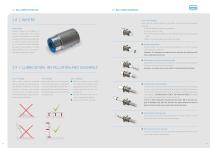
2 | BALL SCREW TECHNOLOGY 2 | BALL SCREW TECHNOLOGY 2.9.4 | Nut assembly Before the nut can be mounted on the shaft, the following points should be reviewed: Plastic wiper • Has the shaft been cleaned and aligned? Segment wipers are standard in a variety of applications: they reliably • heck desired nut orientation on the shaft (e.g. flange to the short journal C side?) prevent the penetration of shavings and coarse dirt particles but allow for • Align nut mounting tube on the shaft accordingly a certain amount of lubricant leakage. In conjunction with an automatic n Remove safety device oil...
Open the catalog to page 13All Steinmeyer Mechatronik GmbH catalogs and technical brochures
 DT65
DT651 Page
 PLT320-DLM
1 Page
 LA340
LA3401 Page
 Technology
44 Pages


- Positioning table
- Translation stage
- Motorized positioning table
- Precision positioning table
- Technology positioning stage
- Single-axis positioning stage
- 2-axis positioning table
- Linear axis
- Compact positioning table
- XY positioning table
- Multi-axis positioning table
- Rotary positioning table
- Electric linear axis
- Aluminum positioning table
- High-accuracy positioning table
- Piezoelectric stage
- Ball screw positioning table
- Industrial positioning table
- Vertical positioning stage
- 3-axis positioning table