Overview: The 2015 Annual Report for Stanley Black & Decker highlights the company's financial performance, strategic initiatives, and operational achievements. The report emphasizes growth, innovation, and sustainability through EcoSmart™ initiatives.
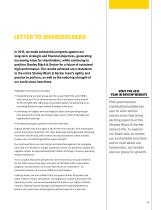
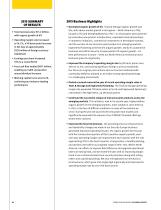
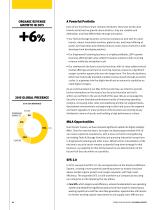
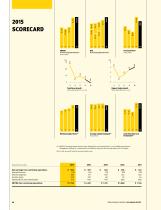
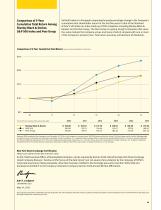
Financial Performance: In 2015, Stanley Black & Decker's share price increased by 11%, outperforming peers and the S&P 500. The company achieved record earnings per share and operating margins, with 6% organic growth driven by Tools & Storage and Engineered Fastening. Despite $220 million in foreign currency headwinds, the operating margin rate improved by 90 basis points to 14.2%.
Strategic Initiatives: The company focused on cost control, price management, and market expansion. It increased its annual dividend for the 48th consecutive year and executed a $1 billion share repurchase program. The SFS operating system was leveraged to enhance scalability and performance.
Business Highlights: Tools & Storage saw 8% organic growth, with significant contributions from North America, Europe, and Emerging Markets. Engineered Fastening achieved 4% growth, led by the automotive sector. Security businesses, particularly in Europe, showed improved performance with 3% organic growth.
Transformation and Growth: Over 15 years, Stanley Black & Decker transformed from a small cap building products company to a large cap diversified industrial leader, involving restructuring, building a Security platform, and merging with Black & Decker.
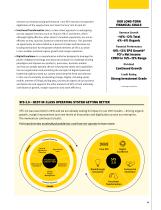
Operational Excellence: The launch of SFS 2.0 aimed to drive organic growth and margin expansion through core SFS, functional transformation, digital excellence, commercial excellence, and breakthrough innovation.
Future Outlook: The company aims to continue growth by focusing on high-growth, high-margin businesses, expanding in emerging markets, and pursuing strategic acquisitions, with plans to deploy 50% of excess capital to acquisitions.
Conclusion: The report concludes with a commitment to maintaining a high-performance culture, delivering on financial goals, and providing value to shareholders through strategic growth and operational excellence.
Major Customers: Tools & Storage products are primarily sold to home centers and mass merchants in the U.S. and Europe. Sales to U.S. home centers and mass merchants decreased from 40% in 2002 to 21% in 2015.
Working Capital: The Stanley Fulfillment System (SFS) is key to reducing working capital, improving turns from 5.9 in 2010 to 9.2 in 2015, with a goal of 10 turns.
Raw Materials: Products are made from various metals and resins, with components like batteries and motors sourced globally. A supplier risk mitigation strategy is in place.
Backlog: Backlog is not a significant performance indicator due to short order cycles. As of February 6, 2016, unfilled orders were $783 million, expected to be filled within the fiscal year.
Patents and Trademarks: The company holds numerous patents and trademarks, with significant trademarks including STANLEY®, BLACK+DECKER®, and DEWALT®.
Environmental Regulations: The company complies with environmental laws and accrues costs for remediation when liabilities are probable and estimable, with reserves of $170.7 million as of January 2, 2016.
Employees: As of January 2, 2016, the company employed approximately 51,250 people, with 13,533 in the U.S.
Research and Development Costs: R&D costs were $188 million in 2015, showing a steady increase from previous years.
Risk Factors: The company faces risks from changes in customer preferences, competition, and economic conditions. Significant customers account for a large portion of sales, and losing them could impact operations.
Product Liability and Recalls: The company faces potential product liability claims which could lead to substantial costs and damage to its reputation.
Credit Risk: The company is exposed to credit risk as its trade receivables are not covered by collateral or insurance.
Goodwill and Intangible Assets: The company holds significant goodwill and intangible assets, which are subject to impairment tests.
Pension Plan Investments: The company sponsors defined benefit plans and may need to increase contributions if investments underperform.
Technological and Legal Challenges: Expansion plans involving RFID and RTLS technologies may face technological and legal hurdles.
Geopolitical Risks: Hostilities involving North Korea could disrupt the supply chain.
Properties: The company owns or leases significant facilities across 19 states and 16 countries.
Legal Proceedings: The company is involved in various legal matters, including a resolved EPA case with a $420,000 penalty.
Market and Stock Information: The company's stock is traded on the NYSE under "SWK". In 2015, the stock price ranged from $90.51 to $110.17, with dividends totaling $2.14 per share.
Financial Data: Net sales in 2015 were $11.172 billion, with net earnings from continuing operations at $904 million.
Financial Results Overview: The document outlines the financial results of the Company for the years 2011 to 2015, highlighting significant charges and their impact on net earnings.
Management’s Discussion and Analysis: The Company provides a detailed analysis of its financial condition and results of operations, emphasizing strategic objectives such as maintaining organic growth and pursuing acquisitive growth.
Strategic Objectives: The Company aims to maintain growth momentum through SFS 2.0, diversify into higher growth markets, and pursue acquisitions.
Acquisitions and Divestitures: Recent acquisitions include Jiangsu Guoqiang Tools Co., Ltd. and Infastech, enhancing the Company's product offerings and global footprint.
Growth and Brand Investment: The Company focuses on growing its Tools & Storage segment through innovation, brand support, and emerging market investments.
Brand Awareness and Sponsorships: The document highlights Stanley's brand awareness strategies, including partnerships with Walt Disney World Resort and sponsorships in various sports.
The Stanley Fulfillment System (SFS): SFS is a system designed to improve operational efficiency and supply chain management through five core principles.
Financial Performance and Outlook: The document discusses the impact of merger and acquisition-related charges on earnings and provides an outlook for 2016.
Results of Operations: Net sales in 2015 were $11.172 billion, a 1% decrease from 2014 due to foreign currency impacts.
SG&A Expense: In 2015, SG&A expenses were $2.486 billion, or 22.3% of net sales, down from $2.596 billion, or 22.9% in 2014.
Other-net: Other-net expenses were $222.0 million in 2015, down from $239.7 million in 2014.
Gain/Loss on Debt Extinguishment: In 2014, the company extinguished $45.7 million of notes payable, recognizing a $0.1 million gain.
Interest, net: Net interest expense was $165.2 million in 2015, up from $163.6 million in 2014.
Income Taxes: The effective tax rate was 21.6% in 2015.
Business Segment Results: The company has three segments: Tools & Storage, Security, and Industrial.
Tools & Storage: Net sales were $7,141 million in 2015, with a segment profit of $1,170 million (16.4% of net sales).
Security: Net sales were $2,093 million in 2015, with a segment profit of $240 million (11.4% of net sales).
Industrial: Net sales were $1,938 million in 2015, with a segment profit of $340 million (17.5% of net sales).
Share Purchase Contracts: The Company entered into forward share purchase contracts in 2014 and 2015.
Junior Subordinated Debentures: In 2013, the Company issued $400 million in debentures maturing in 2053.
Equity Units: Also in 2013, the Company issued Equity Units with a total value of $345 million.
Convertible Preferred Units: Issued in 2010, these units included notes and purchase contracts for Convertible Preferred Stock.
Contractual Obligations: The Company has significant obligations totaling $8.468 billion.
Market Risk: The Company faces market risks from foreign currency exchange rates, interest rates, and commodity prices.
Interest Rate and Commodity Exposure: The Company manages interest rate risk through a mix of fixed and floating rate debt and derivatives.
Pension and Retirement Plans: The Company’s defined benefit plans are exposed to market fluctuations.
Financial Position and Market Conditions: The company maintains a strong financial position with adequate cash flows.
Employee Stock Ownership Plan (ESOP): The ESOP is funded through U.S. Core and 401(k) plans.
Critical Accounting Estimates: Management uses estimates for financial statements, particularly in areas with inherent uncertainty.
Derivative Financial Instruments: Changes in the fair value of derivatives not designated as hedges are reported in earnings.
Revenue Recognition: Revenue from tangible product sales is recognized upon shipment or delivery.
Cost of Sales and SG&A: Cost of sales includes manufacturing and service costs, while SG&A covers selling and administrative expenses.
Taxes: Sales taxes are excluded from net sales.
Stock-Based Compensation: Recognized over the vesting period.
Postretirement Benefits: Uses the corridor approach for expense recognition.
New Accounting Standards: Several ASUs issued by FASB are being evaluated for impact on financial statements.
Summary of Accounting Standards Updates (ASUs): The document outlines several ASUs and their expected impact.
Accounts and Notes Receivable: The company has a diverse range of trade receivables and has established reserves for credit losses.
Inventories: Inventories are valued at the lower of LIFO cost or market.
Property, Plant, and Equipment: Details the gross and net values of property, plant, and equipment.
Acquisitions Overview: The document details several acquisitions made by the Company in 2013 and 2015.
Financial Impact of Acquisitions: The acquisitions in 2015 had minimal impact on the Company's financial statements.
Goodwill and Intangible Assets: The document outlines changes in goodwill, with a total of $7,084.3 million as of January 2, 2016.
Accrued Expenses: Accrued expenses as of January 2, 2016, include payroll, taxes, customer rebates, insurance, restructuring costs, and warranty costs.
Long-Term Debt and Financing Arrangements: The document outlines the company's long-term debt and financing arrangements as of January 2, 2016.
Principal Maturities: The aggregate annual principal maturities of long-term debt from 2016 to 2020 are specified.
Interest Payments: Interest paid during 2015, 2014, and 2013 amounted to $176.6 million, $181.5 million, and $172.6 million, respectively.
Redemption and Issuance of Notes: In December 2013, the company redeemed $300 million of Black & Decker Corporation senior notes due 2016.
Equity Units: The company issued 3,450,000 Equity Units in December 2013.
Commercial Paper and Credit Facilities: As of January 2, 2016, the company had no commercial paper borrowings outstanding against its $2.0 billion program.
Summary: The document provides a detailed overview of the company's long-term debt structure.
Junior Subordinated Notes: During the final remarketing period from November 7 to November 14, 2016, holders of Equity Units could opt out by creating Treasury Units or Cash Settled Units.
Capped Call Transactions: To offset potential dilution from common shares issuable upon settlement of Equity Purchase Contracts, the company entered into capped call transactions.
Convertible Preferred Units: Issued in November 2010, these units included a junior subordinated note and a Purchase Contract for Convertible Preferred Stock.
Convertible Preferred Stock: Holders received cumulative cash dividends at 4.75% per annum.
Notes: The $632.5 million principal amount of Notes is due November 17, 2018.
Equity Option: To offset shares deliverable upon conversion of Convertible Preferred Stock, the company entered into capped call transactions with financial institutions.
Derivative Financial Instruments: The company uses financial instruments like interest rate swaps and currency swaps to manage market risks.
Cash Flow Hedges: The company reported after-tax losses of $52.1 million and $50.9 million for cash flow hedge effectiveness in 2016 and 2015, respectively.
Interest Rate Contracts: The company uses interest rate swaps to manage the cost of funds.
Foreign Currency Contracts: The company uses forward contracts to hedge currency risks from global transactions.
Fair Value Hedges: Interest rate swaps are used to optimize the mix of fixed and floating rate debt.
Net Investment Hedges: The company uses foreign exchange contracts to hedge against translation adjustments from foreign subsidiaries.
Undesignated Hedges: Currency swaps and forward contracts are used to minimize the impact of currency fluctuations.
Capital Stock: The company reported net earnings attributable to common shareholders of $883.7 million in 2015.
Working Capital Incentive Plan: Initiated in 2010 under the 2009 Long Term Incentive Plan, this program allowed executives to receive stock if certain working capital objectives were met.
Share Units Activity: As of January 3, 2015, there were 847,973 non-vested share units with a weighted average grant date fair value of $73.76.
Other Equity Arrangements: In November 2013, the company purchased capped call options on 12.2 million shares to hedge stock price appreciation risks.
Equity Units and Capped Call Transactions: In December 2013, the company issued Equity Units comprising $345 million of Notes and Equity Purchase Contracts.
Convertible Preferred Units and Equity Option: Issued in November 2010, these units included $632.5 million of Notes and Purchase Contracts.
Accumulated Other Comprehensive Loss: The document provides a detailed table of changes in accumulated balances for components like currency translation adjustments and unrealized gains/losses on hedges and pensions.
Employee Benefit Plans: The Employee Stock Ownership Plan (ESOP) allows U.S. employees to contribute to a 401(k) plan with an employer match benefit.
Employee Benefits and Pension Plans Overview: The company has an ESOP where shares of the company's common stock were initially purchased with internal borrowings in 1991.
Asset Allocation and Investment Strategy: The document outlines the company's asset allocation strategy, focusing on a liability-matching approach for pension assets.
Contributions and Benefit Payments: The company plans to contribute approximately $52 million to its pension and post-retirement benefit plans in 2016.
Health Care Cost Trends: The assumed rate of increase in health care costs is 7.1% for 2016, decreasing to 4.5% by 2028.
Fair Value Measurements: The document discusses fair value measurements under FASB ASC 820.
Restructuring Charges and Asset Impairments: In 2015, the company recognized $47.6 million in restructuring charges and asset impairments.
Business Segments: The company operates in three segments: Tools & Storage, Security, and Industrial.
Research and Development: Research and development costs were $188.0 million in 2015.
Segment Analysis: The document provides a detailed analysis of the company's business segments, including Tools & Storage, Security, and Industrial.
Financial Performance: The consolidated net sales for 2015 were $11,171.8 million, with Tools & Storage contributing the most.
Capital Expenditures and Depreciation: Capital expenditures were highest in Tools & Storage, with a total of $311.4 million in 2015.
Geographic Sales and Assets: The United States was the largest market, with net sales of $5,882.0 million in 2015.
Income Taxes: The document details deferred tax liabilities and assets.
Key Customers: Sales to Home Depot and Lowes were significant, comprising 13% and 14% of Tools & Storage segment net sales in 2015, respectively.
Restructuring and Impairments: The company recorded restructuring charges and asset impairments.
Summary of Corporate Governance and Financial Agreements: The document provides a comprehensive overview of the corporate governance structure, financial agreements, and executive compensation plans of Stanley Black & Decker, Inc.
Executive Separation Pay Policy: The policy provides salary replacement for eligible employees whose jobs are permanently and involuntarily eliminated due to a "Job Loss Event."
Termination Conditions: Employment can be terminated for "Just Cause," which includes material breaches of agreement, fraud, misconduct, or actions causing harm to the company.
Eligibility: Employees eligible for separation pay are those involuntarily terminated due to a Job Loss Event.
Separation Pay Details: Eligible employees at MICP Level 4 or 5 receive 26 weeks of separation pay, while those at Level 3 or higher receive 52 weeks.
Release and Waiver: Eligibility for benefits requires signing a release and waiver.
Special Provisions: In cases of facility closure, employees receive the greater of their standard separation pay or an amount based on service length.
Benefits for Terminated Employees: Various benefits cease at different times post-termination.
Medical, Dental, and Vision Care: Employees can continue their insurance under COBRA regulations for up to 18 months.
Policy Modifications: The company reserves the right to modify or revoke policies at any time.
Retiree Coverage and COBRA: At the end of the COBRA continuation period, retiree coverage cannot be elected.
Company Rights: The company reserves the right to modify or terminate retiree plans without notice.
Pensions and Company Cars: Employees eligible for retirement must return company cars by their last working day or purchase them at wholesale value.
Stock Option Plan: Employees have 180 days plus 2 months to exercise eligible shares.
MICP Payments: Pro-rated payments are determined at the discretion of the Senior VP of Human Resources.
Policy Modifications: The company can modify or revoke policies at any time.
Retirement Account Plan: Terminated employees receive entitled funds.
Unemployment Compensation: The company does not accept charges for employees who resign or are discharged for cause.
Appeals Procedure: Employees can appeal denied benefits within 60 days.
ERISA Rights: Participants have rights under ERISA, including examining plan documents.
Promotion and Compensation: John Wyatt's promotion includes a change of employer, participation in incentive programs, and relocation assistance.
Specified Employee Payment Rules: Payments to specified employees may be delayed under Section 409A.
Long-Term Incentive Program: Selected executives participate in a program offering performance shares based on corporate goals.
Performance Awards Calculation: The document outlines the formula for calculating additional shares based on performance achievements.
Vesting and Settlement: Performance Awards vest on the Settlement Date if performance metrics are met.
Shareholder Rights: Participants do not have shareholder rights for Performance Awards or shares before the Settlement Date.
Transferability and Adjustments: Transferability follows the Plan's terms.
Miscellaneous: The Committee has authority over award administration and interpretation.
Unfunded Arrangement: Performance Awards are unsecured promises.
Definitions: Key terms such as Award Documents, Disability, Executive Officer, Measurement Period, Performance Goals, Retirement, Settlement Date, Shares, and Unrestricted Stock are defined.
Exhibit 12 - Earnings to Fixed Charges Ratio: The document provides a computation of the ratio of earnings to fixed charges for fiscal years 2011-2015.
Exhibit 21 - Subsidiaries: A list of active subsidiaries of Stanley Black & Decker, Inc. as of January 2, 2016, is provided.
Certifications: The document includes certifications by John F. Lundgren, Chairman and CEO, and Donald Allan Jr., Senior Vice President and CFO.
Investor Communications: Stanley Black & Decker's investor relations department provides financial information and engages with analysts and fund managers.
Financial Highlights: The document outlines adjustments made to diluted EPS calculations to exclude significant non-recurring merger and acquisition charges.
Cautionary Statements: Forward-looking statements are identified, with a disclaimer about inherent risks and uncertainties.
Product Highlights: The document showcases various products and initiatives, including DeWALT tools, STANLEY Engineered Fastening, and the ECOSMART solar initiative.
Design and Printing: The document was designed by Ideas On Purpose and printed using recycled paper.





 2011 Hand Tools Catalog
 Measuring Tools
 Saws
Saws Hammers
 Storage
 Investor Materials
 Investor Overview