
- Catalogs
- STANLEY Engineered Fastening
- Taptite 2000


Taptite 2000

Taptite 2000
- Trilobular Cross Section: Reduces friction, increases prevailing torque, and resists loosening from vibration.
- Radius Profile™ Thread: Lowers thread forming torque, increases drive-to-fail and drive-to-strip ratios, and ensures excellent axial alignment.
- Roll Forms Own Work-Hardened Mating Threads: Enhances internal thread strength through cold flow/work hardening.
- TORX PLUS® Drive System: Extends tool life and maximizes torque transfer.
- Diameters: M1.6 – M16 (#2 – 5/8”).
- Head Styles: Various including pan, hex washer, and button head.
- Materials: Low carbon steel, medium carbon steel, alloy steel, stainless steel.
- Heat Treatment: Options include Camcore® fasteners, case hardening, and through hardening.
Catalog excerpts
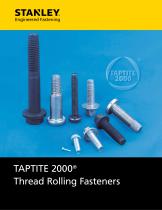
Engineered Fastening Thread Rolling Fasteners
Open the catalog to page 1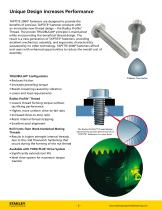
Unique Design Increases Performance TAPTITE 2000® fasteners are designed to provide the benefits of previous TAPTITE® fastener products with an innovative new thread design – the Radius Profile™ Thread. The proven TRILOBULAR® principle is maintained while incorporating this beneficial thread design. The result is a new generation of TAPTITE® fasteners, providing excellent mechanical, assembly, and ergonomic characteristics surpassed by no other technology. TAPTITE 2000® fasteners afford end-users with enhanced opportunities to reduce the overall cost of assembly. TRILOBULAR® Configuration • Reduces...
Open the catalog to page 2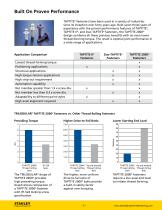
Built On Proven Performance TAPTITE® fasteners have been used in a variety of industries since its inception over forty years ago. Built upon those years of experience with the proven performance features of TAPTITE®, TAPTITE II®, and Duo-TAPTITE® fasteners, the TAPTITE 2000® design combines all these previous benefits with an even lower thread-forming torque. The result is optimal joint performance in a wide range of applications. Application Comparison Lowest thread-forming torque Positioning applications Structural applications High torque-tension applications High strip-out requirement Automation...
Open the catalog to page 3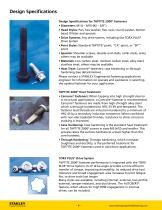
Design Specifications Design Specifications for TAPTITE 2000® Fasteners • Diameters: M1.6 – M16 (#2 – 5/8”) • Head Styles: Pan, hex washer, flat, oval, round washer, button head, fillister and specials • Drive Systems: Any drive system, including the TORX PLUS® Drive System • Point Styles: Standard TAPTITE® point, "CA" point, or "SP"™ point • Specials: Shoulder screws, double-end studs, collar studs, sems; others may be available • Materials: Low carbon steel, medium carbon steel, alloy steel, stainless steel; others may be available • Heat Treat: Camcore® fasteners, case hardening or through...
Open the catalog to page 4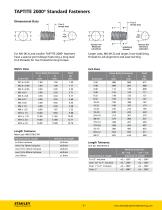
TAPTITE 2000® Standard Fasteners Dimensional Data Section A-A Moderate Lobulation stabilizing threads Section B-B Generous Lobulation For M5 (#12) and smaller TAPTITE 2000® fasteners have a special point design featuring a long lead (3-4 threads) for low thread-forming torque. Larger sizes, M6 (#12) and larger, have stabilizing threads to aid alignment and ease starting. Metric Data Inch Data Screw Size Screw Body Dimensions C D nom. nom. Screw Size Screw Body Dimensions C D nom. nom. Length Tolerance Nominal Screw Length Length Tolerance Nominal Screw Length Nominal Screw Size #4 – #12 1/4"...
Open the catalog to page 5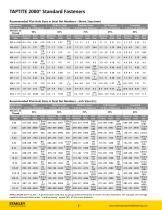
TAPTITE 2000® Standard Fasteners Recommended Pilot Hole Sizes in Steel Nut Members – Metric Sizes (mm) Application Light Duty Class 0.3 Dia. of Material Percent. of 90% Thread Nominal Material Pilot Drill Size Thckns. Hole Size Material Thckns. Pilot Hole Medium-Heavy 0.75 Dia.s of Material Full Strength 1.0 Dia. of Material Material Thckns. Pilot Hole Drill Size Material Pilot Thckns. Hole Drill Size Material Thckns. Pilot Hole Drill Size Recommended Pilot Hole Sizes in Steel Nut Members – Inch Sizes (in.) Application Light Duty Class 0.3 Dia. of Material Percent. of 90% Thread Nominal Material...
Open the catalog to page 6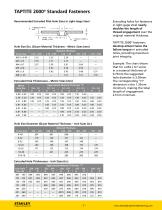
TAPTITE 2000® Standard Fasteners Recommended Extruded Pilot Hole Sizes in Light-Gage Steel Extruding holes for fasteners in light-gage steel nearly doubles the length of thread engagement over the original material thickness. Hole Size Dia. (D) per Material Thickness – Metric Sizes (mm) Material Thickness 1.00 - 1.49 1.50 - 2.49 Screw Size Extruded Hole Thicknesses – Metric Sizes (mm) Metric Hole Dia. D Approximate Material Thickness "T" 1.0 - 1.2 1.2 - 2.0 2.0 - 2.5 H R H R H R Example: The chart shows that for a M4 x 0.7 screw in a material thickness of 0.75mm the suggested hole diameter is...
Open the catalog to page 7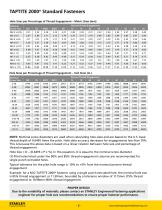
TAPTITE 2000® Standard Fasteners Hole Sizes per Percentage of Thread Engagement – Metric Sizes (mm) 100 Nominal Screw Size Hole Sizes per Percentage of Thread Engagement – Inch Sizes (in.) Nominal Screw Size NOTE: Nominal screw diameters are used when calculating hole sizes and are based on the U.S. basic thread depth of 0.6495 times the pitch. Hole data accuracy decreases for engagements less than 70%. This is because the above data is based on a linear relation between hole size and percentage of thread engagement. Hole Size = D – (0.6495 x P x %). In this equation, D is equal to the nominal...
Open the catalog to page 8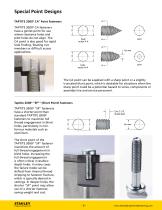
Special Point Designs TAPTITE 2000® CA™ Point Fasteners TAPTITE 2000® CA fasteners have a gimlet point for use where clearance holes and pilot holes do not align. The CA point is also good for rapid hole finding, floating nut members or difficult access applications. The CA point can be supplied with a sharp point or a slightly truncated blunt point, which is desirable for situations when the sharp point could be a potential hazard to wires, components or assembly line and service personnel. Taptite 2000® "SP"™ (Short Point) Fasteners TAPTITE 2000® "SP" fasteners have a shorter point than standard...
Open the catalog to page 9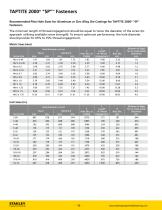
TAPTITE 2000® "SP"™ Fasteners Recommended Pilot Hole Sizes for Aluminum or Zinc Alloy Die Castings for TAPTITE 2000® "SP™ Fasteners The minimum length of thread engagement should be equal to twice the diameter of the screw (to approach utilizing available screw strength). To ensure optimum performance, the hole diameter should provide for 65% to 75% thread engagement. Metric Sizes (mm) Hole Diameter as Cast Top A L Length of Thread Engagement Distance to Edge for no measurable Distortion min. Screw Size L Length of Thread Engagement Distance to Edge for no measurable Distortion min. Inch Sizes...
Open the catalog to page 10
Lower In-Place Costs Through the elimination of tapping operations and their optimal performance, TAPTITE 2000® fasteners can lower your installed costs. Have you considered these design and assembly issues that TAPTITE 2000® fasteners can eliminate or improve? Savings Through Increased Performance of TAPTITE 2000® Fasteners Savings Through Elimination of Tapping Operations Advantage ¨ Uniform driving torque, low end load ¨ Direct labor for tapping operations requirements, and high drive-to-fail ratios ¨ Indirect labor for tapping operations ¨ Taps ¨ Reduced assembly problems from stripped threads...
Open the catalog to page 11All STANLEY Engineered Fastening catalogs and technical brochures
 ENGINEERED FASTENING SOLUTIONS
200 Pages
 ARC-656
2 Pages
 Cold formed Specials
12 Pages
 Threaded Fasteners for Plastics
32 Pages
 Engineered Standards®
32 Pages
 Torx Plus
16 Pages
 NeoSpeed
4 Pages
 SAT Catalog EFS Europe
160 Pages
 Octolok imperial
4 Pages
 Lockbolt Systems
96 Pages
 NeoBolt® Lockbolt System
12 Pages
 SAT Catalog EFS
180 Pages
 Speed Fastening Systems
96 Pages
 Breakstem Riveting Systems NA
128 Pages
 ProSert XTN20
2 Pages
 734 AV? Series
6 Pages
 MULTI-GRIP RIVET DATA SHEET
2 Pages
 LS RIVET DATA SHEET
2 Pages
 Spiralock Fastener
19 Pages
 POP Blind Riveting Systems
68 Pages
 HeliCoil
40 Pages
 Heli-Coil Aftermarket Products
24 Pages
 POP NUT Manual & Power Tools
8 Pages
 Tucker Emhart Plastics
8 Pages
 Heli-Coil Tangless
6 Pages
 QA Socket Trays
2 Pages


Archived catalogs
 Intelligent Air Tools Brochure
12 Pages
 Air Tool Configuration Catalog
40 Pages