
- Catalogs
- Stanford Research Systems
- SR810 and SR830 — DSP lock-in amplifiers

SR810 and SR830 — DSP lock-in amplifiers

SR810 and SR830 — DSP lock-in amplifiers
- Frequency Range: 1 mHz to 102.4 kHz
- Dynamic Reserve: >100 dB
- Stability: <5 ppm/°C
- Phase Resolution: 0.01 degree
- Time Constants: 10 µs to 30 ks with up to 24 dB/oct rolloff
- Interfaces: GPIB and RS-232
Catalog excerpts

Digital Lock-In Amplifiers SR810 and SR830 — DSP lock-in amplifiers SR810 & SR830 DSP Lock-In Amplifiers The SR810 and SR830 DSP Lock-In Amplifiers provide high performance at a reasonable cost. The SR830 simultaneously displays the magnitude and phase of a signal, while the SR810 displays the magnitude only. Both instruments use digital signal processing (DSP) to replace the demodulators, output filters, and amplifiers found in conventional lock-ins. The SR810 and SR830 provide uncompromised performance with an operating range of 1 mHz to 102 kHz and 100 dB of driftfree dynamic reserve. · 1 mHz to 102.4 kHz frequency range · >100 dB dynamic reserve · 5 ppm/°C stability · 0.01 degree phase resolution · Time constants from 10 µs to 30 ks (up to 24 dB/oct rolloff) Input Channel The SR810 and SR830 have differential inputs with 6 nV/√Hz input noise. The input impedance is 10 MΩ, and minimum full-scale input voltage sensitivity is 2 nV. The inputs can also be configured for current measurements with selectable current gains of 106 and 108 V/A. A line filter (50 Hz or 60 Hz) and a 2× line filter (100 Hz or 120 Hz) are provided to eliminate line related interference. However, unlike conventional lock-in amplifiers, no tracking band-pass filter is needed at the input. This filter is used by conventional lockins to increase dynamic reserve. Unfortunately, band pass filters also introduce noise, amplitude and phase error, and drift. The DSP design of these lock-ins has such inherently large dynamic reserve that no band pass filter is needed. · Auto-gain, -phase, -reserve and -offset · Synthesized reference source · GPIB and RS-232 interfaces Extended Dynamic Reserve Stanford Research Systems The dynamic reserve of a lock-in amplifier, at a given fullscale input voltage, is the ratio (in dB) of the largest interfering
Open the catalog to page 1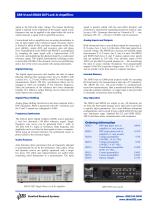
signal to the full-scale input voltage. The largest interfering signal is defined as the amplitude of the largest signal at any frequency that can be applied to the input before the lock-in cannot measure a signal with its specified accuracy. Conventional lock-in amplifiers use an analog demodulator to mix an input signal with a reference signal. Dynamic reserve is limited to about 60 dB, and these instruments suffer from poor stability, output drift, and excessive gain and phase error. Demodulation in the SR810 and SR830 is accomplished by sampling the input signal with a high-precision A/D...
Open the catalog to page 2
Signal Channel Voltage inputs Sensitivity Current input Input impedance Voltage Current Gain accuracy Noise (typ.) Line filters CMRR Dynamic reserve Stability Reference Channel Frequency range Reference input Input impedance Phase resolution Absolute phase error Relative phase error Orthogonality Phase noise Internal ref. External ref. Phase drift Harmonic detection Acquisition time Single-ended or differential 2 nV to 1 V 106 or 108 V/A 10 MQ+25 pF, AC or DC coupled 1 kQ to virtual ground ±1 % (±0.2 % typ.) 6 nV/yHz at 1 kHz 0.13 pA/VHz at 1 kHz (106 V/A) 0.013 pA/VHz at 100 Hz (108 V/A) 50/60...
Open the catalog to page 3All Stanford Research Systems catalogs and technical brochures
 SR556
SR5561 Page
 QMSc
QMSc3 Pages
 FS730/1
4 Pages
 SC10
SC102 Pages
 PRS10
PRS104 Pages
 SR715/720
3 Pages
 CG635
CG6355 Pages
 PERF10
2 Pages
 SR865 DSP Lock-In Amplifier
5 Pages
 SR620
SR6204 Pages
 SIM900Mainframe
2 Pages
 SIM964Analog Limiter
1 Page
 SIM970Quad Digital Voltmeter
2 Pages
 SIM983Scaling Amplifier
1 Page
 SIM965Analog Filter
2 Pages
 SIM921AC Resistance Bridge
3 Pages
 SR250Gated Integrator
3 Pages
 SR540 Optical Chopper
1 Page
 SR640 Programmable Filters
3 Pages
 Rubidium Frequency Standard
4 Pages
 LCR Meters
3 Pages
 Synthesized Clock Generator
5 Pages
 UGAUniversal Gas Analyzer
3 Pages
 RGAResidual Gas Analyzers
5 Pages
 SR850DSP Lock-In Amplifier
4 Pages
 SR10/11/12Audio Switchers
2 Pages
 SR1Audio Analyzer
6 Pages
 6 GHz Vector Signal Generator
10 Pages
 SR255Fast Sampler
3 Pages
 SR245 Computer Interface
2 Pages
 SR200 Gate Scanner
1 Page
 SR630 Thermocouple Reader
3 Pages
 SR510/530 Lock-In Amplifiers
4 Pages
 IGC100 Ion Gauge Controller
4 Pages
 NL100 Nitrogen Laser
2 Pages
 SIM980 Summing Amplifier
1 Page
 SR235 Analog Processor
1 Page
 Laser Diode Controller
4 Pages
 DS335 Function Generator
2 Pages
 Audio Switchers
2 Pages


Archived catalogs
 Partial Pressure Monitor
2 Pages
 Analog PID Controller
2 Pages
 Optical Chopper
2 Pages
 Programmable Filters
3 Pages
 Distribution Amplifier
1 Page
 Audio Analyzer
6 Pages
 Residual Gas Analyzers
5 Pages
 Photon Counters
6 Pages
 Waveform Generator
2 Pages
 Lock in Amplifiers
3 Pages
 DSP Lock-in Amplifier
3 Pages


- Power supply unit
- DC power supply
- AC/DC power supply
- Gas analyzer
- Measuring device
- Concentration analyzer
- Monitoring analyzer
- Automatic analyser
- Benchtop analyser
- Digital temperature control
- Digital indicator
- Temperature controller
- Compact power supply
- Signal amplifying integrated circuit
- Real-time analyzer
- Integration analyzer
- Tabletop power supply
- Generator
- Electronic filter
- Digital gauge