
- Catalogs
- Stanford Research Systems
- SIM922/923Diode & Pt RTD Temperature Monitors

SIM922/923Diode & Pt RTD Temperature Monitors

SIM922/923Diode & Pt RTD Temperature Monitors
The SIM922 Diode Temperature Monitor and the SIM923 Platinum RTD Monitor are designed to measure four sensors simultaneously, offering high-performance and multiple-channel capability in a compact form factor.
SIM922 Features
- Each of the four channels has an independent, precision 10 µA current source for sensor excitation.
- Measurement results can be displayed in kelvin or volts.
SIM923 Features
- Each channel has an independent, stable 1 mA current source for sensor excitation.
- Sensor resistance is determined using a half-bridge circuit with an internal reference resistor.
- The current to the sensor can be reversed to test for offset.
- Results are displayed in kelvin or ohms.
Common Features
- Both models use four-wire measurement circuits, making measurements insensitive to series lead resistance.
- Independent control of channel excitations, which do not switch off when readout advances between channels.
- Sensor excitations can be disabled to reduce power dissipation at sensitive cryogenic stages.
- Measurements can be performed at rates up to four readings per second.
- Built-in factory-standard calibration curve and non-volatile memory for custom calibration curves.
Specifications
- Number of Inputs: 4 for both models.
- Sensor Type: Silicon diode for SIM922; Platinum and other RTDs for SIM923.
- Measurement Type: 4-wire for both models.
- Excitation: 10 µA for SIM922; 1.0 mA for SIM923.
- Sensor Units: Volts for SIM922; Ohms for SIM923.
- Input Range: 0 to 2.5 V for SIM922; 0 Ω to 1400 Ω for SIM923.
- Calibration Curves: 1 standard, 4 user-defined curves for both models.
- Temperature Range: 1.4 K to 475 K for SIM922; 20 K to 873 K for SIM923.
- Display Resolution: 4 digits for both models.
- Interface Resolution: 1 µV for SIM922; 1 mΩ for SIM923.
- Measurement Resolution: 1.2 µVrms for SIM922; 1.2 mΩ rms for SIM923.
- Accuracy: 20 µV + 0.01% of reading for SIM922; 5 mΩ + 0.01% of reading for SIM923.
- Temperature Coefficient: ±5 ppm/°C for both models.
Common Specifications
- Operating Temperature: 0 °C to 40 °C, non-condensing.
- Interface: Serial via SIM interface.
- Connectors: Two DB9 (female) for 4-wire measurement + ground; DB15 (male) for SIM interface.
- Power: Powered by SIM900 Mainframe or user-provided DC power supply.
- Dimensions: 1.5" × 3.6" × 7.0" (WHD).
- Weight: 1.4 lbs.
- Warranty: One year parts and labor on defects in materials and workmanship.
Pricing
- SIM922 Diode temperature monitor: $895
- SIM923 Pt RTD temperature monitor: $895
Catalog excerpts
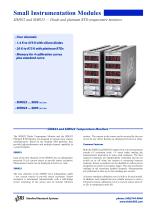
Small Instrumentation Modules SIM922 and SIM923 — Diode and platinum RTD temperature monitors · Four channels · 1.4 K to 475 K with silicon diodes · 20 K to 873 K with platinum RTDs · Memory for 4 calibration curves plus standard curve SIM922 and SIM923 Temperature Monitors The SIM922 Diode Temperature Monitor and the SIM923 Platinum RTD Monitor are designed to measure four sensors simultaneously. Based on the modular SIM platform, they provide high-performance and multiple-channel capability in a small footprint. SIM922 Each of the four channels in the SIM922 has an independent, precision 10 µA current source to provide sensor excitation. Measurement results can be displayed in kelvin or volts. SIM923 The four channels in the SIM923 have independent, stable 1 mA current sources to provide sensor excitation. Sensor resistance is determined ratiometrically with a half-bridge circuit consisting of the sensor and an internal reference Stanford Research Systems resistor. The current to the sensor can be reversed by the user to test for any offset. Results are displayed in kelvin or ohms. Common Features Both the SIM922 and SIM923 employ four-wire measurement circuits (±I excitation leads, ±V sense leads) making the measurements insensitive to series lead resistance. The four channel excitations are independently controlled and do not switch on or off when the readout is advancing between channels. Sensor excitations can be disabled to reduce power dissipation at sensitive cryogenic stages. This also accelerates readings in the remaining enabled channels. Measurements are performed at rates up to four readings per second. A factory-standard calibration curve is built in for each model. In addition, each channel has non-volatile memory to store a 256-point custom calibration curve to convert sensor units (V or Ω) to temperature units (K).
Open the catalog to page 1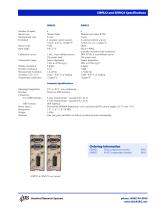
Number of inputs 4 4 Sensor type Silicon diode Platinum and other RTDs Measurement type 4-wire 4-wire Excitation 4 constant current sources 4 constant current sources 10 µA ± 0.01 %, ±5 ppm/°C 1.0 mA ± 0.1 %, ±5 ppm/°C Sensor units Volts Ohms Input range 0 to 2.5 V 0 Ω to 1400 Ω (includes excitation lead resistance) Calibration curves 1 std., 4 user-defined curves DIN 43760, 4 user-defined curves 256 points each 256 points each Temperature range Sensor dependent Sensor dependent 1.4 K to 475 K (typ.) 20 K to 873 K (typ.) Display resolution 4 digits 4 digits Interface resolution 1 µV 1 mΩ Measurement...
Open the catalog to page 2All Stanford Research Systems catalogs and technical brochures
 SR556
SR5561 Page
 QMSc
QMSc3 Pages
 FS730/1
4 Pages
 SC10
SC102 Pages
 PRS10
PRS104 Pages
 SR715/720
3 Pages
 CG635
CG6355 Pages
 PERF10
2 Pages
 SR865 DSP Lock-In Amplifier
5 Pages
 SR620
SR6204 Pages
 SIM900Mainframe
2 Pages
 SIM964Analog Limiter
1 Page
 SIM970Quad Digital Voltmeter
2 Pages
 SIM983Scaling Amplifier
1 Page
 SIM965Analog Filter
2 Pages
 SIM921AC Resistance Bridge
3 Pages
 SR250Gated Integrator
3 Pages
 SR540 Optical Chopper
1 Page
 SR640 Programmable Filters
3 Pages
 Rubidium Frequency Standard
4 Pages
 LCR Meters
3 Pages
 Synthesized Clock Generator
5 Pages
 UGAUniversal Gas Analyzer
3 Pages
 RGAResidual Gas Analyzers
5 Pages
 SR850DSP Lock-In Amplifier
4 Pages
 SR10/11/12Audio Switchers
2 Pages
 SR1Audio Analyzer
6 Pages
 6 GHz Vector Signal Generator
10 Pages
 SR255Fast Sampler
3 Pages
 SR245 Computer Interface
2 Pages
 SR200 Gate Scanner
1 Page
 SR630 Thermocouple Reader
3 Pages
 SR510/530 Lock-In Amplifiers
4 Pages
 IGC100 Ion Gauge Controller
4 Pages
 NL100 Nitrogen Laser
2 Pages
 SIM980 Summing Amplifier
1 Page
 SR235 Analog Processor
1 Page
 Laser Diode Controller
4 Pages
 DS335 Function Generator
2 Pages
 Audio Switchers
2 Pages


Archived catalogs
 Partial Pressure Monitor
2 Pages
 Analog PID Controller
2 Pages
 Optical Chopper
2 Pages
 Programmable Filters
3 Pages
 Distribution Amplifier
1 Page
 Audio Analyzer
6 Pages
 Residual Gas Analyzers
5 Pages
 Photon Counters
6 Pages
 Waveform Generator
2 Pages
 Lock in Amplifiers
3 Pages
 DSP Lock-in Amplifier
3 Pages


- DC power supply
- AC/DC power supply
- Gas analyzer
- Measuring device
- Concentration analyzer
- Monitoring analyzer
- Automatic analyser
- Benchtop analyser
- Digital temperature control
- Digital indicator
- Temperature controller
- Compact power supply
- Signal amplifying integrated circuit
- Real-time analyzer
- Integration analyzer
- Tabletop power supply
- Generator
- Electronic filter
- Digital gauge