
- Catalogs
- Stanford Research Systems
- SIM918 Precision Current Preamplifier

SIM918 Precision Current Preamplifier

SIM918 Precision Current Preamplifier
- Input Offset Voltage: Less than 10 µV with autozero enabled.
- Current Gain: Adjustable from 106 to 108 V/A with gain accuracy of ±0.1% for 106 and 107 V/A, and ±1.0% for 108 V/A.
- Input Noise: As low as 15 fA/√Hz at 108 V/A.
- Bandwidth: Gain-dependent, up to 22 kHz.
- Input Bias Current: Less than 2 pA (DC).
- Output Voltage Range: ±10 V for all gain settings.
- Bias Voltage Input: Range of ±5 VDC, with an input impedance of 10 MΩ.
- Autozero Feature: Can be engaged or inhibited remotely or from the front panel.
- Autozero Sync Input/Output: Provides a one pulse-per-second (pps) output in internal mode, and accepts a 0.9 to 1.1 pps input signal in external mode.
- Flexible Cabling and Grounding: The shield of the current input BNC can be switched between chassis ground, bias voltage, or a floating rear-panel Program input.
- Digital Control Circuitry: Uses a clock-stopping architecture to prevent digital noise contamination.
- Operating Temperature: 0 °C to 40 °C, non-condensing.
- Interface: Serial via SIM interface.
- Power Supply: Powered by SIM900 Mainframe or user-provided DC power supply (±15 V and +5 V).
- Dimensions: 1.5" × 3.6" × 7.0" (WHD).
- Weight: 1.7 lbs.
- Warranty: One year parts and labor on defects in materials and workmanship.
Catalog excerpts

Small Instrumentation Modules SIM918 — Precision current preamplifier with autozero feature · Input offset voltage <10 µV · DC bias current <2 pA · Current gain of 106 to 108 V/A · 15 fA/√Hz input noise (108 V/A) · Autozero feature · Bias voltage input SIM918 Precision Current Preamplifier The SIM918 Current Preamplifier is ideal in applications in which the input offset voltage must be kept to a minimum. The DC voltage difference between the two inputs (current input and voltage bias) is accurately measured every two seconds, and is nulled. The result is a current amplifier with less than 10 µV input offset voltage. This autozeroing feature can be engaged or inhibited remotely or from the front panel, giving you flexibility in sensitive applications. As a current amplifier, the SIM918 offers input noise as low as 15 fA/√Hz and adjustable current gain (106 to 108 V/A). The output voltage range is ±10 V for all gain settings. Input bias current is less than 2 pA (DC), and the instrument has up to 22 kHz of (gain-dependent) bandwidth. There is a voltage bias input for setting the virtual ground potential to an external DC source. This input can range over ±5 V. The bias voltage can be internally grounded. Stanford Research Systems An autozero sync input/output connection is also provided. In the internal autozeroing mode, this port provides a one pulse-per-second (pps) output synchronous with the internal switching circuitry. In the external mode, a 0.9 to 1.1 pps input signal generates the reference for synchronizing the circuitry. The SIM918 provides maximum flexibility for cabling and grounding. The shield of the current input BNC can be switched between chassis ground, the bias voltage, or the rearpanel Program input (which can be left floating, if desired). With the Program input, a user can supply an excitation potential to an experiment via the shield conductor of the input cable, while the excited current flows through the center conductor to the SIM918. The shield of the voltage bias BNC can be independently grounded or floated. The digital control circuitry in the SIM918 is designed with SRS’s special clock-stopping architecture in which the microcontroller is turned on only when settings are being
Open the catalog to page 1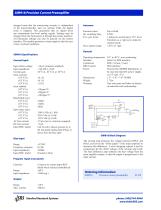
SIM918 Precision Current Preamplifier changed (note that the autozeroing circuitry is independent of the microcontroller, and can operate while the digital clock is stopped). This guarantees that no digital noise can contaminate low-level analog signals. Settings may be changed from the front panel or through the remote interface. All instrument settings can also be queried via the remote interface. The module generates a status signal to alert the user of any overload conditions. Autozero Function select Int. switching freq. Ext. sync in/out Sync capture range On or Hold 0.5 Hz 1 pulse per second...
Open the catalog to page 2All Stanford Research Systems catalogs and technical brochures
 SR556
SR5561 Page
 QMSc
QMSc3 Pages
 FS730/1
4 Pages
 SC10
SC102 Pages
 PRS10
PRS104 Pages
 SR715/720
3 Pages
 CG635
CG6355 Pages
 PERF10
2 Pages
 SR865 DSP Lock-In Amplifier
5 Pages
 SR620
SR6204 Pages
 SIM900Mainframe
2 Pages
 SIM964Analog Limiter
1 Page
 SIM970Quad Digital Voltmeter
2 Pages
 SIM983Scaling Amplifier
1 Page
 SIM965Analog Filter
2 Pages
 SIM921AC Resistance Bridge
3 Pages
 SR250Gated Integrator
3 Pages
 SR540 Optical Chopper
1 Page
 SR640 Programmable Filters
3 Pages
 Rubidium Frequency Standard
4 Pages
 LCR Meters
3 Pages
 Synthesized Clock Generator
5 Pages
 UGAUniversal Gas Analyzer
3 Pages
 RGAResidual Gas Analyzers
5 Pages
 SR850DSP Lock-In Amplifier
4 Pages
 SR10/11/12Audio Switchers
2 Pages
 SR1Audio Analyzer
6 Pages
 6 GHz Vector Signal Generator
10 Pages
 SR255Fast Sampler
3 Pages
 SR245 Computer Interface
2 Pages
 SR200 Gate Scanner
1 Page
 SR630 Thermocouple Reader
3 Pages
 SR510/530 Lock-In Amplifiers
4 Pages
 IGC100 Ion Gauge Controller
4 Pages
 NL100 Nitrogen Laser
2 Pages
 SIM980 Summing Amplifier
1 Page
 SR235 Analog Processor
1 Page
 Laser Diode Controller
4 Pages
 DS335 Function Generator
2 Pages
 Audio Switchers
2 Pages


Archived catalogs
 Partial Pressure Monitor
2 Pages
 Analog PID Controller
2 Pages
 Optical Chopper
2 Pages
 Programmable Filters
3 Pages
 Distribution Amplifier
1 Page
 Audio Analyzer
6 Pages
 Residual Gas Analyzers
5 Pages
 Photon Counters
6 Pages
 Waveform Generator
2 Pages
 Lock in Amplifiers
3 Pages
 DSP Lock-in Amplifier
3 Pages


- AC/DC power supply
- Gas analyzer
- Measuring device
- Concentration analyzer
- Monitoring analyzer
- Automatic analyser
- Benchtop analyser
- Digital temperature control
- Digital indicator
- Temperature controller
- Compact power supply
- Signal amplifying integrated circuit
- Real-time analyzer
- Integration analyzer
- Tabletop power supply
- Generator
- Electronic filter
- Digital analyzer