
- Catalogs
- Stanford Research Systems
- SG392 2 GHz Vector Signal Generator

SG392 2 GHz Vector Signal Generator

SG392 2 GHz Vector Signal Generator
The SG390 Series Vector Signal Generators by Stanford Research Systems are advanced RF sources available in three models: SG392, SG394, and SG396. They support carrier frequencies from DC to 2.025 GHz, 4.050 GHz, and 6.075 GHz respectively, offering both analog and vector modulation capabilities.
The SG390 series uses Rational Approximation Frequency Synthesis (RAFS) for frequency generation, ensuring low phase noise and high frequency resolution. It features an ovenized SC-cut oscillator for improved stability, with an optional rubidium oscillator for enhanced performance.
The series supports amplitude (AM), frequency (FM), phase (ΦM), and pulse modulation. Internal and external modulation sources are available, with internal sources providing various waveform types such as sine, ramp, and noise.
Vector modulation is supported for RF carriers between 400 MHz and 6.075 GHz, with built-in support for modulation schemes like ASK, QPSK, and QAM. It includes standard pulse shaping filters and allows for additive white Gaussian noise injection.
Internal baseband generators support I/Q modulation with real-time waveform generation and preset communication protocols like GSM and W-CDMA. External I/Q modulation is supported via rear-panel inputs.
The RF output is driven by cascaded amplifier stages, providing up to +25 dB of gain, eliminating the need for precision attenuators and automatic level controls.
Remote operation is possible through GPIB, RS-232, and Ethernet interfaces, with storage for up to nine configurations in non-volatile memory.
The SG392, SG394, and SG396 models are priced at $5,400, $6,600, and $8,400 respectively, with additional options like a rubidium timebase and rack mount kits.
- Modulation Bandwidth: 300 MHz RF bandwidth.
- I/Q Input Offset: Less than 500 µV.
- Carrier Suppression: Greater than 40 dBc, and greater than 35 dBc above 4 GHz.
- Channels: Dual baseband generator for I and Q channels.
- DAC Data Format: Dual 14-bit at 125 MS/s.
- Reconstruction Filter: 10 MHz, 3rd order Bessel LPF.
- Arb Symbol Memory: Up to 16 Mbits.
- Symbol Rate: 1 Hz to 6 MHz with 1 µHz resolution.
- Symbol Length: 1 to 9 bits, mapping to constellation.
- Symbol Mapping: Default or user-defined constellation.
- Symbol Source: User-defined symbols, built-in PRBS generator, or settable pattern generator.
- PRBS Length: 2n – 1, where 5 < n < 32.
- Pattern Generator: 16 bits.
- Filter Types: Nyquist, Root Nyquist, Gaussian, Rectangular, Linear, Sinc, User FIR.
- Filter Length: 24 symbols.
- Additive Noise: White, Gaussian.
- Level: –70 dBc to –10 dBc, band limited by digital filter.
- Modulation Types: PSK, QAM, FSK, CPM, MSK, ASK, VSB.
- PSK Derivatives: PSK, BPSK, QPSK, OQPSK, DQPSK, π/4DQPSK, 8 PSK, 16 PSK, 3π/8 8 PSK.
- QAM Derivatives: 4, 16, 32, 64, 256.
- FSK Derivatives: 1-bit to 4-bit with deviations from 0 to 6 MHz.
- ASK Derivatives: 1-bit to 4-bit.
- CMP Derivatives: 1-bit to 4-bit with modulation indices from 0 to 1.0.
- VSB Derivatives: 8 and 16 at rates up to 12 MS/s.
Includes GSM, GSM-EDGE, W-CDMA, APCO-25, DECT, NADC, PDC, TETRA, ATSC DTV, and audio clip (analog AM and FM).
- Type: Symbol Clock, Data Frame, TDMA, and user-defined.
- Amplitude: 0.5 to 4 Vpp (–2 dBm to +16 dBm).
- Output Impedance: 50 Ω, AC coupled.
- TETRA: EVM (typ.) 0.76% at 420 MHz.
- NADC: EVM (typ.) 0.33% at 875 MHz.
- APCO-25: FSK error (typ.) 0.46% at 850 MHz.
- DECT: FSK error (typ.) 1.5% at 1.925 GHz.
- GSM: EVM (typ.) 0.3% at 935 MHz and 0.6% at 1.932 GHz.
- GSM-EDGE: EVM (typ.) 0.3% at 935 MHz and 0.5% at 1.932 GHz.
- W-CDMA: EVM (typ.) 1.7% at 1.850 GHz.
- QAM256: EVM (typ.) 1.1% at 2.450 GHz.
- QAM32: EVM (typ.) 2.5% at 5.800 GHz.
- ATSC-DTV: EVM (typ.) 2.2% at 695 MHz.
Stanford Research Systems, phone: (408)744-9040, website: www.thinkSRS.com.
Catalog excerpts
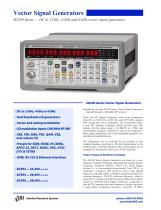
Vector Signal Generators SG390 Series — DC to 2 GHz, 4 GHz and 6 GHz vector signal generators Stanford Research Systems, Inc. Model SG396 DC to 6.05 GHz Vector Signal Generator # ANALOG . VECTOR PRESETS ADD. NOISE EVENTS EmOD or EN8W PULSE WIDTH or Dim • Vector and analog modulation • Presets for GSM, EDGE, W-CDMA, APCO-2S, DECT, NADC, PDC, ATSC- • GPIB, RS-232 & Ethernet interfaces SG390 Series Vector Signal Generators Introducing the new SG390 Series Vector Signal Generators — high performance, affordable RF sources. Three new RF Signal Generators, with carrier frequencies both analog and vector modulation. The instruments utilize a new RF synthesis technique which provides spur free outputs with low phase noise (-116 dBc/Hz at 1 GEfz) and extraordinary frequency resolution (1 uFfz at any frequency). Both analog modulation and vector baseband generators are included as standard features. The instruments use an ovenized SC-cut oscillator as the standard timebase, providing a 100 fold improvement in the stability (and a 100 fold reduction in the in-close phase noise) compared to instruments which use a TCXO timebase. A New Frequency Synthesis Technique The SG390 Series Signal Generators are based on a new frequency synthesis technique called Rational Approximation Frequency Synthesis (RAFS). RAFS uses small integer divisors in a conventional phase-locked loop (PLL) to synthesize a frequency that would be close to the desired frequency (typically within ±100 ppm) using the nominal PLL reference frequency. The PLL reference frequency, which is sourced by a voltage controlled crystal oscillator that is phase locked to a dithered direct digital synthesizer, is adjusted so that the PLL generates the exact frequency. Doing so provides a high phase comparison frequency (typically 25 MHz) Stanford Research Systems
Open the catalog to page 1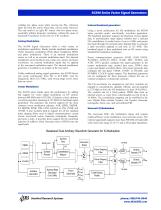
SG390 Series Vector Signal Generators yielding low phase noise while moving the PLL reference spurs far from the carrier where they can be easily removed. The end result is an agile RF source with low phase noise, essentially infinite frequency resolution, without the spurs of fractional-N synthesis or the cost of a YIG oscillator. Analog Modulation The SG390 Signal Generators offer a wide variety of modulation capabilities. Modes include amplitude modulation (AM), frequency modulation (FM), phase modulation (ΦM), and pulse modulation. There is an internal modulation source as well as an external...
Open the catalog to page 2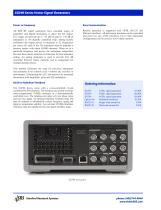
SG390 Series Vector Signal Generators Easy Communication All SRS RF signal generators have cascaded stages of amplifiers and digital attenuators to drive the RF output. Five stages can provide up to +25 dB of gain to -130 dB of attenuation in 156 digitally controlled steps. During factory calibration the output power is measured at 32 frequencies per octave for each of the 156 attenuator steps to populate a memory matrix with about 40,000 elements. When set to a particular frequency and power, the instrument interpolates between these matrix elements to determine the best attenuator setting....
Open the catalog to page 3
SG390 Series Specifications (Analog) Frequency Setting Frequency ranges SG392 SG394 SG396 Frequency resolution Switching speed Frequency error Frequency stability DC to 62.5 MHz (BNC output, all models) 950 kHz to 2.025 GHz (N-type output) 950 kHz to 4.05 GHz (N-type output) 4.05 GHz to 8.1 GHz (w/ Opt. 02) 950 kHz to 6.075 GHz (N-type output) 6.075 GHz to 8.1 GHz (w/ Opt. 02) 1 µHz at any frequency <8 ms (to within 1 ppm) <(10–18 + timebase error) × fC 1 × 10–11 (1 s Allan variance) 1 MHz offset Residual FM (typ.) Residual AM (typ.) * Spurs, phase noise and residual FM scale by 6 dB/octave to...
Open the catalog to page 4
SG390 Series Specifications (Analog) Oscillator type Physics package Timebase Input Input impedance Timebase Output Output Power Error Oven controlled, 3rd OT, SC-cut crystal Rubidium vapor frequency discriminator SG392 Output Power Error vs. Frequency SG394 Output Power Error vs. Frequency SG396 Output Power Error vs. Frequency Internal Modulation Source Ramp linearity Rate resolution Rate error Noise function Noise bandwidth Pulse generator period Pulse generator width Pulse timing resolution Pulse noise function Sine, ramp, saw, square, pulse, noise White Gaussian noise (rms = dev/ 5) Modulation...
Open the catalog to page 5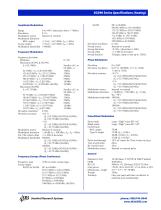
SG390 Series Specifications (Analog) Amplitude Modulation Range Resolution Modulation source Modulation distortion BNC output N-type output Modulation bandwidth 0 to 100 % (decreases above +7 dBm) 0.1 % Internal or external <1 % (fC < 62.5 MHz, fM = 1 kHz) <3 % (fC > 62.5 MHz, fM = 1 kHz) >100 kHz Frequency Modulation Frequency deviation Minimum 0.1 Hz Maximum (SG392 & SG394) fC ≤ 62.5 MHz Smaller of fC or 64 MHz – fC 62.5 MHz < fC ≤ 126.5625 MHz 1 MHz 126.5625 MHz < fC ≤ 253.125 MHz 2 MHz 253.125 MHz < fC ≤ 506.25 MHz 4 MHz 506.25 MHz < fC ≤ 1.0125 GHz 8 MHz 1.0125 GHz < fC ≤ 2.025 GHz 16 MHz...
Open the catalog to page 6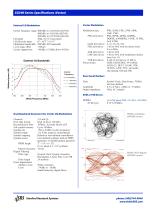
SG390 Series Specifications (Vector) Vector Modulation Carrier frequency range 400 MHz to 2.025 GHz (SG392) 400 MHz to 4.05 GHz (SG394) 400 MHz to 6.075 GHz (SG396) I/Q inputs 50 Ω, ±0.5 V (rear panel) I/Q full scale input (I2 + Q2)1/2 = 0.5 V Modulation bandwidth 300 MHz RF bandwidth I or Q input offset <500 µV Carrier suppression >40 dBc (>35 dBc above 4 GHz) Modulation type PSK derivatives QAM derivatives FSK derivatives ASK derivatives CMP derivatives VSB derivatives Preset modes PSK, QAM, FSK, CPM, MSK, ASK, VSB PSK, BPSK, QPSK, OQPSK, DQPSK, π/4DQPSK, 8 PSK, 16 PSK, 3π/8 8 PSK 4, 16, 32,...
Open the catalog to page 7
SG390 Series Specifications (Vector) NADC constellation NADC I-Eye diagram I-Eye diagram each symbol DECT constellation DECT PEye diagram each symbol SRS Stanford Research Systems
Open the catalog to page 8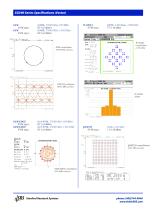
SG390 Series Specifications (Vector) Amplitude Droop (142 syms): RMPH Offset:--- I/Q Measured Polar Vector GSM-EDGE constellation lagnitude Error: active Channels: 7 Slot* IE Stanford Research Systems
Open the catalog to page 9All Stanford Research Systems catalogs and technical brochures
 SR556
SR5561 Page
 QMSc
QMSc3 Pages
 FS730/1
4 Pages
 SC10
SC102 Pages
 PRS10
PRS104 Pages
 SR715/720
3 Pages
 CG635
CG6355 Pages
 PERF10
2 Pages
 SR865 DSP Lock-In Amplifier
5 Pages
 SR620
SR6204 Pages
 SIM900Mainframe
2 Pages
 SIM964Analog Limiter
1 Page
 SIM970Quad Digital Voltmeter
2 Pages
 SIM983Scaling Amplifier
1 Page
 SIM965Analog Filter
2 Pages
 SIM921AC Resistance Bridge
3 Pages
 SR250Gated Integrator
3 Pages
 SR540 Optical Chopper
1 Page
 SR640 Programmable Filters
3 Pages
 Rubidium Frequency Standard
4 Pages
 LCR Meters
3 Pages
 Synthesized Clock Generator
5 Pages
 UGAUniversal Gas Analyzer
3 Pages
 RGAResidual Gas Analyzers
5 Pages
 SR850DSP Lock-In Amplifier
4 Pages
 SR10/11/12Audio Switchers
2 Pages
 SR1Audio Analyzer
6 Pages
 6 GHz Vector Signal Generator
10 Pages
 SR255Fast Sampler
3 Pages
 SR245 Computer Interface
2 Pages
 SR200 Gate Scanner
1 Page
 SR630 Thermocouple Reader
3 Pages
 SR510/530 Lock-In Amplifiers
4 Pages
 IGC100 Ion Gauge Controller
4 Pages
 NL100 Nitrogen Laser
2 Pages
 SIM980 Summing Amplifier
1 Page
 SR235 Analog Processor
1 Page
 Laser Diode Controller
4 Pages
 DS335 Function Generator
2 Pages
 Audio Switchers
2 Pages


Archived catalogs
 Partial Pressure Monitor
2 Pages
 Analog PID Controller
2 Pages
 Optical Chopper
2 Pages
 Programmable Filters
3 Pages
 Distribution Amplifier
1 Page
 Audio Analyzer
6 Pages
 Residual Gas Analyzers
5 Pages
 Photon Counters
6 Pages
 Waveform Generator
2 Pages
 Lock in Amplifiers
3 Pages
 DSP Lock-in Amplifier
3 Pages


- Power supply unit
- DC power supply
- AC/DC power supply
- Gas analyzer
- Measuring device
- Concentration analyzer
- Monitoring analyzer
- Automatic analyser
- Benchtop analyser
- Digital temperature control
- Digital indicator
- Temperature controller
- Compact power supply
- Signal amplifying integrated circuit
- Real-time analyzer
- Integration analyzer
- Tabletop power supply
- Electronic filter
- Digital analyzer