
- Catalogs
- Stanford Research Systems
- Residual Gas Analyzers

Residual Gas Analyzers

Residual Gas Analyzers
Catalog excerpts
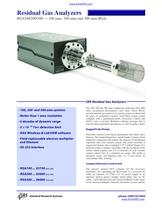
Rugged Probe Design > The 100, 200 and 300 amu residual gas analyzers from SRSoffer exceptional performance and value. These RGAs provide detailed gas analysis of vacuum systems at about half the price of competitive models. Each RGAsystem comes complete with a quadrupole probe, electronics control unit (ECU), and a real-time Windows software package that is used for data acquisition and analysis, as well as probe control. The probe consists of an ionizer, quadrupole mass filter, and adetector. The simple design has a small number of parts which minimizes outgassing and reduces the chances of introducing impurities into your vacuum system. The probe assembly is rugged and mounts onto a standard 2.75 > " of clearance in your vacuumsystem > flange. It isenclosed within a stainless steel tube, with the exception of the ionizer which requires just 2.5 about that of a standard ion gauge. The probe isdesigned using self-aligning parts so it can easily be reassembled after cleaning. Compact Electronics Control Unit The densely packed ECU contains all the necessaryelectronics for controlling the RGAhead. It is powered by either an external +24 VDC (2.5 A) power supply or an optional, built-in power module which plugs into an AC outlet. LED indicators provide instant feedback on the status of the electron multiplier, filament, electronics system and the > (U.S. list)
Open the catalog to page 1
probe. The ECU can easily be removed from the probe forhigh-temperature bakeouts. multi-channel, continuous-dynode electron multiplier (EM)offers increased longevity and stability, and can also be replaced by the user SRS RGAs have a built-in degassing feature. Using electronimpact desorption, the ion source is thoroughly cleaned, greatly reducing the ionizers contribution to background noise. Afirmware driven filament protection feature constantlymonitors (675 Hz) for over pressure. If over pressure is detected, the filament is immediately shut off, preserving its life.Aunique temperature-compensated,...
Open the catalog to page 2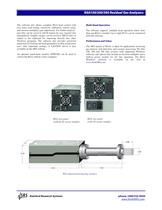
The software also allows complete RGAhead control witheasy mass scale tuning, sensitivity calibration, ionizer setup, and electron-multiplier gain adjustment. For further analysis, data files can be saved in ASCII format for easy transfer into spreadsheets. Graphic images can be saved as METAfiles or copied to the clipboard for importing directly into other Windows programs. The software also provides password protection for locking out head parameters so that casual users cant alter important settings. ALabVIEWdriver is also available on the SRS website.An optional stand-alone monitor (PPM100)...
Open the catalog to page 3
Analog mode provides a line graphrepresentation of the acquired mass spectrum (partial pressure vs. mass number). Span, resolution and noise floor can each be set. Scans can be single-shot, timed or taken continuously. Pressure vs. time presents a strip chart ofpartial pressures for selected masses and provides a complete time history of your data. Complete scrolling and zoom control is available even while data is being acquired. This mode is most often used formonitoring process trends. Library mode contains a comprehensivelist of gases that can be used to compare against the current spectrum....
Open the catalog to page 4All Stanford Research Systems catalogs and technical brochures
 SR556
SR5561 Page
 QMSc
QMSc3 Pages
 FS730/1
4 Pages
 SC10
SC102 Pages
 PRS10
PRS104 Pages
 SR715/720
3 Pages
 CG635
CG6355 Pages
 PERF10
2 Pages
 SR865 DSP Lock-In Amplifier
5 Pages
 SR620
SR6204 Pages
 SIM900Mainframe
2 Pages
 SIM964Analog Limiter
1 Page
 SIM970Quad Digital Voltmeter
2 Pages
 SIM983Scaling Amplifier
1 Page
 SIM965Analog Filter
2 Pages
 SIM921AC Resistance Bridge
3 Pages
 SR250Gated Integrator
3 Pages
 SR540 Optical Chopper
1 Page
 SR640 Programmable Filters
3 Pages
 Rubidium Frequency Standard
4 Pages
 LCR Meters
3 Pages
 Synthesized Clock Generator
5 Pages
 UGAUniversal Gas Analyzer
3 Pages
 RGAResidual Gas Analyzers
5 Pages
 SR850DSP Lock-In Amplifier
4 Pages
 SR10/11/12Audio Switchers
2 Pages
 SR1Audio Analyzer
6 Pages
 6 GHz Vector Signal Generator
10 Pages
 SR255Fast Sampler
3 Pages
 SR245 Computer Interface
2 Pages
 SR200 Gate Scanner
1 Page
 SR630 Thermocouple Reader
3 Pages
 SR510/530 Lock-In Amplifiers
4 Pages
 IGC100 Ion Gauge Controller
4 Pages
 NL100 Nitrogen Laser
2 Pages
 SIM980 Summing Amplifier
1 Page
 SR235 Analog Processor
1 Page
 Laser Diode Controller
4 Pages
 DS335 Function Generator
2 Pages
 Audio Switchers
2 Pages


Archived catalogs
 Partial Pressure Monitor
2 Pages
 Analog PID Controller
2 Pages
 Optical Chopper
2 Pages
 Programmable Filters
3 Pages
 Distribution Amplifier
1 Page
 Audio Analyzer
6 Pages
 Photon Counters
6 Pages
 Waveform Generator
2 Pages
 Lock in Amplifiers
3 Pages
 DSP Lock-in Amplifier
3 Pages


- DC power supply
- AC/DC power supply
- Measuring device
- Concentration analyzer
- Monitoring analyzer
- Automatic analyser
- Benchtop analyser
- Digital temperature control
- Digital indicator
- Temperature controller
- Compact power supply
- Signal amplifying integrated circuit
- Real-time analyzer
- Integration analyzer
- Tabletop power supply
- Generator
- Electronic filter
- Digital gauge