
- Catalogs
- Stanford Research Systems
- Programmable Filters

Programmable Filters

Programmable Filters
Catalog excerpts
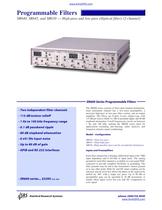
· Two independent filter channels · 115 dB/octave rolloff · 1 Hz to 100 kHz frequency range · 0.1 dB passband ripple · 80 dB stopband attenuation · 6 nV/ãHz input noise · Up to 80 dB of gain · GPIB and RS-232 interfaces · SR600 series... $3295 (U.S. list) Stanford Research Systems phone: (408)744-9040 www.thinkSRS.com The SR600 series consists of three dual-channel instruments. Each instrument channel has a low-noise preamplifier, a precision high-pass or low-pass filter section, and an output amplifier. The filters are 8-pole, 6-zero elliptic-type with 115 dB per octave rolloff, 0.1 dB of passband ripple, and 80 dB stopband attenuation. Cutoff frequencies can be set between 1 Hz and 100 kHz, making the SR600 series ideal for applications including anti-aliasing, audio analysis, and frequency-domain signal conditioning. Model.Configuration SR640.Dual low-pass SR645.Dual high-pass SR650.High-pass/low-pass (can be cascaded for band-pass) Inputs and Preamplifiers Each filter channel has a floating, differential input with 1 MÙ input impedance and 6 nV/ãHz of input noise. The analog ground for each filter channel is available at a rear-panel BNC connector to provide complete flexibility in grounding. The filter grounds may be tied to the instrument's chassis ground or to any other point. Both AC and DC input coupling can be selected, and an invert key allows the phase of the signal to be shifted by 180° with a single key press. Up to 60 dB of preamplifier gain can be specified in 10 dB increments. A simple offset adjust screw lets you null DC components in your signal. SR600 Series Programmable Filters Programmable Filters SR640, SR645, and SR650 . High-pass and low-pass elliptical filters (2-channel) www.thinkSRS.com
Open the catalog to page 1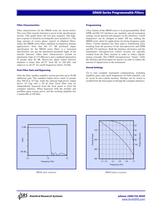
Filter Characteristics Filter characteristics for the SR600 series are shown below. The exact filter transfer function is given in the specifications section. (The graph shows the low pass response. The highpass response is found by inverting the curve around f=1.) The large amount of excess phase, typical of elliptical filters, makes the SR600 series filters optimum in frequency-domain applications. Note that the 0.1 dB passband ripple specification for the SR640 series filters is a measured specification, not just the theoretical passband ripple of the transfer function. Other filter characteristics...
Open the catalog to page 2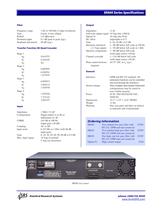
Filter Frequency range 1 Hz to 100 kHz (3-digit resolution) Type 8-pole, 6-zero elliptic Rolloff 115 dB/octave Passband ripple 0.1 dB peak to peak (typ.) Stopband attenuation 80 dB (typ.) Transfer Function (Bi-Quad Cascade) Stage 1 ùp 0.634752 Q 0.543939 ùz n/a Stage 2 ùp 0.805995 Q 0.950701 ùz 1.675935 Stage 3 ùp 0.985073 Q 2.095314 ùz 1.935978 Stage 4 ùp 1.076768 Q 7.375143 ùz 2.883197 Input Impedance 1 MÙ // 15 pF Configuration Single-ended (A or B) or differential (A-B) CMRR >85 dB at 100 Hz (input gain >20 dB) Coupling AC or DC Input noise 6 nV/ãHz at 1 kHz (with 60 dB input gain) Gain 0,...
Open the catalog to page 3All Stanford Research Systems catalogs and technical brochures
 SR556
SR5561 Page
 QMSc
QMSc3 Pages
 FS730/1
4 Pages
 SC10
SC102 Pages
 PRS10
PRS104 Pages
 SR715/720
3 Pages
 CG635
CG6355 Pages
 PERF10
2 Pages
 SR865 DSP Lock-In Amplifier
5 Pages
 SR620
SR6204 Pages
 SIM900Mainframe
2 Pages
 SIM964Analog Limiter
1 Page
 SIM970Quad Digital Voltmeter
2 Pages
 SIM983Scaling Amplifier
1 Page
 SIM965Analog Filter
2 Pages
 SIM921AC Resistance Bridge
3 Pages
 SR250Gated Integrator
3 Pages
 SR540 Optical Chopper
1 Page
 SR640 Programmable Filters
3 Pages
 Rubidium Frequency Standard
4 Pages
 LCR Meters
3 Pages
 Synthesized Clock Generator
5 Pages
 UGAUniversal Gas Analyzer
3 Pages
 RGAResidual Gas Analyzers
5 Pages
 SR850DSP Lock-In Amplifier
4 Pages
 SR10/11/12Audio Switchers
2 Pages
 SR1Audio Analyzer
6 Pages
 6 GHz Vector Signal Generator
10 Pages
 SR255Fast Sampler
3 Pages
 SR245 Computer Interface
2 Pages
 SR200 Gate Scanner
1 Page
 SR630 Thermocouple Reader
3 Pages
 SR510/530 Lock-In Amplifiers
4 Pages
 IGC100 Ion Gauge Controller
4 Pages
 NL100 Nitrogen Laser
2 Pages
 SIM980 Summing Amplifier
1 Page
 SR235 Analog Processor
1 Page
 Laser Diode Controller
4 Pages
 DS335 Function Generator
2 Pages
 Audio Switchers
2 Pages


Archived catalogs
 Partial Pressure Monitor
2 Pages
 Analog PID Controller
2 Pages
 Optical Chopper
2 Pages
 Distribution Amplifier
1 Page
 Audio Analyzer
6 Pages
 Residual Gas Analyzers
5 Pages
 Photon Counters
6 Pages
 Waveform Generator
2 Pages
 Lock in Amplifiers
3 Pages
 DSP Lock-in Amplifier
3 Pages


- Power supply unit
- DC power supply
- AC/DC power supply
- Gas analyzer
- Measuring device
- Concentration analyzer
- Monitoring analyzer
- Automatic analyser
- Benchtop analyser
- Digital temperature control
- Digital indicator
- Temperature controller
- Compact power supply
- Signal amplifying integrated circuit
- Real-time analyzer
- Integration analyzer
- Tabletop power supply
- Generator
- Electronic filter
- Digital analyzer