

PERF10

PERF10
- Outputs: Eight 10 MHz, 75 Ω outputs compatible with master clocks.
- Accuracy: ±0.05 ppb at shipment.
- Aging: Less than 5 ppb over 10 years.
- Phase Noise: Ultra-low phase noise (<−150 dBc/Hz @ 10 kHz).
- Short-term Stability: <2 × 10–11 (1 s Allan variance).
- Warm-up Time: Less than 6 minutes to lock.
- Power Options: AC power (90 to 132 VAC or 175 to 264 VAC) and optional 12 VDC redundant power input.
- Environmental Conditions: Operating temperature from +10 ºC to +40 ºC, storage temperature from –55 ºC to +85 ºC, and 95% relative humidity (non-condensing).
- Dimensions and Weight: 19" × 3.5" × 10.125" (WHD), 10 lbs.
- Warranty: One year parts and labor on defects in materials and workmanship.
Catalog excerpts
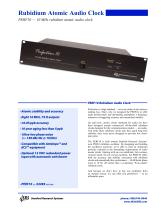
PERF10 Rubidium Audio Clock- • Atomic stability and accuracy • Eight 10 MHz, 75 Q outputs • ±0.05 ppb accuracy • 10 year aging less than 5 ppb • Ultra-low phase noise (<-150 dBc/Hz @ 10 kHz) • Compatible with Antelope™ and dCS™ equipment • Optional 12 VDC redundant power input with automatic switchover Perfection is a high standard — but your studio clocks deserve nothing less. That’s why we designed the PERF10, to offer audio professionals and demanding audiophiles a frequency reference of staggering accuracy and unmatched stability. Up until now, atomic clocks marketed for audio use have been designed around commercial off-the-shelf rubidium clocks designed for the communications market — not audio. And while these rubidium clocks may have good long-term stability, they were never designed to provide low shortterm jitter. The PERF10 is built around Stanford Research Systems’ own PRS10 rubidium oscillator. By designing and building the oscillators ourselves, we’re able to craft an instrument perfectly matched to the demanding requirements of audio master clocks. Starting with an oven stabilized, 3rd overtone, varactor tuned, SC-cut crystal oscillator, the PERF10 offers both the accuracy and stability associated with rubidium clocks and unmatched jitter performance—30 dB better phase noise at 10 Hz off carrier than a competing “Swiss-made” rubidium clock. And because we don’t have to buy our oscillators from an outside source, we can offer you perfection — at an affordable price.
Open the catalog to page 1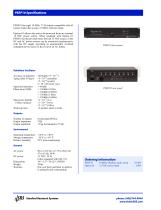
PERF10 has eight 10 MHz, 75 Ω outputs compatible with all master clocks that accept a 10 MHz reference input. Option 01 allows the unit to be powered from an external 12 VDC power source. When equipped with Option 01 PERF10 can be powered solely from an 12 VDC source, or the DC and AC power sources can be connected simultaneously with the DC supply providing an automatically switched redundant power source in the event of an AC failure. Rubidium Oscillator Accuracy at shipment ±0.05 ppb (±5 × 10–11) Aging (after 30 days) <5 × 10–11 (monthly) <5 × 10⁻¹⁰ (yearly) 5 × 10⁻⁹ (20 years, typ.) Spurious...
Open the catalog to page 2All Stanford Research Systems catalogs and technical brochures
 SR556
SR5561 Page
 QMSc
QMSc3 Pages
 FS730/1
4 Pages
 SC10
SC102 Pages
 PRS10
PRS104 Pages
 SR715/720
3 Pages
 CG635
CG6355 Pages
 SR865 DSP Lock-In Amplifier
5 Pages
 SR620
SR6204 Pages
 SIM900Mainframe
2 Pages
 SIM964Analog Limiter
1 Page
 SIM970Quad Digital Voltmeter
2 Pages
 SIM983Scaling Amplifier
1 Page
 SIM965Analog Filter
2 Pages
 SIM921AC Resistance Bridge
3 Pages
 SR250Gated Integrator
3 Pages
 SR540 Optical Chopper
1 Page
 SR640 Programmable Filters
3 Pages
 Rubidium Frequency Standard
4 Pages
 LCR Meters
3 Pages
 Synthesized Clock Generator
5 Pages
 UGAUniversal Gas Analyzer
3 Pages
 RGAResidual Gas Analyzers
5 Pages
 SR850DSP Lock-In Amplifier
4 Pages
 SR10/11/12Audio Switchers
2 Pages
 SR1Audio Analyzer
6 Pages
 6 GHz Vector Signal Generator
10 Pages
 SR255Fast Sampler
3 Pages
 SR245 Computer Interface
2 Pages
 SR200 Gate Scanner
1 Page
 SR630 Thermocouple Reader
3 Pages
 SR510/530 Lock-In Amplifiers
4 Pages
 IGC100 Ion Gauge Controller
4 Pages
 NL100 Nitrogen Laser
2 Pages
 SIM980 Summing Amplifier
1 Page
 SR235 Analog Processor
1 Page
 Laser Diode Controller
4 Pages
 DS335 Function Generator
2 Pages
 Audio Switchers
2 Pages


Archived catalogs
 Partial Pressure Monitor
2 Pages
 Analog PID Controller
2 Pages
 Optical Chopper
2 Pages
 Programmable Filters
3 Pages
 Distribution Amplifier
1 Page
 Audio Analyzer
6 Pages
 Residual Gas Analyzers
5 Pages
 Photon Counters
6 Pages
 Waveform Generator
2 Pages
 Lock in Amplifiers
3 Pages
 DSP Lock-in Amplifier
3 Pages


- Power supply unit
- DC power supply
- AC/DC power supply
- Gas analyzer
- Measuring device
- Concentration analyzer
- Monitoring analyzer
- Automatic analyser
- Benchtop analyser
- Digital temperature control
- Digital indicator
- Temperature controller
- Compact power supply
- Signal amplifying integrated circuit
- Real-time analyzer
- Integration analyzer
- Tabletop power supply
- Generator
- Electronic filter
- Digital gauge