
- Catalogs
- Stanford Research Systems
- FS740 — GPS/GNSS Time and Frequency System

FS740 — GPS/GNSS Time and Frequency System

FS740 — GPS/GNSS Time and Frequency System
Catalog excerpts
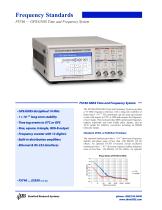
Frequency Standards FS740 — GPS/GNSS Time and Frequency System FS740 GNSS Time and Frequency System · GPS/GNSS disciplined 10 MHz · 1 × 10−13 long-term stability · Time tag events to UTC or GPS · Sine, square, triangle, IRIG-B output The FS740 GPS/GNSS Time and Frequency System provides a 10 MHz frequency reference with a long-term stability of better than 1 × 10–13. The instrument can also time tag external events with respect to UTC or GPS and measure the frequency of user inputs. The instrument has DDS synthesized frequency outputs, adjustable rate (and width) pulse outputs, and an AUX output for arbitrary waveforms including an IRIGB timecode output. · Frequency counter with 12 digits/s Standard, OCXO, or Rubidium Timebase · Built-in distribution amplifiers The standard timebase provides 1 × 10⁻⁹ short-term frequency stability and phase noise of less than –100 dBc/Hz (10 Hz offset). An optional OCXO (ovenized crystal oscillator) timebase provides 1 × 10–11 short-term frequency stability and phase noise of less than –130 dBc/Hz (10 Hz offset). An optional Stanford Research Systems
Open the catalog to page 1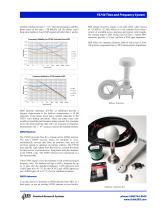
FS740 Time and Frequency System rubidium timebase provides 1 × 10–12 short-term frequency stability, phase noise of less than –130 dBc/Hz (10 Hz offset), and a long-term holdover (lost GNSS signal) of better than 1 μs/day. SRS timing receivers require a net gain (after cable losses) of +20 dBi to +32 dBi, which is a very common level from a variety of available active antennas and typical cable lengths. The antenna input to SRS timing receivers have a female BNC connector, provide +5 V bias, and have a 50 Ω input impedance. SRS offers two antenna solutions, both of which have LNAs. All systems...
Open the catalog to page 2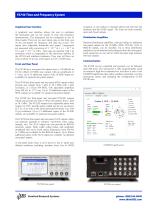
FS740 Time and Frequency System Graphical User Interface A graphical user interface allows the user to configure the instrument and see the results of time and frequency measurements. The instrument can be configured in one of three modes: There are two user inputs (one on the front, one on the rear-panel) for frequency and time tag events. The inputs have adjustable thresholds and slopes. Frequencies are measured with a precision of 1 × 10–11 in 1 s, 1 × 10–12 in 10 s, and 1 × 10–13 in 100 s. Time tags are reported with 1 ps resolution which is comparable to the short-term stability of the OCXO...
Open the catalog to page 3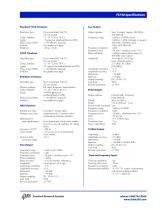
Oscillator type Temp. Stability Aging Phase noise (SSB) Stability Holdover OCXO Timebase Oscillator type Temp. Stability Aging Phase noise (SSB) Stability Rubidium Timebase Oscillator type Physics package Temp. Stability Aging Phase noise (SSB) Stability GNSS Receiver Satelite acq. time Almanac acq. time Optimized for static applications Oven controlled, 3rd OT, AT-cut crystal <2 x 10⁻⁶ (20 to 30 °C) <5 ppm/year (undisciplined to GPS) <-105 dBc/Hz (typical) See graphs next page <40 ps / 24 hr. Oven controlled, 3rd OT, SC-cut crystal <2 x 10⁻⁹ (20 to 30 °C) <0.2 ppm/year (undisciplined to GPS)...
Open the catalog to page 4
Computer Interfaces Ethernet (LAN) RS-232 General AC power EMI Compliance Dimensions Weight Warranty 10/100 Base-T. TCP/IP & DHCP 4.8k-115.2k baud, RTS/CTS flow 90 to 264 VAC, 90 W 47 to 63 Hz with PFC FCC Part 15 (Class B), CISPR-22 (Class B) 8.5” x 3.5” x 13” (WHL) 10 lbs. One year parts and labor on defects in materials and workmanship SRS Stanford Research Systems Ordering information FS740 GPS Time and Frequency System $2950 Option 01 OCXO timebase $650 Option 02 Rubidium timebase $1500 Option A Five 10 MHz outputs $495 Option B Five Sine/Aux outputs $495 Option C Five Pulse outputs $495
Open the catalog to page 5All Stanford Research Systems catalogs and technical brochures
 SR556
SR5561 Page
 QMSc
QMSc3 Pages
 FS730/1
4 Pages
 SC10
SC102 Pages
 PRS10
PRS104 Pages
 SR715/720
3 Pages
 CG635
CG6355 Pages
 PERF10
2 Pages
 SR865 DSP Lock-In Amplifier
5 Pages
 SR620
SR6204 Pages
 SIM900Mainframe
2 Pages
 SIM964Analog Limiter
1 Page
 SIM970Quad Digital Voltmeter
2 Pages
 SIM983Scaling Amplifier
1 Page
 SIM965Analog Filter
2 Pages
 SIM921AC Resistance Bridge
3 Pages
 SR250Gated Integrator
3 Pages
 SR540 Optical Chopper
1 Page
 SR640 Programmable Filters
3 Pages
 Rubidium Frequency Standard
4 Pages
 LCR Meters
3 Pages
 Synthesized Clock Generator
5 Pages
 UGAUniversal Gas Analyzer
3 Pages
 RGAResidual Gas Analyzers
5 Pages
 SR850DSP Lock-In Amplifier
4 Pages
 SR10/11/12Audio Switchers
2 Pages
 SR1Audio Analyzer
6 Pages
 6 GHz Vector Signal Generator
10 Pages
 SR255Fast Sampler
3 Pages
 SR245 Computer Interface
2 Pages
 SR200 Gate Scanner
1 Page
 SR630 Thermocouple Reader
3 Pages
 SR510/530 Lock-In Amplifiers
4 Pages
 IGC100 Ion Gauge Controller
4 Pages
 NL100 Nitrogen Laser
2 Pages
 SIM980 Summing Amplifier
1 Page
 SR235 Analog Processor
1 Page
 Laser Diode Controller
4 Pages
 DS335 Function Generator
2 Pages
 Audio Switchers
2 Pages


Archived catalogs
 Partial Pressure Monitor
2 Pages
 Analog PID Controller
2 Pages
 Optical Chopper
2 Pages
 Programmable Filters
3 Pages
 Distribution Amplifier
1 Page
 Audio Analyzer
6 Pages
 Residual Gas Analyzers
5 Pages
 Photon Counters
6 Pages
 Waveform Generator
2 Pages
 Lock in Amplifiers
3 Pages
 DSP Lock-in Amplifier
3 Pages


- Power supply unit
- DC power supply
- AC/DC power supply
- Gas analyzer
- Measuring device
- Concentration analyzer
- Monitoring analyzer
- Automatic analyser
- Benchtop analyser
- Digital temperature control
- Digital indicator
- Temperature controller
- Compact power supply
- Signal amplifying integrated circuit
- Real-time analyzer
- Tabletop power supply
- Integration analyzer
- Generator
- Electronic filter
- Digital gauge