
- Catalogs
- Stanford Research Systems
- FS730/3 CMOS Logic Distribution Amplifier

FS730/3 CMOS Logic Distribution Amplifier

FS730/3 CMOS Logic Distribution Amplifier
The FS73X series by Stanford Research Systems includes the FS730 and FS735 distribution amplifiers, designed for 5 MHz, 10 MHz, CMOS, and broadband applications. These amplifiers are suitable for distributing low-noise frequency references and logic pulses.
5 MHz and 10 MHz Distribution Amplifiers
The FS730 is a benchtop model with one input and seven outputs, while the FS735 is a rack-mount model with two inputs and fourteen outputs. Both models feature amplitude leveling, low additive phase noise, and excellent isolation. Inputs are AC coupled with a 50 Ω impedance, and outputs provide a 1 Vrms sine wave into a 50 Ω load. Key features include a limiter to remove amplitude modulation and a bandpass filter for signal conditioning.
CMOS Distribution Amplifiers
The FS730 and FS735 models distribute CMOS level logic pulses with high input impedance and fast transition times. Each output has a 50 Ω source impedance, and the polarity can be configured via an internal jumper. The system includes indicator LEDs for power and signal status.
Broadband Distribution Amplifiers
These amplifiers handle broadband signals from DC to 100 MHz, with options for 50 Ω or 75 Ω impedance. They offer a flat frequency response, large dynamic range, and low noise. The FS730 has one input and seven outputs, while the FS735 has two inputs and fourteen outputs.
Specifications
- 5 MHz & 10 MHz Amplifiers: Input frequency of 5 MHz or 10 MHz, output level of +13 dBm, and isolation greater than 100 dB.
- CMOS Amplifiers: Input impedance of 1 kΩ, output levels of 0 V and 5 V, and rise/fall times under 1.5 ns.
- Broadband Amplifiers: Bandwidth over 100 MHz, gain of ×1.00 for 50 Ω loads, and noise under 15 nV/√Hz.
Configuration & Ordering
The FS73X series can be configured as a benchtop or rack-mount unit, with various models available for different frequency and impedance requirements. Prices range from $950 to $2150 depending on the model and configuration.
Catalog excerpts
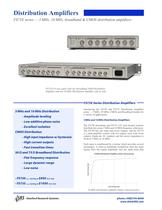
Distribution Amplifiers FS73X series — 5 MHz, 10 MHz, broadband & CMOS distribution amplifiers FS730/1 front panel FS735/1/4 rear panel with one Broadband 50 Ω Distribution Amplifier and one 10 MHz Distribution Amplifier side by side. FS73X Series Distribution Amplifiers 5 MHz and 10 MHz Distribution · Amplitude leveling · Low additive phase noise · Excellent isolation CMOS Distribution · High input impedance w/ hysteresis · High current outputs · Fast transition times 50 Ω and 75 Ω Broadband Distribution · Large dynamic range · Low noise The FS730 (benchtop) and FS735 (19" rack-mount) systems distribute low-noise 5 MHz and 10 MHz frequency references. The FS730 has one input and seven outputs, and the FS735 is a dual-amplifier system with two inputs, each with seven outputs. Inputs are AC coupled, and the source impedance is 50 Ω at 5 MHz or 10 MHz. Each input is conditioned by a limiter which provides several advantages: it removes amplitude modulation from the input signal, fixes the output amplitude, and any input noise that 10 MHz Distribution Amplifier Limiter Characteristic · Flat frequency response 5 MHz and 10 MHz Distribution Amplifiers 3 Output Voltage (Vpp) Introducing the FS730 and FS735 Distribution Amplifier series — 5 MHz, 10 MHz, CMOS, and Broadband models for a variety of applications. 2 1 · FS730 ... starting at $950 (U.S. list) · FS735 ... starting at $1050 (U.S. list) 0 0 1 2 3 4 Input Voltage (Vpp) 10 MHz distribution amplifier limiter characteristics Stanford Research Systems phone: (408)744-9040 www.thinkSRS.com
Open the catalog to page 1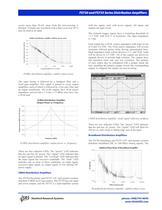
FS730 and FS735 Series Distribution Amplifiers occurs more than 50 mV away from the zero-crossing is blocked. Virtually any waveform with a duty cycle near 50 % 10MHz Distribution amplifier additive phase noise Frequency offset from carrier (Hi) with two inputs, each with seven outputs. All inputs and outputs are logic levels. The Schmitt trigger inputs have a switching threshold of +1.3 VDC with 0.35 V of hysteresis. The input impedance Each output has a 50 Q source impedance with logic levels of 0 and 5.0 VDC. The 50 D source impedance will reverse terminate reflected pulses when driving unterminated...
Open the catalog to page 2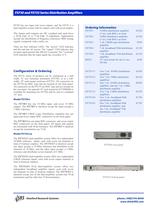
FS730 and FS735 Series Distribution Amplifiers FS730 has one input and seven outputs, and the FS735 is a dual-amplifier system with two inputs, each with seven outputs. The inputs and outputs are DC coupled and each have a 50 Ω (Opt. 4) or 75 Ω (Opt. 5) impedance. Applications include the distribution of frequency references, IRIG timing signals, composite video, audio, etc. There are four indicator LEDs. The “power” LED indicates that the unit has AC power. The “signal” LED indicates that an input signal greater that 300 mV is present. The “overload” LED indicates that the input signal has exceeded...
Open the catalog to page 3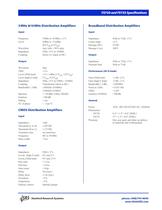
Level (high-Z load) CMOS Distribution Amplifiers Lransition time Pulse width Levels (high-Z load) Rise time Fall time Delay skew Polarity control Internal jumper Broadband Distribution Amplifiers Linear range Nominal load Gain (high-Z load) One year parts and labor on defects SRS Stanford Research Systems
Open the catalog to page 4All Stanford Research Systems catalogs and technical brochures
 SR556
SR5561 Page
 QMSc
QMSc3 Pages
 FS730/1
4 Pages
 SC10
SC102 Pages
 PRS10
PRS104 Pages
 SR715/720
3 Pages
 CG635
CG6355 Pages
 PERF10
2 Pages
 SR865 DSP Lock-In Amplifier
5 Pages
 SR620
SR6204 Pages
 SIM900Mainframe
2 Pages
 SIM964Analog Limiter
1 Page
 SIM970Quad Digital Voltmeter
2 Pages
 SIM983Scaling Amplifier
1 Page
 SIM965Analog Filter
2 Pages
 SIM921AC Resistance Bridge
3 Pages
 SR250Gated Integrator
3 Pages
 SR540 Optical Chopper
1 Page
 SR640 Programmable Filters
3 Pages
 Rubidium Frequency Standard
4 Pages
 LCR Meters
3 Pages
 Synthesized Clock Generator
5 Pages
 UGAUniversal Gas Analyzer
3 Pages
 RGAResidual Gas Analyzers
5 Pages
 SR850DSP Lock-In Amplifier
4 Pages
 SR10/11/12Audio Switchers
2 Pages
 SR1Audio Analyzer
6 Pages
 6 GHz Vector Signal Generator
10 Pages
 SR255Fast Sampler
3 Pages
 SR245 Computer Interface
2 Pages
 SR200 Gate Scanner
1 Page
 SR630 Thermocouple Reader
3 Pages
 SR510/530 Lock-In Amplifiers
4 Pages
 IGC100 Ion Gauge Controller
4 Pages
 NL100 Nitrogen Laser
2 Pages
 SIM980 Summing Amplifier
1 Page
 SR235 Analog Processor
1 Page
 Laser Diode Controller
4 Pages
 DS335 Function Generator
2 Pages
 Audio Switchers
2 Pages


Archived catalogs
 Partial Pressure Monitor
2 Pages
 Analog PID Controller
2 Pages
 Optical Chopper
2 Pages
 Programmable Filters
3 Pages
 Distribution Amplifier
1 Page
 Audio Analyzer
6 Pages
 Residual Gas Analyzers
5 Pages
 Photon Counters
6 Pages
 Waveform Generator
2 Pages
 Lock in Amplifiers
3 Pages
 DSP Lock-in Amplifier
3 Pages


- Power supply unit
- DC power supply
- AC/DC power supply
- Gas analyzer
- Measuring device
- Concentration analyzer
- Monitoring analyzer
- Automatic analyser
- Benchtop analyser
- Digital temperature control
- Digital indicator
- Temperature controller
- Compact power supply
- Signal amplifying integrated circuit
- Real-time analyzer
- Integration analyzer
- Tabletop power supply
- Generator
- Electronic filter
- Digital gauge