
- Catalogs
- Stalam S.p.A.
- RADIO FREQUENCY DRYERS FOR FABRICS

- Company
- Products
- Catalogs
- News & Trends
- Exhibitions
RADIO FREQUENCY DRYERS FOR FABRICS

RADIO FREQUENCY DRYERS FOR FABRICS
STALAM has developed a revolutionary Radio Frequency (RF) dryer for fabrics, specifically designed for tensionless drying of woven or knitted fabrics. This innovation is a result of collaboration with a leading Italian manufacturer of finishing machines.
- The RF/T series dryer uses a patented Double Polarity Electrode to deliver high power to thin fabrics, creating a concentrated electric field even at low RF voltages.
- Drying occurs at low temperatures (40-60°C) and takes only a few seconds.
- Residual moisture is uniformly controlled by an in-line computerized system.
- The fabric is fed into the drying chamber via a spreading and centering system, passing through RF electrodes.
- Motorized rollers ensure no tension is applied to the fabric.
- Air circulation is managed by the RF generator cooling system, with temperature control.
- Water vapor is extracted by a fan, and moisture content is adjusted automatically to maintain set levels with +/-0.5% accuracy.
- High productivity in a compact space.
- Rapid drying process under low temperature conditions.
- Uniform residual moisture content.
- Modular construction to fit various production needs.
- Can be used standalone or to enhance existing equipment performance.
- Work frequency: 27.12 MHz ± 0.6%.
- Cooling system: Air cooling.
- Average evaporation rate: 1.2 ÷ 1.3 kg (H2O)/kW(RF)h.
- Available RF power values: 60 kW, 85 kW.
- Dimensions: 4.2 m (L) x 4.2 m (W) x 4.2 m (H).
STALAM, Via dell’Olmo, 7, I - 36055 Nove (VI), T. +39 0424 597400, F. +39 0424 590722, E. [email protected], I. www.stalam.com
Catalog excerpts
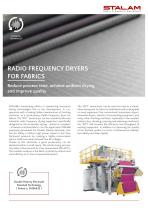
PATENTED TECHNOLOGY RADIO FREQUENCY DRYERS FOR FABRICS Reduce process time, achieve uniform drying and improve quality STALAM’s outstanding efforts in researching innovative drying technologies led to the development, in cooperation with a leading Italian manufacturer of finishing machines, of a revolutionary Radio Frequency dryer for fabrics. The “RF/T” series dryer can be considered the only industrial radio frequency drying equipment specifically designed for the tensionless drying - partial or complete - of woven or knitted fabrics. For this application STALAM purposely developed the Double Polarity Electrode, that has the ability to deliver high power values to thin (low thickness) products by creating a highly-concentrated electric field even when fed with low RF voltages. Thanks to this electrode, a great productivity can be obtained within a small space. The whole drying process only takes a few seconds at a low temperature (40-60°C). The residual moisture in the fabric is perfectly uniform and controlled by an in-line computerised system. Double Polarity Electrode Patented Technology ( Patent n. 01266633 ) The “RF/T” series dryer can be used not only as a standalone drying unit, but also in combination with existing (old or new) equipment like conventional tensionless dryers, relaxation dryers, stenters, thermosetting equipment, and many other finishing machines, especially in the woollen industry (e.g. decating, pressing and steaming machines): the “RF/T” will increase the efficiency and throughput of existing equipment, in addition to improving the quality of the finished product in terms of dimensional stability, formability and she
Open the catalog to page 1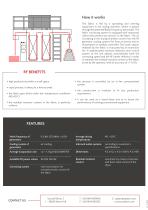
How it works The fabric is fed by a spreading and centring equipment to the drying chamber, where it passes through the patented Radio Frequency electrodes. The fabric conveying system is equipped with motorised rollers that prevent any tension on the fabric. The air circulating in the drying chamber comes from the RF generator cooling system (for heat recovery) and its temperature is suitably controlled. The water vapour released by the fabric is evacuated by an extraction fan. A sophisticated moisture detection and control system at the exit adjusts automatically both the conveying speed and...
Open the catalog to page 2All Stalam S.p.A. catalogs and technical brochures
 Food safety equipment
15 Pages
 STALAM CATALOG - FOOD DIVISION
27 Pages
 RF ECO +
4 Pages
 Dryers for glass fibres
4 Pages
 Textile dryers - Catalogue 2019
15 Pages


Archived catalogs
 RF VULCANISATION
2 Pages

- Kiln
- Drying kiln
- Continuous drying system
- Tunnel kiln
- Curing furnace
- Air blast dewatering system
- Disinfection unit
- Continuous oven
- Dewatering system for the food industry
- Pasteurizer
- Batch drying system
- Pasteurizer for the food industry
- Dewatering system with belt conveyor
- Dryer for the pharmaceutical industry
- Dryer with temperature control
- Stainless steel drying system
- Dryer with automatic controls
- Radiation dryer
- Horizontal drying system