
- Catalogs
- Stackpole Electronics
- Low and Ultra-Low Capacitance ESD Suppressor Arrays ESA(U)

Low and Ultra-Low Capacitance ESD Suppressor Arrays ESA(U)
1 / 2 PagesView full catalog
Low and Ultra-Low Capacitance ESD Suppressor Arrays ESA(U)
Product catalog summary
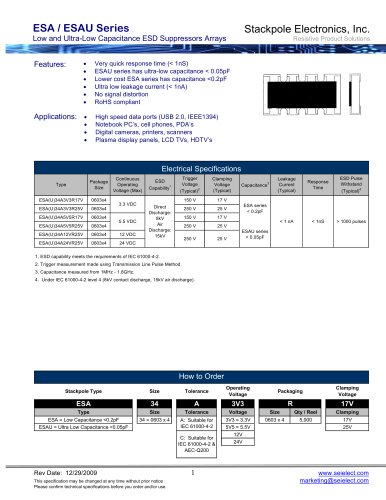
Overview: The document provides technical specifications for the ESA and ESAU series of low and ultra-low capacitance ESD suppressor arrays by Stackpole Electronics, Inc. These components are designed for high-speed data ports and various electronic devices, offering quick response times and minimal signal distortion.
Features:
- Quick response time of less than 1 nanosecond.
- Ultra-low capacitance for ESAU series (<0.05pF) and low capacitance for ESA series (<0.2pF).
- Ultra-low leakage current (<1nA).
- RoHS compliant.
Applications: Suitable for high-speed data ports (USB 2.0, IEEE1394), notebook PCs, cell phones, PDAs, digital cameras, printers, scanners, plasma display panels, LCD TVs, and HDTVs.
Electrical Specifications:
- ESD capability meets IEC 61000-4-2 requirements.
- Trigger voltage and clamping voltage vary by model, with typical values provided.
- Capacitance measured from 1MHz to 1.8GHz.
- ESD pulse withstand capability: Direct discharge at 8kV and air discharge at 15kV.
Mechanical Specifications:
- Dimensions provided for body length, width, height, and terminations.
- Solderability and resistance to solder heat tested under specified conditions.
Performance Characteristics:
- Operating temperature range from -55°C to 125°C.
- Full load voltage tested for 1000 hours at 25°C.
- Resistance to bending and thermal shock tested according to MIL-STD methods.
Ordering Information: Details on how to order, including type, size, tolerance, and operating voltage, are provided.
See more
All Stackpole Electronics catalogs and technical brochures





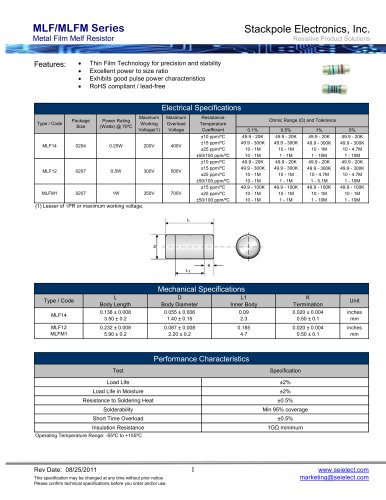

Archived catalogs
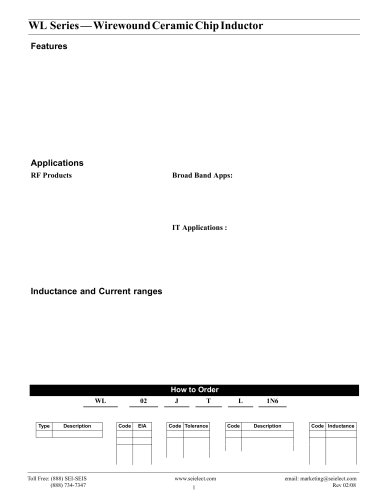 Wirewound Ceramic Chip Inductor
10 Pages
 Low Voltage Leaded Varistors
3 Pages
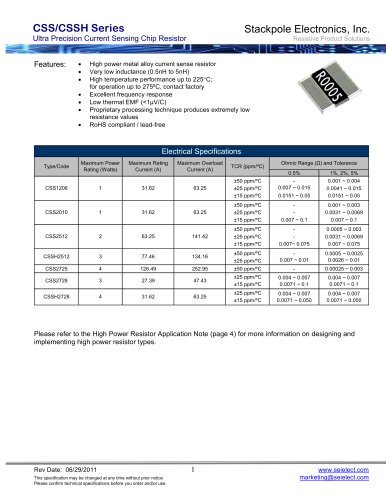
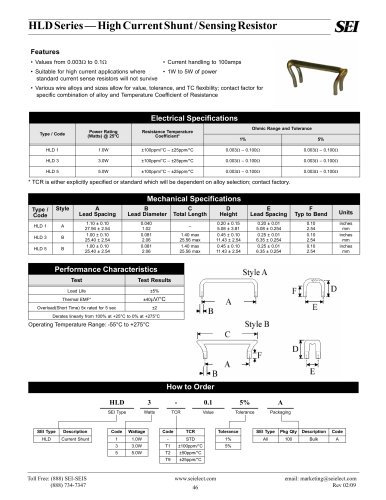 current-sense resistor
1 Page
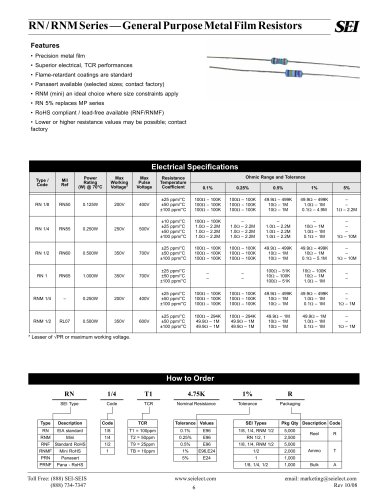
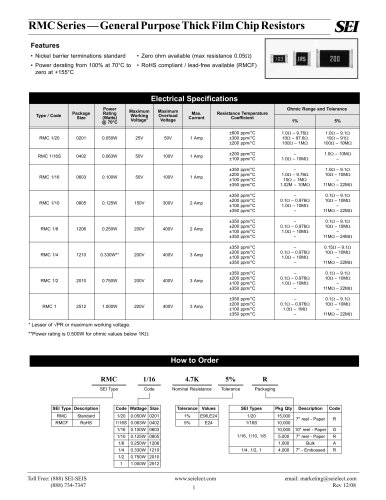 Thick Film Chip Resistors
2 Pages


Related Searches
- Wire-wound resistor
- Board-mount resistor
- Power resistor
- Housed resistor
- Thin-film resistor
- Electronic inductor
- SMD resistor
- Thick-film resistor
- Ferrite inductor
- High-power resistor
- Voltage resistor
- High-voltage resistor
- Non-inductive resistor
- Ceramic-housed resistor
- Metal-film resistor
- Precision resistor
- Aluminum-housed resistor
- Electronic resistor
- Current-sense resistor
- Varistor
*Prices are pre-tax. They exclude delivery charges and customs duties and do not include additional charges for installation or activation options. Prices are indicative only and may vary by country, with changes to the cost of raw materials and exchange rates.
About DirectIndustry
DirectIndustry is a marketplace that offers B2B players a complete experience, from product sourcing to purchase. DirectIndustry is an entity of VirtualExpo Group.
Are you a buyer?
Are you a supplier?