


Absorber

Absorber
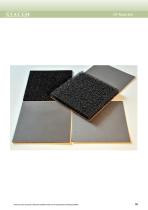
- AH-11: A silicone-based material filled with magnetic particles, designed for resonant frequency absorption in a narrow band. It operates within a frequency range of 1 to 40 GHz and offers an attenuation of less than -20dB (99% energy loss). The material is suitable for applications like antenna isolation and electromagnetic interference reduction.
- AH-21: Similar to AH-11 but focuses on cavity resonance attenuation. It operates from 1 to 20 GHz with an attenuation of less than -10dB (90% energy loss).
- AH-31: Designed for surface wave absorption, this material also targets cavity resonance attenuation. It operates within 1 to 20 GHz with similar attenuation properties as AH-21.
- AH-41: A high-loss cavity resonance absorber with a frequency range of 1 to 18 GHz. It is designed to reduce the Q index of cavities.
- AH-51: Made with an acrylic binder, this absorber targets low frequencies from 1MHz to 3GHz, with attenuation ranging from -3 to -10 dB.
- AH-91 to AH-94: These are foam-based materials filled with carbon, designed for wide-band resonance frequency absorption. They operate within 1 to 18 GHz and are used for applications like antenna pattern performance and electromagnetic interference reduction.
- Common applications across all types include automotive, aeronautics, military, shipbuilding, telecoms, antenna isolation, electromagnetic interference reduction, and radar wave absorption.
- Specific applications vary slightly depending on the absorber type, focusing on aspects like surface wave absorption, cavity resonance attenuation, and antenna pattern performance.
- All absorbers are silicone-based or foam-based, with varying thicknesses and dimensions tailored to specific frequency ranges.
- Operating temperatures generally range from -50°C to +190°C, with some variations depending on the material type.
- Most materials are grey or black, with compliance to UL and RoHS standards.
- Each absorber type has a specific part numbering system that indicates the presence of adhesive (PSA) and the thickness of the material.
Catalog excerpts
These tests were carried out in laboratory conditions which are not representative of working conditions.
Open the catalog to page 1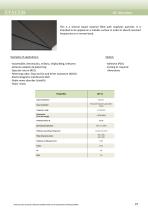
This is a silicone based material filled with magnetic particles. It is intended to be applied on a metallic surface in order to absorb resonant frequencies on a narrow band. - Automobile, Aeronautics, military, shipbuilding, telecoms - Antenna isolation & patterning - Specular return (RCS) - Reversing radar, Stop and Go and driver assistance (ADAS) - Electromagnetic interference EMI - Radar wave absorber (stealth) - Ships’ masts - Adhesive (PSA) - Cutting to required dimensions Resonant frequency absorber/ Tuned Frequency range Attenuation (% of lost energy) Hardness (shore A) Operating temperature...
Open the catalog to page 2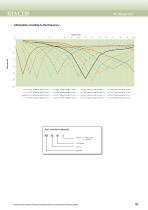
HF Absorber Attenuation according to the frequency Part number example: AH 11 x Adhesive : 0 = without PSA 1 = with PSA Part number Serial no. Absorber These tests were carried out in laboratory conditions which are not representative of working conditions.
Open the catalog to page 3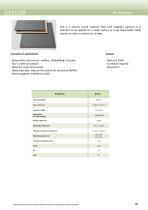
This is a silicone based material filled with magnetic particles. It is intended to be applied on a metal surface or caulk dispensable inside cavities in order to reduce the Q index. - Automobile, Aeronautics, military, shipbuilding, telecoms - Rx/ Tx antenna isolation - Resonant cavity attenuation - Reversing radar, Stop and Go and driver assistance (ADAS) - Electromagnetic interference EMI - Adhesive (PSA) - Cutting to required dimensions Cavity resonance Frequency range Attenuation (% of lost energy) Hardness (shore A) Operating temperature Thickness according to frequency Plate dimensions...
Open the catalog to page 4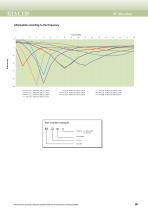
HF Absorber Attenuation according to the frequency Part number example: AH x Adhesive : 0 = without PSA 1 = with PSA Part number Serial no. Absorber These tests were carried out in laboratory conditions which are not representative of working conditions.
Open the catalog to page 5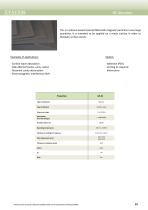
This is a silicone based material filled with magnetic particles in very large quantities. It is intended to be applied on a metal surface in order to dissipate surface waves. - Surface wave absorption - Side effects (frames, units, racks) - Resonant cavity attenuation - Electromagnetic Interference EMI - Adhesive (PSA) - Cutting to required dimensions Surface wave Frequency range Attenuation (% of lost energy) Hardness (shore A) Operating temperature Thickness according to frequency Plate dimensions (mm) These tests were carried out in laboratory conditions which are not representative of working...
Open the catalog to page 6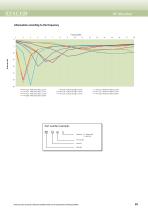
HF Absorber Attenuation according to the frequency Part number example: AH x Adhesive : 0 = without PSA 1 = with PSA Part number Serial no Absorber These tests were carried out in laboratory conditions which are not representative of working conditions.
Open the catalog to page 7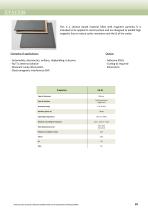
This is a silicone based material filled with magnetic particles. It is intended to be applied to metal surface and are designed to exhibit high magnetic loss to reduce cavity resonance and the Q of the cavity. - Automobile, Aeronautics, military, shipbuilding, telecoms - Rx/ Tx antenna isolation - Resonant cavity attenuation - Electromagnetic interference EMI - Adhesive (PSA) - Cutting to required dimensions Cavity resonance (High Loss) Frequency range Hardness (shore A) Operating temperature Thickness according to frequency Plate dimensions (mm) These tests were carried out in laboratory conditions...
Open the catalog to page 8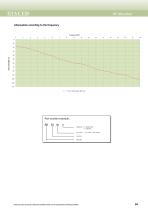
HF Absorber Attenuation according to the frequency Part number example: AH x Adhesive : 0 = without PSA 1 = with PSA 01 = 1mm These tests were carried out in laboratory conditions which are not representative of working conditions.
Open the catalog to page 9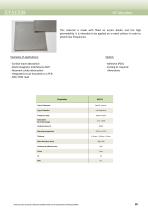
This material is made with filled an acrylic binder and has high permeability. It is intended to be applied on a metal surface in order to absorb low frequencies. - Surface wave absorption - Electromagnetic Interference EMI - Resonant cavity attenuation - Integrated circuit mounted on a PCB - NFC/ RFID read - Adhesive (PSA) - Cutting to required dimensions Specific mixture Frequency range Attenuation (% of lost energy) Hardness (shore A) Operating temperature Thickness Plate dimensions (mm) These tests were carried out in laboratory conditions which are not representative of working conditions....
Open the catalog to page 10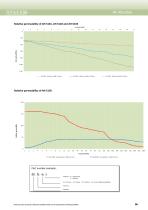
HF Absorber Relative permeability of AH-5101, AH-5102 and AH-5103 Part number example: AH 51 xx x Adhesive : 0 = without PSA 1 = with PSA 01 = 0,15mm These tests were carried out in laboratory conditions which are not representative of working conditions.
Open the catalog to page 11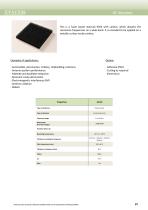
This is a foam based material filled with carbon, which absorbs the resonance frequencies on a wide band. It is intended to be applied on a metallic surface inside cavities. - Automobile, Aeronautics, military, shipbuilding, telecoms - Antenna pattern performance - Sidelobe and backlobe eeduction - Resonant cavity attenuation - Electromagnetic interference EMI - Antenna isolation - Radom - Adhesive (PSA) - Cutting to required dimensions Carbon Foam Cavity resonance Frequency range Attenuation (% of lost energy) Hardness (shore A) Operating temperature Thickness according to frequency Plate dimensions...
Open the catalog to page 12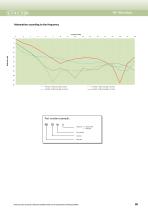
HF Absorber Attenuation according to the frequency Part number example: AH x Adhesive : 0 = without PSA 1 = with PSA Part number Serial no Absorber These tests were carried out in laboratory conditions which are not representative of working conditions.
Open the catalog to page 13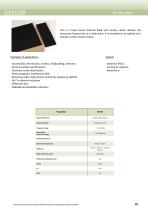
This is a foam based material filled with carbon, which absorbs the resonance frequencies on a wide band. It is intended to be applied on a metallic surface inside cavities. - Automobile, Aeronautics, military, shipbuilding, telecoms - Antenna pattern performance - Resonant cavity attenuation - Electromagnetic interference EMI - Reversing radar, Stop and Go and driver assistance (ADAS) - Rx/ Tx antenna reduction - Reflection loss - Sidelobe and backlobe reduction - Adhesive (PSA) - Cutting to required dimensions Carbon Foam (Lossy) Cavity resonance Frequency range Attenuation (% of lost energy)...
Open the catalog to page 14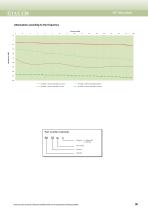
HF Absorber Attenuation according to the frequency Part number example: AH x Adhesive : 0 = without PSA 1 = with PSA Part number Serial no Absorber These tests were carried out in laboratory conditions which are not representative of working conditions.
Open the catalog to page 15All STACEM catalogs and technical brochures
 Conductive foam
2 Pages
 Fabric Over foam
10 Pages
 O-ring
32 Pages
 V-rings
5 Pages
 Quad rings
13 Pages
 Back-up rings
8 Pages
 Bonded seals
5 Pages
 Aseptic-seals
3 Pages
 Cut Seals
3 Pages
 Mousse Silicone COHRlastic
16 Pages
 Thermal Interface
12 Pages
 Thermal PAD
27 Pages
 Knitted wire
6 Pages
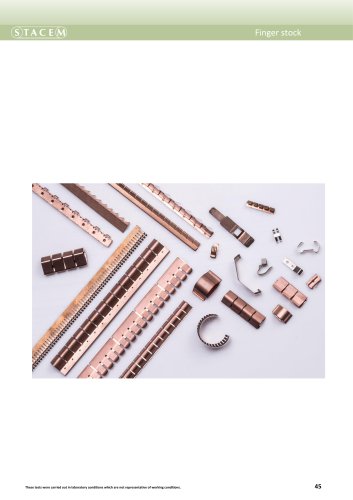 Finger stock
12 Pages
 Filled elastomers
26 Pages
Archived catalogs
 Shielding covers
3 Pages