- Catalogs
- ST Engineering iDirect
- GROUP QOS TECHNOLOGY BRIEF


GROUP QOS TECHNOLOGY BRIEF
GROUP QOS TECHNOLOGY BRIEF
ST Engineering iDirect's advanced Group Quality of Service (GQoS) technology enhances network operators' ability to manage bandwidth effectively in shared network environments. It offers increased flexibility in traffic configuration and prioritization, leading to cost savings and improved customer service quality.
- Bandwidth Partitioning: Allows partitioning of both outbound and in-route group bandwidth, enabling operators to segregate bandwidth by groups of remotes and applications.
- User Profile Management: Supports diverse user profiles and traffic requirements, allowing operators to apply predefined profiles to new customers and network configurations, saving setup time and facilitating future upgrades.
- Configuration Support: Includes configuring Bandwidth Groups, Service Groups, Applications, Default Profile, Additional Profiles, Remotes Configuration, and managing Group Profiles.
- Traffic Management Flexibility: Offers limitless possibilities for quality of service levels and traffic prioritization, allowing differentiation by groups of remotes, applications, and VLANs.
- Cost Savings: Enables grouping of diverse user profiles into the same bandwidth pool, reducing space segment costs.
- Ease of Use: Configuration profiles are easy to replicate, facilitating reconfiguration on a large network scale.
- Traffic Differentiation: Can be done by groups of remotes, applications, VLANs, or all simultaneously.
- Hierarchical Bandwidth Methodology: Each bandwidth, service, and application group can be configured by priority, cost, Committed Information Rate (CIR), and Maximum Information Rate (MIR).
Group QoS technology provides significant enhancements in bandwidth management and traffic prioritization, offering network operators the tools to meet complex traffic management requirements in mixed media environments.
Catalog excerpts
GROUP QOS TECHNOLOGY BRIEF ST Engineering iDirect’s advanced Group Quality of Service (GQoS) significantly increases network operator bandwidth management capabilities when prioritizing traffic for customers in a shared network environment. The results are more flexibility with traffic configuration and prioritization, more savings over conventional QoS, and improved customer service quality. Network operators face increasingly difficult requirements when it comes to traffic management in a mixed media environment that may include voice, video, and data. Group QoS provides a comprehensive set of powerful, state of the art features that bring robust dimensions and options for traffic prioritization and bandwidth management that spans across multiple applications, multiple remotes, even multiple sub-networks. The customer’s experience and quality are improved — and determining the right tiered service levels across the pool of end customers and their applications is easier. Key Highlights Allows partitioning of both outbound and in-route group bandwidth Operators can segregate bandwidth by groups of remotes and by applications Support different end customers with diverse user profiles, whether multiple applications and traffic requirements or different sub-segments Apply once-defined user profiles to new customers and network configurations, saving set-up time and future upgrades Supports configuring Bandwidth Groups, Service Groups, Applications, Default Profile, Additional Profiles, Remotes Configuration, Managing Group Profiles, and configuration following upgrade to Group QoS VELOCITY EVOLUT
Open the catalog to page 1
Group QoS delivers greater traffic management flexibility. There are limitless possibilities for quality of service levels and traffic prioritization. Traffic can be differentiated by group of remotes, applications, VLANS, or all of these simultaneously, enabling a network operator to define configuration profiles by service and application groups based on priority, cost, Commited Information Rate (CIR) and Maximum Information Rate (MIR). Customers with diverse user profiles can be grouped into the same bandwidth pool, providing substantial savings in terms of space segment costs. These configuration...
Open the catalog to page 2All ST Engineering iDirect catalogs and technical brochures
 iVantage
4 Pages
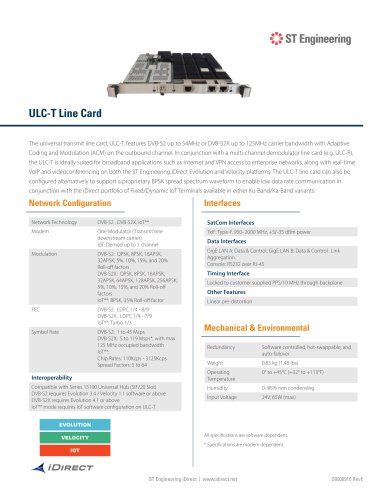 ULC-T Line Card
1 Page
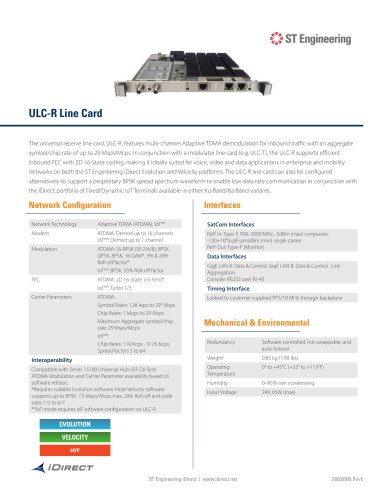 ULC-R Line Card
1 Page
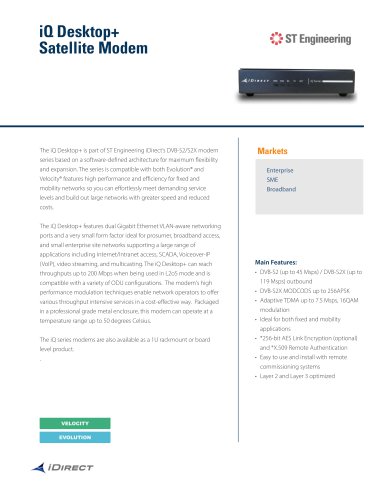 iQ Desktop+ Satellite Modem
2 Pages
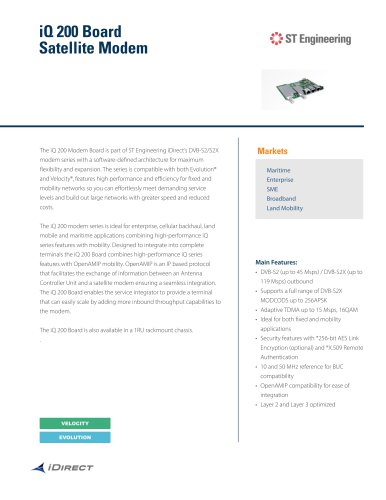 iQ 200 Board Satellite Modem
2 Pages
 EVOLUTION®
7 Pages
 iDirect Hub Infrastructure
3 Pages
 DIALOG
27 Pages
 OD6000
6 Pages