
- Catalogs
- SPX Transformer Solutions
- 2nd Generation Nitrogen Generator

2nd Generation Nitrogen Generator

2nd Generation Nitrogen Generator
The 2nd Generation Nitrogen Generator is designed for electrical devices needing a gas-blanketed enclosure. It separates oxygen from compressed air using hollow fiberglass membranes, producing nitrogen stored in internal vessels. The system maintains tank pressure between 0.5 and 5.0 psi, with a relief valve for excess pressure. Only trained technicians should adjust the output concentration.
Compressed air enters the hollow fiber membrane, where gases diffuse at different rates. Oxygen and water vapor diffuse quickly, while nitrogen diffuses slowly, ensuring high nitrogen purity. The membrane's capacity depends on flow rate, temperature, and pressure.
Proper use is crucial for safety and functionality. The unit should not be used beyond specified limits. Key safety guidelines include disconnecting power before maintenance, avoiding loose clothing near fans, and ensuring adequate ventilation to prevent suffocation or fire risks.
The system delivers nitrogen at 125 psi with 99.5% purity. It operates within a temperature range of -40° to +40°C and is designed for outdoor, wall-mounted installation. The unit should not exceed a continuous flow rate of 1 l/m to avoid damage.
The unit must be mounted upright and above grade level, using a crane for installation. Proper ventilation is required, and the unit should be plumbed to the transformer using appropriate tubing.
For multiple transformers, ensure total usage does not exceed 1 slpm. Each transformer requires a nitrogen pressure regulation system, one-way valves, isolation valves, and pressure/vacuum protection devices.
If the fan or heater is not operating, ensure the correct voltage input to the PTC2 assembly, inspect the wiring harness for damage, and check for debris in the fan assembly. The manual cautions against using the generator for oil volumes exceeding 30,000 gallons without consulting the manufacturer.
The manual emphasizes the importance of proper grounding to prevent electrical shock. It provides step-by-step instructions for connecting electrical components, including sealing conduit entries and connecting alarm systems, which are recommended but not required for operation.
Figures in the manual illustrate the components of the nitrogen system, including the nitrogen regulator module, climate control interface, and various filters and valves. The system includes a nitrogen storage tank, air compressor, and climate control modules.
The system must be installed vertically for 12 hours before activation. The climate control system should be energized for 8 hours to ensure optimal nitrogen purity. Detailed steps are provided for setting pressure contacts and verifying system operations, including checks for leaks and proper pressure settings.
Specific instructions are provided for systems with bottle back-up, including installation of nitrogen bottles, pressure checks, and validation of the bottle bypass system.
The climate control system operates continuously to monitor and adjust the enclosure's temperature. The system includes a cooling cycle activated at 80°F and a heating cycle at 63°F, with a programmed temperature differential to prevent simultaneous heating and cooling.
- Cooling system activates at 80°F.
- Heating system activates at 63°F.
- High temperature alarm at 105°F, low at 40°F.
- Audible and visual alarms are enabled.
- Temperature displayed in Fahrenheit.
- Filter maintenance alarm is disabled by default.
- To change settings, use a sequence of button presses: Adjust-up, Adjust-down, Select, Exit.
- Temperature settings can be adjusted within specified ranges.
- Alarm settings should be reviewed if temperature set points are changed.
- Alarms can be toggled on or off, and the system can switch between Fahrenheit and Celsius.
- A user PIN code can be set for security.
- Low and high gas space pressure alarms with specific terminal conditions and electrical ratings.
- Generator temperature alarms activate if internal air space exceeds 105°F or drops below 40°F.
- Generator shutdown alarm for bottle back-up systems.
- Disconnect main power for maintenance.
- Compressor decompresses automatically.
- Storage tank maintains pressure unless manually drained.
- Carbon filter and air compressor inlet filter should be replaced bi-annually or every 400 hours.
- Oil sump should be cleaned bi-annually.
- Coalescing and particle filter assemblies require replacement bi-annually.
- Climate control filter replacement depends on environmental conditions.
- Storage tank pressure switch settings are factory set and should not be altered without expertise.
- Climate Control Issues: If the climate control is not functioning properly, it should be checked, and SPX Waukesha should be contacted.
- Low Membrane or Delivery Pressure: Possible causes include contaminated inlet filters, leaks in hoses or connections, excessive consumption, mis-adjusted pressure switch, or dirty coalescing filters. Solutions involve replacing filters, sealing leaks, adjusting the pressure switch, and contacting SPX Waukesha for application confirmation.
- Desired Nitrogen Flow Not Achieved: Causes may include a leaking one-way valve, hose leaks, or non-functioning climate control. Solutions involve replacing the valve, sealing leaks, and contacting SPX Waukesha.
- The N2 Generator supplies a maximum of one liter/minute of nitrogen and operates in ambient temperatures up to 104°F.
- A conservator circuit protects the system by monitoring compressor run time and cabinet temperature, shutting down the compressor if limits are exceeded.
- If the compressor runs for more than six minutes, it enters a 15-minute cool-down period. Excessive gas usage typically indicates a leak.
- The compressor shuts down if cabinet temperature exceeds 105°F and will restart once it falls below 95°F. High ambient temperature alarms indicate potential AC cooling unit faults.
- Regularly check and replace AC filters to ensure proper cooling.
- Contact the factory for replacement parts and service at 800-338-5526 or visit www.waukeshacomponents.com.
Catalog excerpts
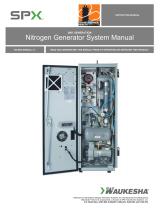
INSTRUCTION MANUAL Nitrogen Generator System Manual N2-GEN-MANUAL 3.7 READ AND UNDERSTAND THIS MANUAL PRIOR TO OPERATING OR SERVICING THIS PRODUCT. Patented 2nd Generation Nitrogen Generator Systems are manufactured and distributed by Waukesha® Service & Components, a division of SPX Transformer Solutions, Inc. U.S. Patent Nos. 6,581,694; 6,568,287; 6,062,821; 5,902,381 and 5,744,764.
Open the catalog to page 1
2nd GENERATION NITROGEN GENERATOR SYSTEM MANUAL General Description & Principle of Operation Page 2 Nitrogen Membrane Principle of Operation Page 3 Safety Information Page 4 Single Transformer Installation Page 6 Multiple Transformer Installation Pages 7-8 Electrical Connections Page 9 General Component Identification Pages 10-11 Start-up I nstructions Pages 12-14 Climate Control Description & Operation Pages 15-17 System Alarms Page 18 System Shut Down Procedure Page 19 Periodic Maintenance Pages 20-21 Compressor Conservator Circuit Page 23 Patented 2nd Generation Nitrogen Generator Systems...
Open the catalog to page 2
2nd GENERATION NITROGEN GENERATOR SYSTEM MANUAL GENERAL DESCRIPTION The N2 Nitrogen Generator is designed for use on tap changers, breakers, main tanks or any other electrical device requiring a gas-blanketed enclosure. The unit produces nitrogen by separating oxygen from compressed air by means of hollow fiberglass separation membranes. The compressed air is supplied by an on-board compressor and the generated nitrogen (N2) is fed to internal storage vessels. The output concentration of the air separator (nitrogen purity) is factory pre-set. The final regulator system maintains the gas-blanketed...
Open the catalog to page 3
2nd GENERATION NITROGEN GENERATOR SYSTEM MANUAL NITROGEN MEMBRANE PRINCIPLE OF OPERATION Refer to Figure 2 below. Compressed air flows into the hollow fiber membrane. Various air components, such as oxygen, nitrogen, carbon dioxide and water vapor pass through the membrane wall, but the rate at which this occurs differs for the various gases. Oxygen and water vapor have a high diffusion rate and diffuse rapidly through the membrane wall. Nitrogen has a low diffusion rate and penetrates the membrane wall slowly, mainly at the end of the hollow fibers. The purity of the nitrogen at the end of the...
Open the catalog to page 4
2nd GENERATION NITROGEN GENERATOR SYSTEM MANUAL SAFETY INFORMATION Proper use of this equipment is important for your personal safety and for trouble-free functioning of the unit. Incorrect control or attempts to perform adjustments could cause damage or lead to incorrect gas supply. Be sure to read and understand all instructions before attempting to operate the unit. The unit is designed to produce nitrogen. The nitrogen is supplied by an internal generator that produces nitrogen from ambient air through a process of separating oxygen from normal air. You must not use the unit for any other...
Open the catalog to page 5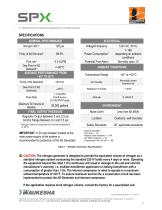
2nd GENERATION NITROGEN GENERATOR SYSTEM MANUAL SPECIFICATIONS NOMINAL PERFORMANCE Power Consumption* Flow rate* Dew Point of N2 Delivered* Potential Free Alarm AVERAGE PERFORMANCE FROM –40° TO 50°C 120V AC, 60 Hz 1–19A depending on ambient conditions Normally open,1A AMBIENT CONDITIONS Temperature Range Normally clean ambient air Relative Humidity Flow Rate 1.0 SLPM Continuous 5.0 SLPM Purge Maximum Oil Volume to Blanket FINAL OUTPUT PRESSURE Regulator Output Between 0 and 2.0 psi Control Range Between 0.2 and 5.5 psi Noise Level Outdoors, wall mounted * Nitrogen Delivery properties at nominal...
Open the catalog to page 6
2nd GENERATION NITROGEN GENERATOR SYSTEM MANUAL INSTALLATION – SINGLE TRANSFORMER CAUTION: The unit must be mounted in an upright position. Do not mount unit on its side or back. The unit MUST be vertical for 12 hours before turning the unit on. WARNING: A crane, or similar lifting device, is required to lift and secure unit to wall mounting surface. CAUTION: Do not block the ventilation inlets and outlets as this could cause overheating and damage to the unit. WARNING: Support structure and mounting hardware must be capable of supporting the generator weight of 380 lbs. minimum. Cabinet is designed...
Open the catalog to page 7
2nd GENERATION NITROGEN GENERATOR SYSTEM MANUAL INSTALLATION - MULTIPLE TRANSFORMERS A CAUTION: The unit must be mounted in an upright position. Do not mount unit on its side or back. The unit MUST be vertical for 12 hours before turning the unit on. A WARNING: A crane or similar lifting device is required to lift and secure unit to wall mounting surface. A CAUTION: Do not block the ventilation inlets and outlets as this could cause overheating A WARNING: Support structure and mounting hardware must be capable of supporting the generator weight of 380 lbs. minimum. Cabinet is designed to be mounted...
Open the catalog to page 8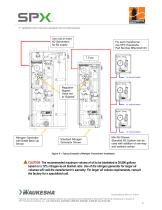
2nd GENERATION NITROGEN GENERATOR SYSTEM MANUAL Use one or more N2 Generators for N2 supply For each transformer, use SPX Waukesha Part Number MN2-0A0133 7.5 psi Regulator Bypass Valve set to “Bypass” TO TRANSFORMER THE FAN OR HEATER IS NOT OPERATING Confirm that the voltage input to the PTC2 assembly is the correct voltage. Check heater assembly terminals at the power harness quick-connect plug. Check wiring harness for cuts or bare insulation. Confirm fan assembly has not been clogged with debris—clean if necessary. Nitrogen Generator with Bottle Back-Up Shown Mini N2 Shown. Standard N2 System...
Open the catalog to page 9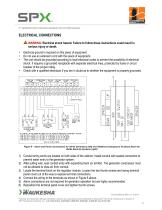
2ND GENERATION NITROGEN GENERATOR SYSTEM MANUAL ELECTRICAL CONNECTIONS A WARNING: Electrical shock hazard. Failure to follow these instructions could result in serious injury or death. ■ Electrical ground is required on this piece of equipment. Do not use an extension cord with this piece of equipment. ■ The unit should be grounded according to local electrical codes to prevent the possibility of electrical shock. It requires a grounded receptacle with separate electrical lines, protected by fuses or circuit breaker of the proper rating. ■ Check with a qualified electrician if you are in doubt...
Open the catalog to page 10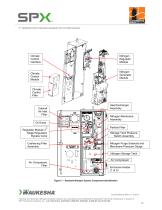
2nd GENERATION NITROGEN GENERATOR SYSTEM MANUAL Climate Control Interface Nitrogen Regulator Module Nitrogen Generator Module Climate Control Module Climate Control Filter Heat Exchanger Assembly Cabinet Air Inlet Filter Nitrogen Membrane Assembly Particle Filter Regulator Module 3 Stage Regulation Bypass Valve Storage Tank Pressure Switch Assembly Coalescing Filter Assembly Nitrogen Purge Solenoid and Membrane Pressure Gauge Nitrogen Storage Tank Air Compressor Figure 7 – Standard Nitrogen System Component Identification Patented 2nd Generation Nitrogen Generator Systems are manufactured and...
Open the catalog to page 11All SPX Transformer Solutions catalogs and technical brochures
 Mini Inert Air Systems
2 Pages
 PTC2
PTC22 Pages
 Large Power Transformers
6 Pages
 Waukesha® UZDvac
2 Pages
 Waukesha® UZD® Brochure
2 Pages


- Computer-aided design software
- 3D software solution
- Power transformer
- Electrical cabinet
- 2D software
- Distribution transformer
- Floor-mounted electrical cabinet
- Immersed transformer
- Process nitrogen generator
- Pure nitrogen generator
- Control electrical cabinet
- Power inductor
- Auto-transformer
- PCB transformer
- Electric cabinet with post
- Power auto-transformer
- Quick-connect transformer
- Three-phase auto-transformer