
- Catalogs
- Spraying Systems Co.
- PWM Flow Control


- Products
- Catalogs
- News & Trends
- Exhibitions
PWM Flow Control

PWM Flow Control
- Flexibility: A single nozzle can achieve a wide range of flow rates.
- Immediate Flow Adjustments: AutoJet® spray controllers enable almost instantaneous response times with electrically-actuated PulsaJet® spray nozzles.
- Reduced Clogging: Large spray orifices maintain low flows, improving reliability and reducing maintenance.
- Reduced Misting: Operating at low pressures with larger orifices reduces misting and enhances transfer efficiency and safety.
- Uniform Coating/Improved Quality: Constant pressure operation ensures even coating by preventing variations in spray angle and drop size.
- Pulse Width Modulation (PWM): Allows flow rate control without changing spray pressure.
- Applications: Includes coating silicone on paper, moisturizing cardboard, spraying textiles, metal lubrication, mold release, and more.
- Spray Nozzles: Electrically-actuated PulsaJet® nozzles can achieve speeds up to 10,000 cycles per minute, offering accurate spray placement and pattern integrity.
- Spray Knowledge: Effective PWM flow control requires understanding liquid flow and spray nozzle operation.
- Spray Controller and Software: AutoJet® Technologies provides manual or automated PWM flow control options, with advanced versions offering automation and spray detection/verification.
- A Guide to Pulse Width Modulated Flow Control Technical Manual 414
- PWM Flow Control Center at www.spray.com/pwm
- PulsaJet® Automatic Spray Nozzles Bulletin 603
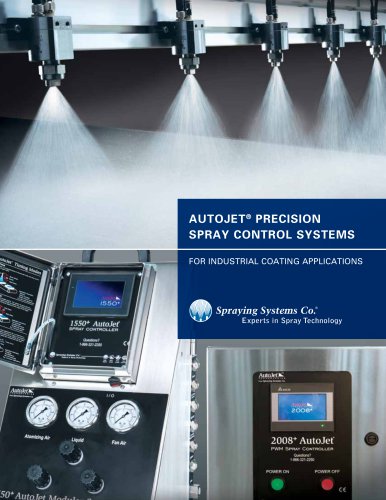
- AutoJet® PWM Spray Control Panel Bulletin AT162B
- PulsaJet Control Panel Bulletin AT164B
Catalog excerpts

Expe r t s i n S p ra y Tec h nolo g y 1.800.95.SPRAY | Intl. 1.630.665.5000 | www.spray.com Benefits • Flexibility: Achieve a wide range of flow rates with a single nozzle • Immediate flow adjustments: Using AutoJet® spray controllers, response time of electrically-actuated PulsaJet® spray nozzles is almost instantaneous • Reduced clogging: Maintain low flows even with large spray orifices for improved reliability and reduced maintenance • Reduced misting: Low flow operation using larger orifices at low pressures reduces the misting common at higher pressures and improves transfer efficiency and safety • Uniform coating/improved quality: Constant pressure operation prevents variations in spray angle and drop size for more even coating over a wide range of flow rates PWM Flow Control Pulse Width Modulation (PWM) Enables Flow Rate Control Without Changing Spray Pressure Examples of PWM Flow Control Applications • Applying a uniform coating of silicone across a web of paper machine clothing • Moisturizing cardboard to prevent warping • Spraying coatings on textiles and nonwoven products • Metal strip lube • Punch press lubrication • Spraying oil to improve mold release • Coating drum screen with release agent during OSB manufacturing • Humidifying particle board • Adding perfume to powdered soap • Spraying protective coatings on glass and glass bottles
Open the catalog to page 1
What You Need for PWM Flow Control Experts in Spray Techn olog y Spray Nozzles Spray Control Spray Analysis Spray Fabrication Bulletin No. 619 Printed in the U.S.A. ©Spraying Systems Co. 2007 P.O. Box 7900, Wheaton, IL 60189-7900 USA Tel: 1.800.95.SPRAY Intl. Tel: 1.630.665.5000 Fax: 1.888.95.SPRAY Intl. Fax: 1.630.260.0842 www.spray.com A fast spray nozzle Electrically-actuated PulsaJet® nozzles achieve speeds up to 10,000 cycles per minute and are ideal for PWM flow control. PulsaJet nozzles also offer accurate spray placement, excellent spray pattern integrity and a choice of hydraulic or...
Open the catalog to page 2All Spraying Systems Co. catalogs and technical brochures
 G U N J E T® S P R AY G U N S
64 Pages
 WindJet Air Products
28 Pages
 Air Atomizing Nozzles
62 Pages
 Fine Spray Nozzles
16 Pages
 Hollow Cone Nozzles
42 Pages
 Flat Spray Nozzles
56 Pages
 Full Cone Nozzles
52 Pages
 PWM Spray Control Panel
2 Pages
 Optimizing Your Spray System
47 Pages


Archived catalogs
 AutoJet Gas Cooling System
4 Pages
 CU150A GunJet Spray Gun
2 Pages


