
- Catalogs
- Spraying Systems Co.
- Optimizing Your Spray System


- Products
- Catalogs
- News & Trends
- Exhibitions
Optimizing Your Spray System

Optimizing Your Spray System
This handbook provides guidance on optimizing spray systems, leveraging over 60 years of experience across 200 industries. It focuses on maximizing performance through maintenance and control.
What is Spray System Optimization?
Spray systems are complex, requiring evaluation, monitoring, and maintenance for optimal performance. An optimization program is crucial to prevent issues like quality control problems and environmental impacts.
Benefits of Optimization
Optimizing spray systems enhances efficiency, reduces costs, ensures consistent quality, and minimizes environmental impact. The process involves evaluating the current system, setting performance standards, and implementing necessary modifications.
Section I: The Value of Spray System Optimization
This section covers assessing system effectiveness and the costs of inefficiencies, highlighting common applications and problems, and providing a cost calculator for potential savings.
Section II: Setting Optimization Strategies
Defines performance standards and strategies to achieve optimization goals, emphasizing the importance of identifying critical requirements for specific applications.
Section III: Detecting Spray Nozzle Problems
Identifies symptoms and causes of nozzle problems, such as wear and clogging, affecting system performance.
Section IV: Solving Spray Nozzle Problems
Offers a maintenance checklist and guidelines for nozzle replacement and extending nozzle life, along with solutions to common problems.
Section V: Automating Your Spray System
Explores the benefits of automation, including improved productivity and performance management through dedicated controllers.
Section VI: Preventing Spray System Problems
Focuses on avoiding potential issues and ensuring optimal performance through proactive measures.
Conclusion
A well-executed Spray System Optimization Program can quickly pay for itself by reducing waste and improving efficiency.
Establishing measurable performance standards involves considering factors like product quality, throughput, and maintenance time. Consulting experts and specialized testing may be required. Key performance factors include spray patterns, atomization, and product coverage.
Optimization Strategies
Advanced spray analysis requires state-of-the-art equipment and knowledgeable staff. Real-time monitoring, minimizing overspray, and ensuring chemical resistance are crucial. Automation can enhance performance and reduce costs.
Detecting Spray Nozzle Problems
Common symptoms include changes in flow rate and spray pattern quality. Specialized testing is recommended as visual inspections may not reveal all problems.
Solving Spray Nozzle Problems
Understanding nozzle characteristics is essential. Regular maintenance and timely replacement are crucial for optimal performance. Solutions include proper cleaning and using appropriate materials.
Conclusion
Optimizing spray systems involves understanding application requirements, detecting and solving nozzle problems, and considering automation. Regular maintenance and expert consultation can enhance performance.
- Fine Drop Formation: Used for finely atomized sprays in applications like humidification and cooling.
- Solid Stream Nozzles: Provide high impact for cleaning and cooling applications.
- Atomizing Nozzles: Produce finely atomized sprays for cooling and drying applications.
Spray Nozzle Maintenance and Optimization
- Maintenance Program: Includes routine checks and documentation to establish performance baselines.
- Maintenance Checklist: Monitor flow rate, spray pressure, and pattern.
- Nozzle Replacement: Criteria include cost considerations and quality deterioration.
- Extending Nozzle Life: Options include changing materials and improving cleaning procedures.
Solutions to Common Spray Nozzle Problems
- Uneven Coating: Use adjustable fittings for precise control.
- Plugged Nozzles: Quick-connect nozzles reduce downtime.
- Dust Build-up: Use hollow cone nozzles for dust suppression.
- Soiled Tanks: Increase pressure or upgrade nozzles for better cleaning.
Automating Spray Systems
- Benefits of Automation: Improves productivity and reduces maintenance costs.
- Considerations for Automation: Factors include coverage and environmental conditions.
- Components of Automated Systems: Include headers, sensors, and valves for precise control.
Automated systems offer precise control, enhancing productivity and efficiency. They range from basic setups to fully automated systems with real-time adjustments. Key components include spray controllers and software.
Key Features of Spray Controllers
Controllers monitor and adjust performance, managing conditions like pressure and flow rates. Alarms prompt intervention if performance deviates.
Case Studies of Automated Solutions
- Meat Processing: Automated dosing of antimicrobial agents improves safety and reduces costs.
- Particleboard Manufacturing: Applies release agents to enhance throughput and quality.
- Mining Operations: Gas cooling systems manage exhaust temperatures efficiently.
- Tissue Manufacturing: Ensures precise adhesive application, reducing costs.
Preventing Spray System Problems
Most issues are preventable with an optimization program, which involves assessing performance and considering upgrades.
Steps for Spray System Optimization
Conduct an audit and develop a maintenance plan. Expert assistance can streamline the process, leading to substantial cost savings.
Conclusion
Optimizing spray systems leads to savings and improved performance by reducing waste and downtime.
Catalog excerpts

Optimizing Your Spray System Spray nozzle maintenance and control for improved production efficiency Spray Nozzles Spray Control Spray Analysis Spray Fabrication
Open the catalog to page 1
3 This handbook is a compilation of the knowledge we’ve acquired through more than 60 years of helping users solve spray application problems. Our experience reaches into more than 200 different industries and has led us to develop tens of thousands of spray nozzles and accessories, a turnkey systems division, spray research and analysis services and custom fabrication facilities. We have manufacturing locations around the world and we work with hundreds of thousands of customers. The intent of this handbook is educational. Our goal is to help you maximize the performance of your spray system...
Open the catalog to page 2
4 What is Spray System Optimization? Spray systems are often perceived as pretty simple. After all, what’s so complicated about pumps, piping, liquid and spray nozzles? As long as the nozzles are spraying, the system is working properly, right? Wrong! Spray nozzles are precision components designed to yield very specific performance under very specific conditions. Just because a nozzle is spraying doesn’t mean that it is working properly. And it certainly doesn’t mean that your spray system performance is optimal. Many other factors can impact your spraying system. To achieve long-term, efficient,...
Open the catalog to page 3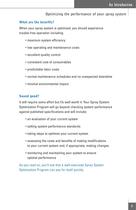
5 An I n t r o d u c t i o n What are the benefits? When your spray system is optimized, you should experience trouble-free operation including: • maximum system efficiency • low operating and maintenance costs • excellent quality control • consistent cost of consumables • predictable labor costs • normal maintenance schedules and no unexpected downtime • minimal environmental impact Sound good? It will require some effort but it’s well worth it. Your Spray System Optimization Program will go beyond checking system performance against published specifications and will include: • an evaluation...
Open the catalog to page 4
8 Many spray systems today are manual systems. However, automated systems — with a controller that “manages” performance — are gaining popularity quickly. Whether you have a manual or an automated system, there are two main considerations when evaluating your spray system. 1. How is your system performing today? Could you improve performance by making some minor modifications or changing your maintenance procedures? 2. Could performance be further enhanced if you automated your system or upgraded your existing control device? A Spray System Optimization Program begins with an assessment of your...
Open the catalog to page 7
9 Assessing the effectiveness of your spray system The Va l u e o f Spray O p t i m i z a t i o n In general, a good place to start is to review your costs for water, chemicals and electricity. If your present system isn’t performing properly, you could experience significant waste and increased costs. The charts on pages 10 and 11 will give you a feel for how much this waste could be costing. As you think about your application, keep the following factors in mind as well. They can have a significant impact on cost, too. • Labor: Are you spending a lot of time operating or monitoring your system?...
Open the catalog to page 8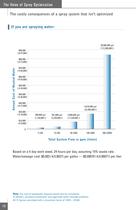
1 0 The costly consequences of a spray system that isn’t optimized The Va l u e o f Spray O p t i m i z a t i o n If you are spraying water: Based on a 5 day work week, 24 hours per day, assuming 15% waste rate. Water/sewage cost: $0.003 ( 0.0027) per gallon — $0.00079 ( 0.00071) per liter Note: The cost of wastewater disposal should also be considered. In addition, excessive wastewater may aggravate water shortage problems. All figures calculated with a conversion factor of 1USD = 0.90. $90,000 ( 81,000) $80,000 ( 72,000) $70,000 ( 63,000) $60,000 ( 54,000) $50,000 ( 45,000) $40,000 ( 36,000)...
Open the catalog to page 9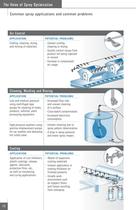
1 2 Common spray applications and common problems The Va l u e o f Spray O p t i m i z a t i o n A i r C o n t r o l C l e a n i n g , Wa s h i n g a n d R i n s i n g C o a t i n g application: Cooling, cleaning, drying and moving of materials. potential problems: – Uneven cooling, cleaning or drying. – Quality control issues from product not being rejected or moved. – Increase in compressed air usage. application: Low and medium pressure using centrifugal-type pumps for cleaning of tanks, products, vehicles, plant processing equipment. High-pressure washers using positive displacement pumps...
Open the catalog to page 11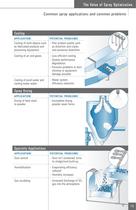
1 3 Common spray applications and common problems The Va l u e o f Spray O p t i m i z a t i o n Spray D r y i n g application: Cooling of solid objects such as fabricated products and processing equipment. Cooling of air and gases. Cooling of pond water and cooling tower water. potential problems: – Poor product quality such as distortion and cracks and excessive downtime. – Less efficient cooling. – System performance degradation. – Emission problems or duct, chimney or equipment damage possible. – Water system efficiency reduction. application: Drying of feed stock to powder. potential problems:...
Open the catalog to page 12
1 4 Calculating the potential cost in your application The Va l u e o f Spray O p t i m i z a t i o n The next step in the assessment of your present system is to obtain information specific to your application. One way to do this is to utilize our Spray System Savings Calculator. Available at www.spray.com/save, this tool will allow you to enter detailed information about your application and determine how much you may save by optimizing your spray system. The calculator prompts you for information about the cost of the liquid you are spraying, the number of nozzles you’re using, your flow rates,...
Open the catalog to page 13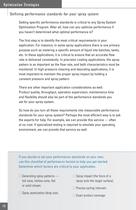
1 6 Setting specific performance standards is critical to any Spray System Optimization Program. After all, how can you optimize performance if you haven’t determined what optimal performance is? The first step is to identify the most critical requirements in your application. For instance, in some spray applications there is one primary purpose such as metering a specific amount of liquid into batches, tanks, etc. In these applications, it is critical to ensure that an accurate flow rate is delivered consistently. In precision coating applications, the spray pattern is as important as the flow...
Open the catalog to page 15All Spraying Systems Co. catalogs and technical brochures
 G U N J E T® S P R AY G U N S
64 Pages
 WindJet Air Products
28 Pages
 Air Atomizing Nozzles
62 Pages
 Fine Spray Nozzles
16 Pages
 Hollow Cone Nozzles
42 Pages
 Flat Spray Nozzles
56 Pages
 Full Cone Nozzles
52 Pages
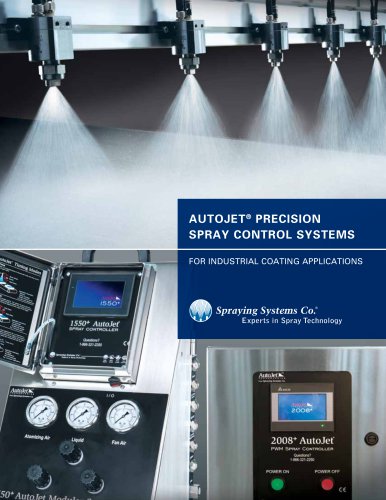
 PWM Spray Control Panel
2 Pages


Archived catalogs
 PWM Flow Control
2 Pages
 AutoJet Gas Cooling System
4 Pages
 CU150A GunJet Spray Gun
2 Pages


