


- Company
- Products
- Catalogs
- News & Trends
- Exhibitions
SpotBot™ Cellular

SpotBot™ Cellular
The case study focuses on an international automotive company facing supply chain damage issues with over 30 million car parts shipped daily. The company aimed to monitor individual units for damage notifications.
Challenge
The immediate challenge was the damage to sensitive instrument panels during transit, despite passing impact and vibration tests. The company needed a solution to identify and mitigate the cause of damage.
Solution
The company chose the SpotBot Cellular impact monitoring system for its real-time damage visualization, global connectivity, superior impact data, and battery life. This system helped identify the cause of damage, educate drivers, and reduce costs associated with unusable parts and downtime.
SpotBot Cellular Overview
- Impact Data: Monitors impacts up to 65G, suitable for products weighing 100-60,000 lbs, offering four times the range of competitors.
- Battery Life: Provides up to 75 days of monitoring with off-the-shelf lithium batteries, 50% longer than competitors.
- Settings & Download: Users can define impact settings and download detailed impact reports post-trip.
SpotSee Cloud
The SpotSee Cloud aggregates trip data in real-time, offering easy-to-read graphs and data on impact specifics, location, and temperature. Features include secure web access, real-time incident tracking, and comprehensive impact visualization.
Catalog excerpts

Instrument Panels and Bumpers Case Study: SpotBot™ Cellular Industry: Automotive Application: Instrument Panels and Bumpers Challenge: A major, international automotive company was experiencing a high rate of supply chain damage to the more than 30 million car parts in 7,000 containers that they ship on a daily basis. Long term, the company would like to monitor every individual unit within their supply chain network on a macrolevel and be notified when something is damaged. Short term, they needed to start on a micro-level. Instrument panels are a very sensitive car part and were falling off their racks while being shipped between manufacturing plants. The component racks which held the instrument panels during transit passed impact and vibration testing, but shipments were still arriving damaged. With no way to tell what was causing the issue, the automotive company had to get creative. Solution: After reviewing six monitoring solutions, the automotive company selected the SpotBot Cellular impact monitoring system for it’s real-time visualization of damaging events on the SpotSee Cloud, worldwide cellular connectivity, best in class impact data, and superior battery life. Using SpotBot Cellular, the automotive company was able to identify why the instrument panels were falling off the rack, educate drivers, and prevent the associated cost of unusable parts and downtime in the future. After improving the way they shipped instrument panels, the automotive company simply adjusted the impact threshold settings on their SpotBot Cellular and proceeded to monitor other damaged components within their supply chain
Open the catalog to page 1
Instrument Panels and Bumpers Case Study: SpotBot Cellular SpotBot™ Cellular Overview Best in Class Impact Data SpotBot Cellular generates accurate data on impacts up to 65G providing more than four times (4X) the range of the best competitive alternative (which captures impacts up to 16G). This range of impact monitoring is best suited for products between 100-60,000 lbs. Longest Battery Life With off-the-shelf lithium batteries, SpotBot Cellular delivers up to 75 days of monitoring (set to hourly summary reporting). This represents a battery life that is greater than 50% (1.5X) more than the...
Open the catalog to page 2All SpotSee catalogs and technical brochures
 HemoTemp® II Activator
11 Pages
 WarmMark Data Sheet
3 Pages
 ShockLog® 298 Overview
5 Pages


Archived catalogs
 TempU
TempU1 Page
 ShockWatch RFID Overview
2 Pages
 Forehead Thermometer
2 Pages
 Tilt Indicators
2 Pages
 ShockLog 248
2 Pages
 SpotSee® Tilt Indicators
2 Pages
 SpotBot 4G Plus Overview
3 Pages
 Blood Temp 10
1 Page
 SpotBot BLE
1 Page
 Temperature Recorders
2 Pages
 Cold Chain Indicators
2 Pages
 SpotBot Cellular
2 Pages
 Mag-2000
2 Pages
 ShockDot
2 Pages
 ShockLog Cellular
2 Pages
 ShockWatch Label
2 Pages
 ShockWatch Tube
2 Pages
 ShockWatch Flex
2 Pages
 OpsWatch Overview
3 Pages
 WarmMark Overview
2 Pages
 ColdMark
1 Page
 LOGIC Temperature Recorder
2 Pages
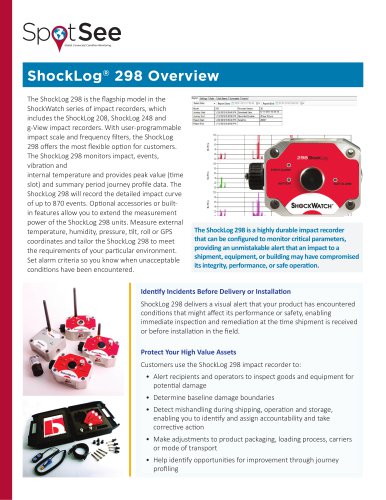 2018 ShockLog® 298 Overview
4 Pages
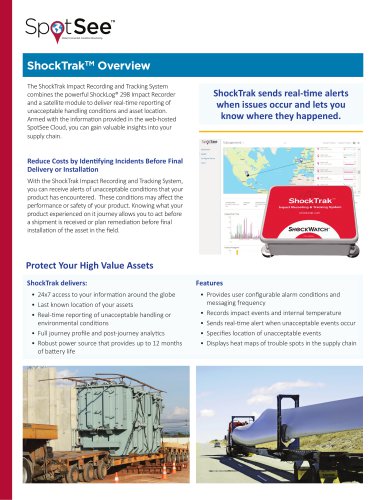 2018 ShockTrak™ Overview
2 Pages
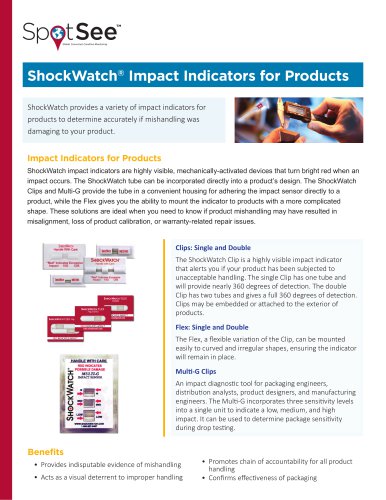 2018 ShockWatch Clip
2 Pages
 ShockDot Impact Indicator
2 Pages
 ShockWatch® MAG 2000
2 Pages
 ShockWatch® Flex
2 Pages
 OpsWatch
2 Pages
 ShockLog 208
2 Pages
 ShockWatch Labels
2 Pages
 Seafood Indicator
1 Page
 Impact Recorders
2 Pages
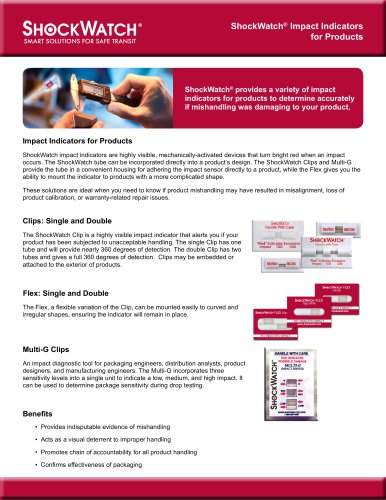 2016 ShockWatch Clip
2 Pages





- Temperature probe
- Data logger
- Resistance temperature sensor
- Temperature datalogger
- USB datalogger
- Data-logger with screen
- Stainless steel temperature transducer
- Wireless datalogger
- Datalogger without display
- Battery-powered datalogger
- Monitoring datalogger
- RTD temperature sensor
- Datalogger with LCD display
- Precision temperature transducer
- Analog indicator
- Programmable datalogger
- Polymer tag
- Compact logger
- Temperature indicator
- Ink