


Threaded Inserts for Plastics Design Guide
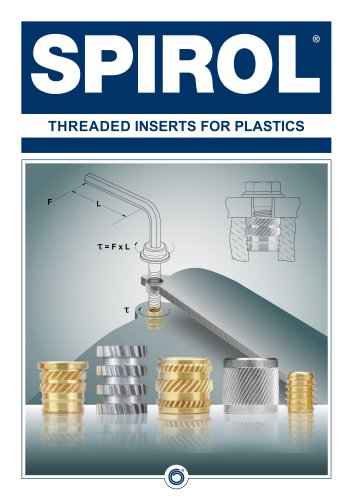
Threaded Inserts for Plastics Design Guide
Threaded inserts are essential in plastic applications for providing reusable threads and secure joints. They offer high load-carrying capability and resist stress relaxation, with brass and aluminum providing permanent creep resistance.
Correct torque application during assembly is crucial to prevent loosening, with the insert design accommodating appropriate installation torque.
Inserts maintain the integrity of threaded joints and enhance load-carrying ability due to their larger diameter compared to screws, increasing shear surface and pull-out resistance.
SPIROL offers engineering support and a range of products, certified under IATF 16949, ISO 9001, and ISO 14001, ensuring high-quality standards.
Design involves balancing torque resistance and pull-out values, with straight knurls preferred for torque resistance and helical knurls for axial pull-out resistance.
- Press-In Inserts: Cost-effective with moderate performance.
- Self-Tapping Inserts: Excellent pull-out resistance with minimal stress.
- Moulded-In Inserts: Best performance but higher cost.
Plastics are categorized into thermoset, thermoplastics, foam, and elastomers, with different insert types suitable for each.
Correct hole size and depth are critical, with moulded holes preferred. The plastic boss diameter should be two to three times the insert diameter.
The insert should carry the load, not the plastic. The clearance hole must be larger than the screw's outer diameter but smaller than the insert's pilot diameter.
Compression limiters maintain preload, and insert heads provide a larger bearing surface, facilitating plastic flow.
Post-mould inserts require larger boss diameters. Heat installation is versatile for thermoplastics, while ultrasonic installation is complex but suitable for amorphous polymers.
SPIROL offers a range of inserts and engineering support to reduce costs and rejects.
- Heat/Ultrasonic Inserts: For post-mould installation in thermoplastics.
- Self-Tapping Inserts: For soft, flexible thermoplastics.
- Press-In Inserts: For softer plastics.
- Moulded-In Inserts: For maximum performance.
Custom components are available if standard inserts do not meet requirements.
Heat installation requires careful temperature and pressure control.
The document provides guidance on insert installation methods, emphasizing proper installation for optimal performance.
Involves using SPIROL heat Insert drivers, with specific temperature and pressure settings.
Simple method using a hammer or arbor press, with pneumatic machines recommended for high-volume applications.
Complex method requiring expertise, suitable for thermoplastics.
Proper retention is verified by cross-sectioning an installed Insert.
Offers higher performance and is quieter and more economical than ultrasonic installation.
Necessary to prevent creep and stress relaxation in plastic components.
Outlines testing methods for tensile strength and rotational torque, emphasizing correct installation settings.
Technical specifications and recommendations for SPIROL's fastening solutions are provided.
Details tensile and torque performance of different insert types.
Highlights SPIROL Series 63 and 65 Moulded-In Inserts for exceeding recommended torque.
Testing inserts in specific applications is recommended to determine optimal installation criteria.
Lists contact details for SPIROL's technical centers worldwide.
SPIROL offers complimentary engineering support and encourages visiting their website for specifications.
Catalog excerpts
THREADED INSERTS FOR PLASTICS
Open the catalog to page 1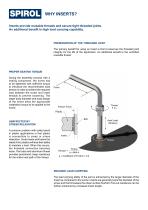
WHY INSERTS? Inserts provide reusable threads and secure tight threaded joints. An additional benefit is high load carrying capability. PRESERVATION OF THE THREADED JOINT The primary benefit for using an Insert is that it preserves the threaded joint integrity for the life of the application. An additional benefit is the unlimited reusable thread. PROPER SEATING TORQUE During the assembly process with a mating component, the screw has to be tightened with sufficient torque to introduce the recommended axial tension in order to achieve the required load between the screw and Insert threads to...
Open the catalog to page 2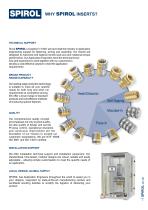
TECHNICAL SUPPORT Since SPIROL’s inception in 1948, we have lead the industry in application engineering support for fastening, joining and assembly. Our Inserts are designed to maximise and balance tensile (pull-out) and rotational torque performance. Our Application Engineers have the technical knowhow and experience to work together with our customers to develop a cost-effective solution to meet the application requirements. BROAD PRODUCT RANGE/CAPABILITY Our leading edge production technology is suitable to meet all your specific needs for both long and short run requirements at competitive...
Open the catalog to page 3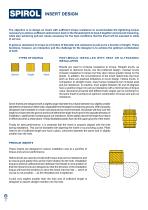
The objective is to design an Insert with sufficient torque resistance to accommodate the tightening torque necessary to achieve sufficient axial tension load on the threaded joint to keep it together and prevent loosening, while also achieving pull-out values necessary for the load conditions that the Insert will be exposed to while in service. In general, resistance to torque is a function of diameter and resistance to pull-out is a function of length. These functions, however, are interactive and the challenge for the designer is to achieve the optimum combination of both. POST-MOULD INSTALLED...
Open the catalog to page 4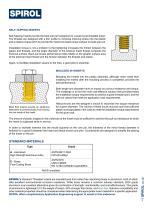
Self-Tapping Inserts provide the best pull-out resistance for a post-mould installed Insert. The threads are designed with a thin profile to minimise inducing stress into the plastic and a relative coarse pitch to provide the maximum plastic shear surface to resist pull-out. Installation torque is not a problem in that tightening increases the friction between the plastic and threads, and the larger diameter of the external Insert thread increases the frictional surface. Back-out torque performance relies totally on the greater surface area of the external Insert thread and the tension between...
Open the catalog to page 5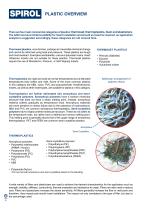
PLASTIC OVERVIEW SPIROL There are four main commercial categories of plastics: thermoset, thermoplastics, foam and elastomers. The latter two have limited suitability for Insert installation and should an Insert be required, an application analysis is suggested. Accordingly, these categories are not covered here. THERMOSET PLASTICS • Phenolic (Bakelite) • Vulcanised rubber Molecular arrangement of polymer chains Thermoset plastics, once formed, undergo an irreversible chemical change and cannot be reformed using heat and pressure. These plastics are tough and heat-resistant. Examples are Bakelite,...
Open the catalog to page 6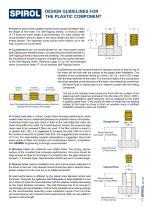
DESIGN GUIDELINES FOR THE PLASTIC COMPONENT l Holes for post-mould installed Inserts should always be deeper than the length of the Insert. For Self-Tapping Inserts, a minimum depth of 1.2 times the Insert length is recommended. For other Inserts, the recommended minimum depth is the Insert length plus two (2) Insert thread pitches. The assembly screw should never bottom out in the hole, as jack-out would result. l Counterbores are not recommended for any Insert types except Self-Tapping and Headed Inserts. Counterbores are recommended for Self-Tapping Inserts to reduce the risk of flaking. The...
Open the catalog to page 7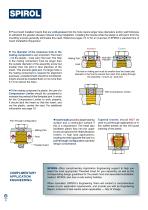
l Post-mould installed Inserts that are cold-pressed into the hole require larger boss diameters and/or wall thickness to withstand the greater stresses induced during installation. Installing the Inserts while the plastic is still warm from the moulding process generally eliminates this need. Reference pages 15-17 for an overview of SPIROL’s standard line of Insert Installation Equipment. Incorrect Incorrect Incorrect l The diameter of the clearance hole in the mating component is very important. The Insert - not the plastic - must carry the load. The hole in the mating component must be larger...
Open the catalog to page 8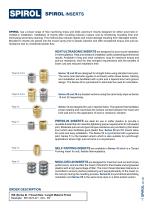
SPIROL INSERTS SPIROL has a broad range of free machining brass and 2024 aluminum Inserts designed for either post-mold or molded-in installation. Installation of Inserts after moulding reduces in-place cost by shortening moulding time and eliminating secondary cleaning. This method also reduces rejects and mould damage resulting from dislodged Inserts. Moulded-In Inserts are placed into the mould cavity prior to plastic injection and offer exceptional torque and pull-out resistance due to unrestricted plastic flow. HEAT/ULTRASONIC INSERTS are designed for post-mould installation in thermoplastics....
Open the catalog to page 9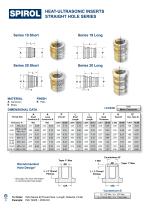
HEAT-ULTRASONIC INSERTS STRAIGHT HOLE SERIES Series 19 Short MATERIAL FINISHA Aluminium K PlainE BrassDIMENSIONAL DATA LEGEND Inch Metric Conversion Thread Size Recommended Hole Design* * See page 5 for more information on recommended hole design To Order: INS (Series #)/Thread Size / Length, Material, Finish Example: INS 19/M5 / .250S EK
Open the catalog to page 10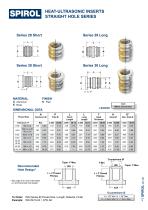
HEAT-ULTRASONIC INSERTS STRAIGHT HOLE SERIES Series 29 Short MATERIAL FINISHA Aluminium K PlainE BrassDIMENSIONAL DATA LEGEND Inch Thread Size Recommended Hole Design* * See page 5 for more information on recommended hole design To Order: INS (Series #)/Thread Size / Length, Material, Finish Example: INS 29/10-24 / .375L AK
Open the catalog to page 11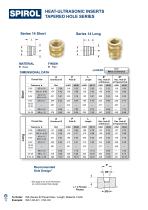
HEAT-ULTRASONIC INSERTS TAPERED HOLE SERIESSeries 14 ShortSeries 14 Long MATERIAL FINISH Inch Metric Conversion Recommended Hole Design* * See page 5 for more information on recommended hole design To Order: INS (Series #)/Thread Size / Length, Material, Finis
Open the catalog to page 12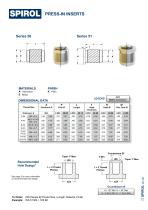
PRESS-IN INSERTS Series 50 Series 51 MATERIALS FINISH A Aluminium K PlainE BrassDIMENSIONAL DATA LEGEND Inch Metric Conversion Thread Size Recommended Hole Design* * See page 5 for more information on recommended hole design To Order: INS (Series #)/Thread Size / Length, Material, Finish Example: INS 51/M4 / .185 EK
Open the catalog to page 13All SPIROL catalogs and technical brochures
 SPIROL Corporate Brochure
12 Pages
 Coiled Spring Pins
24 Pages
 Slotted Spring Pins
16 Pages
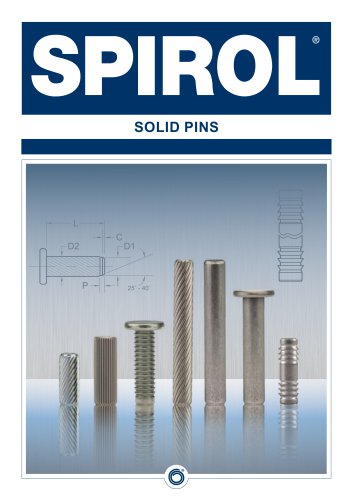 Solid Pins
12 Pages
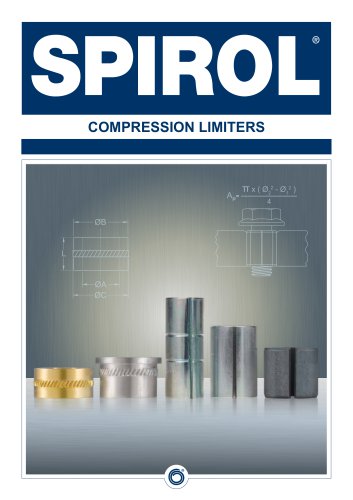 Compression Limiter Design Guide
20 Pages
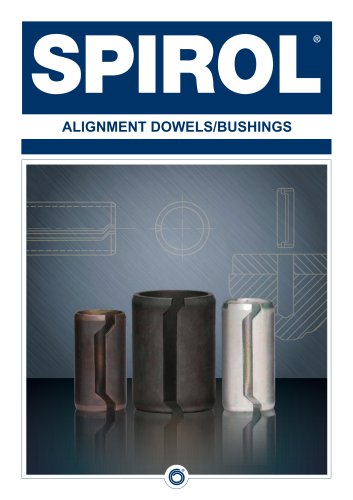 Alignment Dowels/Bushings
12 Pages
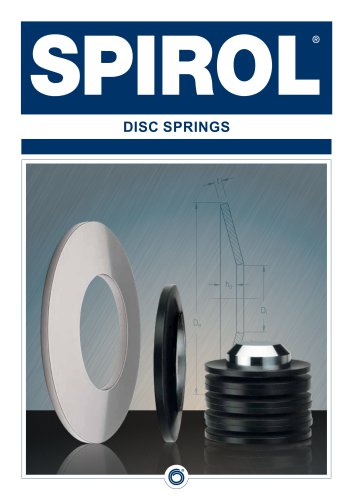 Disc Springs
20 Pages
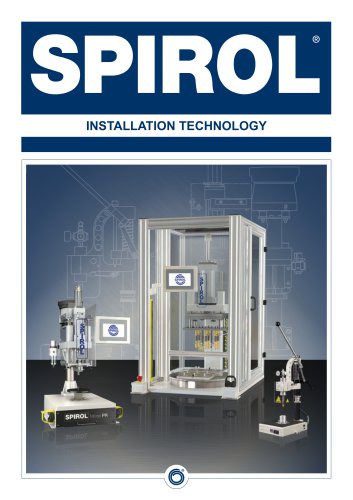 Installation Technology
8 Pages
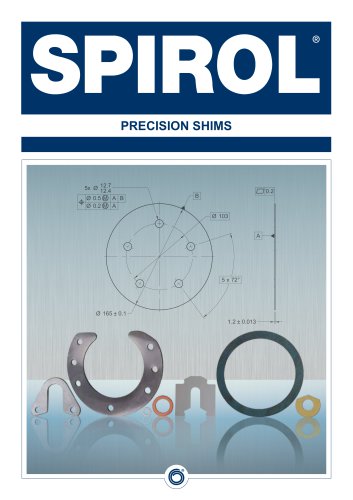 SPIROL Precision Shims
8 Pages
 Series 2000 Series 2000
4 Pages
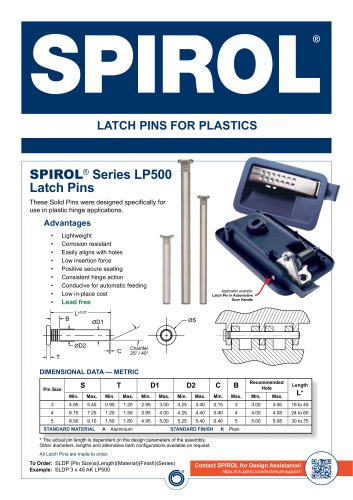 Latch Pins for Plastics
2 Pages
 Railroad Nuts - AAR Series
2 Pages
 Series RH600 Twist-Lok™ Pins
2 Pages
 Cosmestic Pins 550 series
2 Pages
 Medical Device Applications
2 Pages
 Aerospace Applications Flyer
2 Pages
 Tables Lift and Roll
2 Pages
 Tables Standard
2 Pages
 SPD, CXA, CXD, CXE CRD
2 Pages
 HC series HC series
2 Pages
 PH series PH series
2 Pages






Archived catalogs
 880 Series
2 Pages
