


How Pre-Assembled Disc Spring Stacks Help Manufacturers Save Time, Money and Ensure Quality

How Pre-Assembled Disc Spring Stacks Help Manufacturers Save Time, Money and Ensure Quality
Disc Spring Stacks are complex components used in manufacturing to meet specific height, force, and travel requirements. They can be arranged in series, parallel, or a combination of both. The construction of these stacks involves various considerations, including size, configuration, lubrication, and quality control.
The outer diameter of Disc Springs in a stack ranges from 8 mm to 200 mm. Stacks may include thrust washers for stability. Lubrication is crucial for parallel stacks to reduce friction and heat buildup. The construction process involves sourcing the springs, determining the configuration, applying lubrication, and ensuring proper assembly orientation.
Key challenges include sourcing materials, training assemblers, constructing jigs, and ensuring quality control. Incorrect assembly or lubrication can significantly impact the performance and lifespan of the stack and the product it is used in.
Pre-Assembled Disc Spring Stacks offer several advantages: they eliminate the time and training required for assembly, ensure consistent lubrication, remove the need for assembly jigs, and simplify the purchasing process. These stacks are delivered as single units, reducing assembly time and ensuring quality.
Using Pre-Assembled Disc Spring Stacks allows manufacturers to save time and money while ensuring the quality of their assemblies. This approach simplifies logistics and enhances the efficiency of production processes.
Catalog excerpts
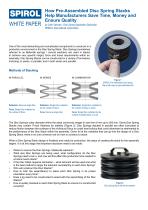
WHITE PAPER How Pre-Assembled Disc Spring Stacks Help Manufacturers Save Time, Money and Ensure Quality by John Valvoda - Disc Spring Application Specialist SPIROL International Corporation One of the most demanding and complicated components to construct in a production environment is the Disc Spring Stack. Disc Springs (sometimes referred to as Belleville springs / conical washers) are used in stacks to achieve very specific height, force and travel requirements within an assembly. Disc Spring Stacks can be constructed in a variety of formations including: in series, in parallel, and in both series and parallel. Methods of Stacking IN PARALLEL Deflection: Same as single Disc Deflection: Single Disc multiplied by the number of Discs Deflection: Single Disc multiplied by the number of Discs in series Force: Same as single Disc Force: Single Disc multiplied by the number of parallel Discs in a set Force: Single Disc multiplied by the number of Discs Figure 1 SPIROL Pre-Assembled Disc Spring Stack with easy-to-peel perforated tab The Disc Spring’s outer diameter within the stack commonly ranges in size from 8 mm up to 200 mm. Some Disc Spring Stacks may contain Thrust Washers for stability (Figure 2). Disc Springs stacked in parallel are often lubricated to reduce friction between the surfaces of the individual Discs to curtail heat buildup that could otherwise be detrimental to the performance of the Disc Stack within the assembly. Given all of the variables that can go into the design of a Disc Spring Stack, there is no one universal rule on how to construct a stack. When a Disc Spring Stack design is finalised and ready for production, the steps of creating the stack for the assembly begins. It is at this stage that important decisions need to be made: • • • • • • • Where to source the Disc Springs / Belleville washers? What size Disc Springs are being used, what configuration do the Disc Springs need to be in, and how will this affect the production time needed to construct each stack? If the Disc Stack requires lubrication – what lubricant will be used and what is the best method to apply the lubricant consistently on each Disc Spring? Who will construct the Disc Stacks? How to train the assembler(s) to place each Disc Spring in its proper orientation every time? Does a jig need to be constructed to assist with the assembling of the Disc Stacks? How is quality checked on each Disc Spring Stack to ensure it is constructed correctly? Figure 2 Disc Spring Stack with
Open the catalog to page 1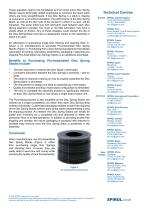
These questions need to be Innovative considered up front since someSolutions. Disc Spring Fastening Stacks require technically skilled employees to construct the stack while Lower others are more straightforward. If oneAssembly Disc Spring in Costs. a stack is missing or is placed in an incorrect orientation, the performance of the Disc Spring Stack, as well as the life cycle of the product in which it is used, will be impacted. The same holds true with lubricants used between each Disc Spring stacked in parallel. Too much or too little lubrication may have a drastic effect on friction. Any...
Open the catalog to page 2All SPIROL catalogs and technical brochures
 SPIROL Corporate Brochure
12 Pages
 Coiled Spring Pins
24 Pages
 Slotted Spring Pins
16 Pages
 Solid Pins
12 Pages
 Compression Limiter Design Guide
20 Pages
 Alignment Dowels/Bushings
12 Pages
 Disc Springs
20 Pages
 Installation Technology
8 Pages
 SPIROL Precision Shims
8 Pages
 Series 2000 Series 2000
4 Pages
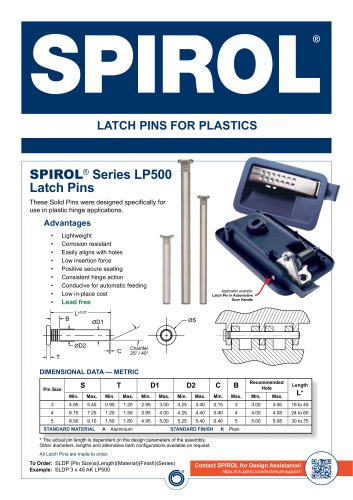 Latch Pins for Plastics
2 Pages
 Railroad Nuts - AAR Series
2 Pages
 Series RH600 Twist-Lok™ Pins
2 Pages
 Cosmestic Pins 550 series
2 Pages
 Medical Device Applications
2 Pages
 Aerospace Applications Flyer
2 Pages
 Tables Lift and Roll
2 Pages
 Tables Standard
2 Pages
 SPD, CXA, CXD, CXE CRD
2 Pages
 HC series HC series
2 Pages
 PH series PH series
2 Pages
 880 Series
2 Pages





- Chuck
- Feeder
- SPIROL metal insert
- SPIROL threaded insert
- Mounting machine
- Automated feeder
- SPIROL round insert
- Drilling chuck
- Metal washer
- Round washer
- SPIROL pin
- SPIROL metal pin
- Automatic assembling machine
- Drilling tool holder
- Vibratory feeder
- Steel washer
- SPIROL brass insert
- SPIROL plastic insert
- Knurled insert
- SPIROL steel pin