


Factors to Consider When Selecting a Raw Material for Disc Springs
Factors to Consider When Selecting a Raw Material for Disc Springs
This white paper by John Valvoda from SPIROL International Corporation discusses the factors to consider when selecting raw materials for Disc Springs, focusing on performance, operating environment, fatigue life, and cost.
Carbon and alloy steel Disc Springs are noted for their superior force output and durability due to their 'springy' nature and resistance to fatigue when heat-treated. However, their performance may decline at higher temperatures. Stainless steel Disc Springs offer better temperature resistance but may not maintain force output as effectively as exotic materials like Inconel.
The choice of material is influenced by operating temperatures and corrosion potential. For example, Inconel may be suitable for aerospace applications with extreme temperatures, while 17-7 stainless steel might be better for dynamic applications in corrosive environments. In hydraulic systems, uncoated carbon and alloy steel Disc Springs can perform well at a lower cost.
The fatigue life of a Disc Spring is affected by the stress levels relative to the material's tensile or yield strength and the stress differential during cycling. Dynamic applications may shorten the fatigue life of 300 series stainless steel compared to 17-7 stainless steel and carbon/alloy steel.
While exotic materials are more expensive, they may offer longer life and lower replacement costs. The decision should balance material cost against the desired lifespan of the assembly.
Choosing the appropriate raw material for Disc Springs requires careful consideration of technical and commercial requirements. Collaboration with specialized Application Engineers is recommended to ensure optimal material selection.
SPIROL offers complimentary Application Engineering support to assist in selecting cost-effective Disc Springs tailored to specific needs.
Catalog excerpts
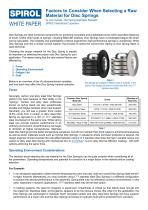
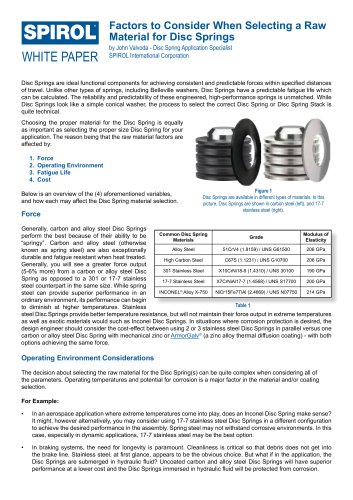
WHITE PAPER Factors to Consider When Selecting a Raw Material for Disc Springs by John Valvoda - Disc Spring Application Specialist SPIROL International Corporation Disc Springs are ideal functional components for achieving consistent and predictable forces within specified distances of travel. Unlike other types of springs, including Belleville washers, Disc Springs have a predictable fatigue life which can be calculated. The reliability and predictability of these engineered, high-performance springs is unmatched. While Disc Springs look like a simple conical washer, the process to select the correct Disc Spring or Disc Spring Stack is quite technical. Choosing the proper material for the Disc Spring is equally as important as selecting the proper size Disc Spring for your application. The reason being that the raw material factors are affected by: Disc Springs are available in different types of materials. In this picture, Disc Springs are shown in carbon steel (left), and 17-7 stainless steel (right). Below is an overview of the (4) aforementioned variables, and how each may affect the Disc Spring material selection. Generally, carbon and alloy steel Disc Springs perform the best because of their ability to be “springy”. Carbon and alloy steel (otherwise known as spring steel) are also exceptionally durable and fatigue resistant when heat treated. Generally, you will see a greater force output (5-6% more) from a carbon or alloy steel Disc Spring as opposed to a 301 or 17-7 stainless steel counterpart in the same size. While spring steel can provide superior performance in an ordinary environment, its performance can begin to diminish at higher temperatures. Stainless steel Disc Springs provide better temperature resistance, but will not maintain their force output in extreme temperatures as well as exotic materials would such as Inconel Disc Springs. In situations where corrosion protection is desired, the design engineer should consider the cost-effect between using 2 or 3 stainless steel Disc Springs in parallel versus one carbon or alloy steel Disc Spring with mechanical zinc or ArmorGalv® (a zinc alloy thermal diffusion coating) - with both options achieving the same force. The decision about selecting the raw material for the Disc Spring(s) can be quite complex when considering all of the parameters. Operating temperatures and potential for corrosion is a major factor in the material and/or coating selection. • In an aerospace application where extreme temperatures come into play, does an Inconel Disc Spring make sense? It might, however alternatively, you may consider using 17-7 stainless steel Disc Springs in a different configuration to achieve the desired performance in the assembly. Spring steel may not withstand corrosive environments. In this case, especially in dynamic applications, 17-7 stainless steel may be the best option. • In braking systems, the need for longevity is paramount. Cleanliness is critical so that debris does not get into the brake line. Stainless steel, at first glance, appears to be the obvious choice. But what if in the application, the Disc Springs are submerged in hydraulic fluid? Uncoated carbon and alloy steel Disc Springs will have superior performance at a lower cost and the Disc Springs immersed in hydraulic fluid will be protected from corrosion.
Open the catalog to page 1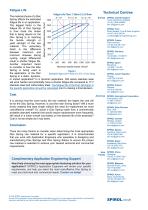
Innovative Fastening Solutions. Fatigue Life Chart: 1.25mm ≤ t ≤ 6.0mm Lower Assembly Costs. The material choice of a Disc Fatigue Life Maximum differential stress, N/mm2 Spring affects the estimated 1400 1400 fatigue life in an application. 1200 The biggest factor in the 1200 fatigue life of Disc Springs 1000 1000 is how close the stress that is being placed on the 800 800 Disc Spring is to reaching the tensile strength or 600 600 yield strength of the raw Coiled Spring Pins Slotted Spring Pins Solid Pins material. The secondary 400 400 factor is the difference between maximum and 200 200 minimum...
Open the catalog to page 2All SPIROL catalogs and technical brochures
 SPIROL Corporate Brochure
12 Pages
 Coiled Spring Pins
24 Pages
 Slotted Spring Pins
16 Pages
 Solid Pins
12 Pages
 Compression Limiter Design Guide
20 Pages
 Alignment Dowels/Bushings
12 Pages
 Disc Springs
20 Pages
 Installation Technology
8 Pages
 SPIROL Precision Shims
8 Pages
 Series 2000 Series 2000
4 Pages
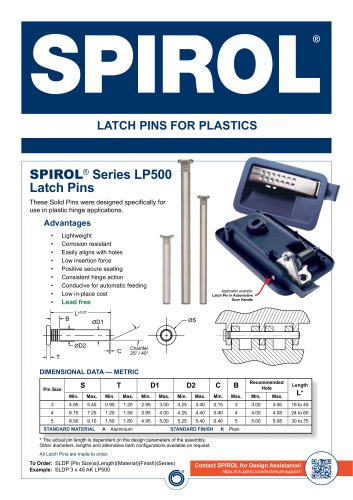 Latch Pins for Plastics
2 Pages
 Railroad Nuts - AAR Series
2 Pages
 Series RH600 Twist-Lok™ Pins
2 Pages
 Cosmestic Pins 550 series
2 Pages
 Medical Device Applications
2 Pages
 Aerospace Applications Flyer
2 Pages
 Tables Lift and Roll
2 Pages
 Tables Standard
2 Pages
 SPD, CXA, CXD, CXE CRD
2 Pages
 HC series HC series
2 Pages
 PH series PH series
2 Pages
 880 Series
2 Pages






- Chuck
- Feeder
- SPIROL metal insert
- SPIROL threaded insert
- Mounting machine
- Automated feeder
- SPIROL round insert
- Drilling chuck
- Metal washer
- Round washer
- SPIROL metal pin
- Automatic assembling machine
- Drilling tool holder
- Vibratory feeder
- Steel washer
- SPIROL brass insert
- SPIROL plastic insert
- Knurled insert
- SPIROL steel pin