


Coiled Spring Pins
1 /24Pages
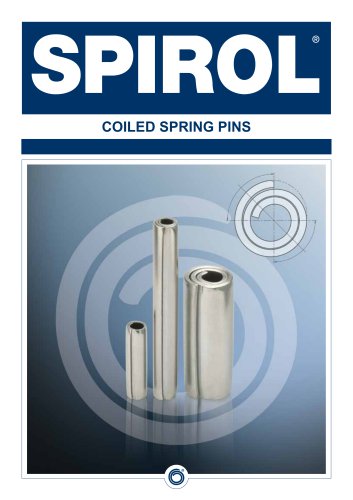
Coiled Spring Pins
1 /24Pages
Catalog excerpts
COILED SPRING PINS
Open the catalog to page 1
PROVIDING INNOVATIVE SOLUTIONS FOR FASTENING AND JOINING SINCE 1948! Starting with the invention of the Coiled Spring Pin, SPIROL stands apart from all other companies in our industry. We are a technical resource that provides high quality components that improve the quality of your assembly, extend the life of your products and reduce your manufacturing costs. Warsaw: Poland Prague: Czech Munich: Germany Apodaca, Nuevo León: Windsor, Ontario: Stow, Ohio: Canada United States North America Seoul: South Barcelona: Spain United States Danielson, Connecticut: Kyoto: Japan Saint-Léonard: France South...
Open the catalog to page 2
SPIROL invented the Coiled Spring Pin in 1948. This engineered product was specifically designed to address deficiencies associated with conventional methods of fastening such as threaded fasteners, rivets and other types of pins subject to lateral forces. Easily recognised by its unique 2¼ coil cross section, Coiled Pins are retained by radial tension when installed into the host component, and they are the only pins with uniform strength and flexibility after insertion. Truly an “engineered-fastener”, the Coiled Pin is available in three “duties” to enable the designer to choose the optimum...
Open the catalog to page 3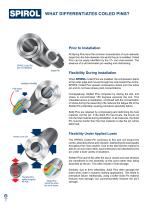
WHAT DIFFERENTIATES COILED PINS? SPIROL Coiled Pin prior to installation All Spring Pins have the common characteristic of a pin diameter larger than the hole diameter into which the pin is installed. Coiled Pins can be easily identified by the 21/4 coil cross‑section. The absence of a slot eliminates pin nesting and interlocking. Slotted Pin Flexibility During Installation When SPIROL Coiled Pins are installed, the compression starts at the outer edge and moves through the coils toward the centre. SPIROL Coiled Pins spread compressive stress over the entire pin and do not have stress point concentrations....
Open the catalog to page 4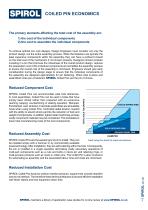
The primary elements affecting the total cost of the assembly are: 1) the cost of the individual components 2) the cost to assemble the individual components To achieve optimal low cost designs, Design Engineers must consider not only the product design, but the entire assembly process. While the fasteners are typically the least expensive components within the assembly, they can have a profound impact on the total cost of the mechanism if not chosen properly. Designers should consider investing in a pin that improves the robustness of the overall product design, reduces the preparation cost...
Open the catalog to page 5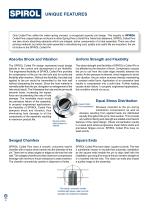
UNIQUE FEATURES SPIROL Only Coiled Pins utilise the coiled spring concept; a recognised superior pin design. This imparts to SPIROL Coiled Pins unique features not found in other Spring Pins or Solid Pins. More than fasteners, SPIROL Coiled Pins are also shock absorbing elements which are integral, active components of a total assembly. There are other pinning methods, but when the total assembly’s manufacturing cost, quality and useful life are important, the pin of choice is the SPIROL Coiled Pin. The SPIROL Coiled Pin design represents broad design latitude in the control and development of...
Open the catalog to page 6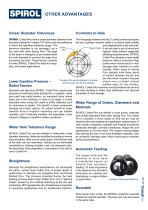
OTHER ADVANTAGES Closer Diameter Tolerances SPIROL Coiled Pins have a closer diameter tolerance than any other Spring Pin. At least 270° of the outer circumference is within the specified tolerance range. The minimum diameter is not averaged, as is Comma Area the case with other Spring Pins. The edge of the seam is designed to be tucked below the hole diameter to prevent the edge from contacting the host. These factors combine to make SPIROL Coiled Pins ideal for hinge, axle, and dowel applications. Straightness Although the straightness specifications are technically the same, carbon steel Coiled...
Open the catalog to page 7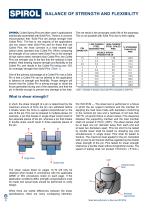
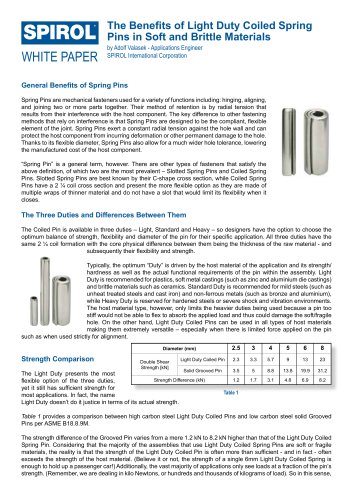
BALANCE OF STRENGTH AND FLEXIBILITY SPIROL Coiled Spring Pins are often used in applications traditionally assembled with Solid Pins. There is a common misconception that “Solid Pins are always stronger than Coiled Pins”. The fact is, the majority of the applications use low carbon steel Solid Pins and for those that use Coiled Pins, the most common is a heat treated high carbon steel, standard duty Coiled Pin. When comparing the strength of low carbon steel Solid Pins to the strength of high carbon steel, standard duty Coiled Pins, the Coiled Pins are stronger due to the fact that the material...
Open the catalog to page 8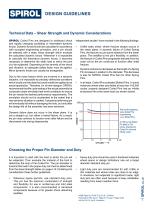
DESIGN GUIDELINES Technical Data – Shear Strength and Dynamic Considerations Due to the many factors which are involved in a dynamic situation, it is impossible to precisely define test conditions which would provide data that could readily be applied to an actual application. Therefore, for all new designs, SPIROL recommends that life cycle testing of the actual assembly be conducted under simulated real world conditions to ensure the pin meets the desired performance requirements. The simulation should not be accelerated to the extent that a new dynamic situation is created. A properly performing...
Open the catalog to page 9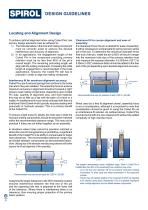
DESIGN GUIDELINES SPIROLLocating and Alignment Design To achieve optimal alignment when using Coiled Pins, two primary design elements must be adhered to: 1) The hole diameters in the host and mating component must be correctly sized to achieve the desired interference and accuracy of alignment. 2) In all applications, the engagement length of the Coiled Pin in the component providing primary retention must be no less than 60% of the pin’s overall length. The remaining protruding length will align with the mating component. Increasing the initial length of engagement is recommended in thru-hole...
Open the catalog to page 10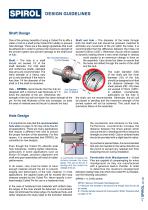
DESIGN GUIDELINES Shaft Design One of the primary benefits of using a Coiled Pin to affix a collar or hub to a shaft is the Coiled Pin’s ability to prevent hole damage. There are a few design guidelines that must be adhered to in order to achieve the maximum strength of the pinned system and prevent damage to the shaft and/ or hub: Shaft – The hole in a shaft should not exceed 1/3 of the shaft diameter. For mild steel and nonferrous shafts, standard duty pins are recommended. The extra strength of a heavy duty pin is only beneficial if the hole is less than 1/4 the diameter of the shaft or if...
Open the catalog to page 11All SPIROL catalogs and technical brochures
 SPIROL Corporate Brochure
12 Pages
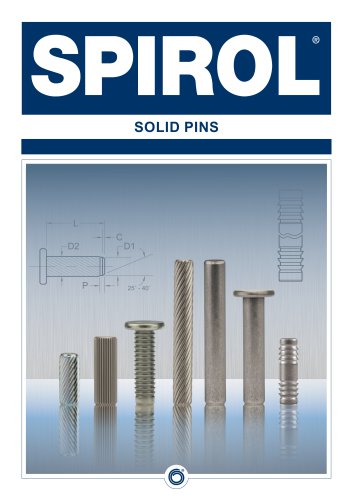 Solid Pins
12 Pages
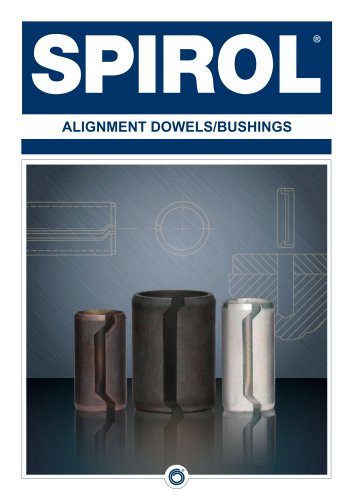 Alignment Dowels/Bushings
12 Pages
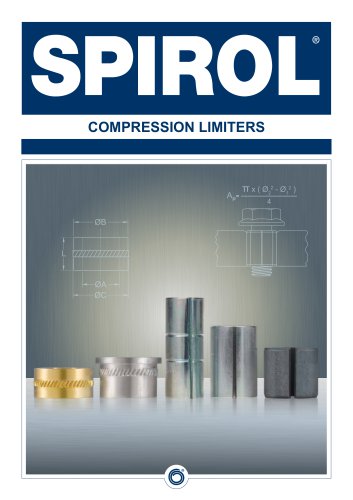 Compression Limiter Design Guide
20 Pages
 Slotted Spring Pins
16 Pages
 Latch Pins for Plastics
2 Pages
 Railroad Nuts - AAR Series
2 Pages
 Disc Springs
20 Pages
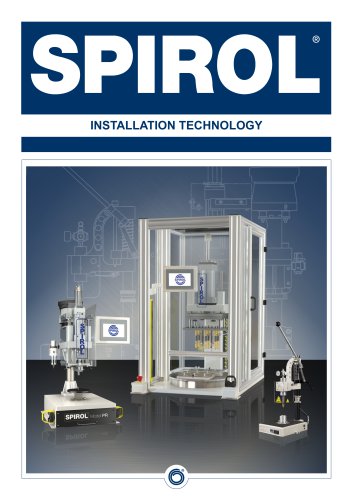 Installation Technology
8 Pages
 Series RH600 Twist-Lok™ Pins
2 Pages
 Cosmestic Pins 550 series
2 Pages
 SPIROL Precision Shims
8 Pages
 Medical Device Applications
2 Pages
 Series 2000 Series 2000
4 Pages
 Aerospace Applications Flyer
2 Pages
 Tables Lift and Roll
2 Pages
 Tables Standard
2 Pages
 SPD, CXA, CXD, CXE CRD
2 Pages
 HC series HC series
2 Pages
 PH series PH series
2 Pages
 880 Series
2 Pages




- Chuck
- Feeder
- SPIROL metal insert
- SPIROL threaded insert
- Mounting machine
- Automated feeder
- SPIROL round insert
- Drilling chuck
- Round washer
- Metal washer
- Automatic assembling machine
- SPIROL metal pin
- Drilling tool holder
- Vibrating feeder
- SPIROL brass insert
- Steel washer
- SPIROL plastic insert
- Knurled insert
- SPIROL steel pin