


The Benefits of Light Duty Coiled Spring Pins in Soft and Brittle Materials
The Benefits of Light Duty Coiled Spring Pins in Soft and Brittle Materials
Spring Pins are versatile mechanical fasteners used for hinging, aligning, and joining parts. They rely on radial tension for retention, offering flexibility and protecting host components from deformation. Coiled Spring Pins, with their multiple wraps, provide greater flexibility compared to Slotted Spring Pins.
The Three Duties and Their Applications
Coiled Pins come in Light, Standard, and Heavy duties, differentiated by material thickness. Light Duty is ideal for soft and brittle materials like plastics and ceramics, Standard for mild steels, and Heavy for hardened steels. Light Duty Pins are versatile and suitable for all host materials, especially where limited force is applied.
Strength Comparison
Light Duty Coiled Pins, despite their name, offer sufficient strength for most applications, often exceeding the strength of the host material. They are compared to Solid Grooved Pins, with the latter offering slightly higher strength but often unnecessary for typical applications.
Lower Insertion Force and Assembly Cost
Light Duty Pins require significantly less insertion force, improving ergonomics and safety. They are cost-effective due to lower raw material usage and reduced equipment needs for installation, resulting in overall lower assembly costs.
Benefits of Light Duty Coiled Spring Pins
These pins protect host components by exerting minimal radial pressure, making them suitable for soft and brittle materials. They are ideal for alignment applications, hinges, and fastening where high load-bearing is not required.
Conclusion
Light Duty Coiled Spring Pins offer advantages such as lower costs, host material protection, and ease of installation, making them a preferred choice in applications without high load demands.
Catalog excerpts
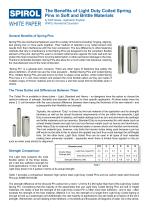
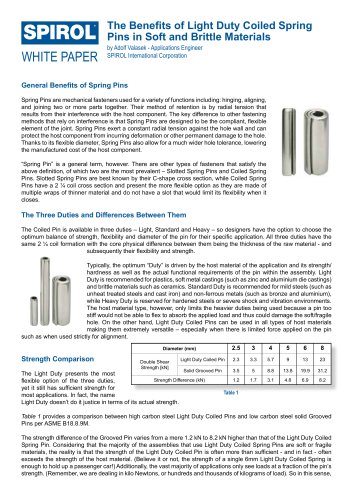
WHITE PAPER The Benefits of Light Duty Coiled Spring Pins in Soft and Brittle Materials by Adolf Valasek - Applications Engineer SPIROL International Corporation Spring Pins are mechanical fasteners used for a variety of functions including: hinging, aligning, and joining two or more parts together. Their method of retention is by radial tension that results from their interference with the host component. The key difference to other fastening methods that rely on interference is that Spring Pins are designed to be the compliant, flexible element of the joint. Spring Pins exert a constant radial tension against the hole wall and can protect the host component from incurring deformation or other permanent damage to the hole. Thanks to its flexible diameter, Spring Pins also allow for a much wider hole tolerance, lowering the manufactured cost of the host component. “Spring Pin” is a general term, however. There are other types of fasteners that satisfy the above definition, of which two are the most prevalent - Slotted Spring Pins and Coiled Spring Pins. Slotted Spring Pins are best known by their C-shape cross section, while Coiled Spring Pins have a 2 % coil cross section and present the more flexible option as they are made of multiple wraps of thinner material and do not have a slot that would limit its flexibility when it closes. The Coiled Pin is available in three duties - Light, Standard and Heavy - so designers have the option to choose the optimum balance of strength, flexibility and diameter of the pin for their specific application. All three duties have the same 2 % coil formation with the core physical difference between them being the thickness of the raw material - and subsequently their flexibility and strength. Typically, the optimum “Duty” is driven by the host material of the application and its strength/ hardness as well as the actual functional requirements of the pin within the assembly. Light Duty is recommended for plastics, soft metal castings (such as zinc and aluminium die castings) and brittle materials such as ceramics. Standard Duty is recommended for mild steels (such as unheat treated steels and cast iron) and non-ferrous metals (such as bronze and aluminium), while Heavy Duty is reserved for hardened steels or severe shock and vibration environments. The host material type, however, only limits the heavier duties being used because a pin too stiff would not be able to flex to absorb the applied load and thus could damage the soft/fragile hole. On the other hand, Light Duty Coiled Pins can be used in all types of host materials making them extremely versatile - especially when there is limited force applied on the pin such as when used strictly for alignment. Strength Comparison The Light Duty presents the most flexible option of the three duties, yet it still has sufficient strength for most applications. In fact, the name Light Duty doesn’t do it justice in terms of its actual strength. Table 1 provides a comparison between high carbon steel Light Duty Coiled Pins and low carbon steel solid Grooved Pins per ASME B18.8.9M. The strength difference of the Grooved Pin varies from a mere 1.2 kN to 8.2 kN higher than that of the Light Duty Coiled Spring Pin. Considering that the majority of the assemblies that use Light Duty Coiled Spring Pins are soft or fragile materials, the reality is that the strength of the Light Duty Coiled Pin is often more than sufficient - and in fact - often exceeds the strength of the host material. (Believe it or not, the strength of a single 6mm Light Duty Coiled Spring is enough to hold up a passenger car!) Additionally, the vast majority of applications only see loads at a fraction of the pin’s strength. (Remember, we are dealing in kilo Newtons, or hundreds and thousands of kilograms of load). So in this sense,
Open the catalog to page 1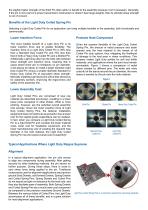
the slightly higher strength of the Solid Pin often adds no benefit to the assembly because it isn’t necessary. Generally, if the pin is not a part of a power transmission mechanism or doesn’t bear large weights, then its ultimate shear strength is not of concern. Benefits of the Light Duty Coiled Spring Pin Selecting a Light Duty Coiled Pin for an application can bring multiple benefits to the assembly, both functionally and commercially. Lower Insertion Force Protects Host Component The most notable benefit of a Light Duty Pin is its lower insertion force due to greater flexibility. The insertion...
Open the catalog to page 2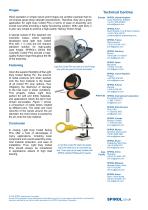
Innovative Fastening Solutions. Lower Assembly Costs. Hand operated or simple swivel point hinges are another example that do not impose great shear strength requirements. Therefore, they are a great application for Light Duty Coiled Pins in terms of ease of assembly and overall cost while providing a highly functioning solution. With Light Duty, it is also very simple to achieve a high-quality “feeling” friction hinge. A special subset of this segment are Cosmetic Cases, where specially developed extra light duty Coiled Pins withSpring 1 ½ coils industry Coiled Pins are the Slotted Spring Pins...
Open the catalog to page 3All SPIROL catalogs and technical brochures
 SPIROL Corporate Brochure
12 Pages
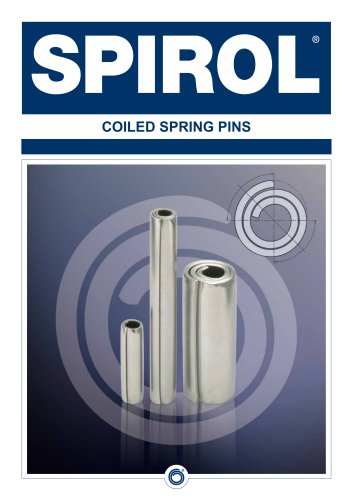 Coiled Spring Pins
24 Pages
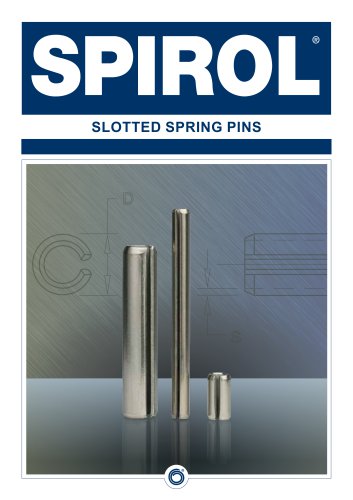 Slotted Spring Pins
16 Pages
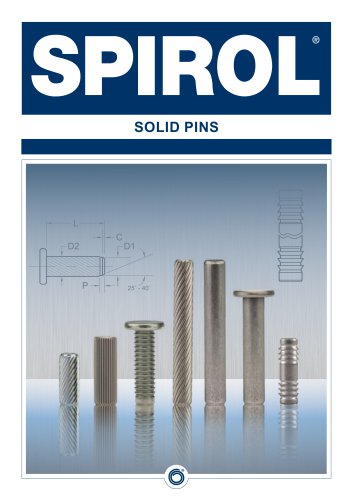 Solid Pins
12 Pages
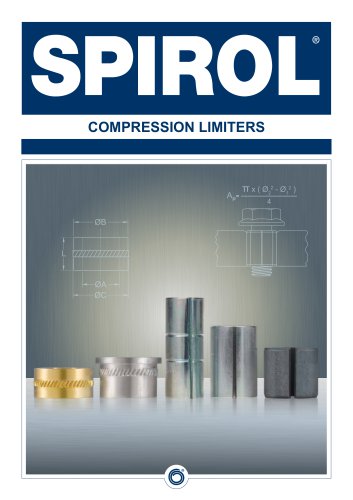 Compression Limiter Design Guide
20 Pages
 Alignment Dowels/Bushings
12 Pages
 Disc Springs
20 Pages
 Installation Technology
8 Pages
 SPIROL Precision Shims
8 Pages
 Series 2000 Series 2000
4 Pages
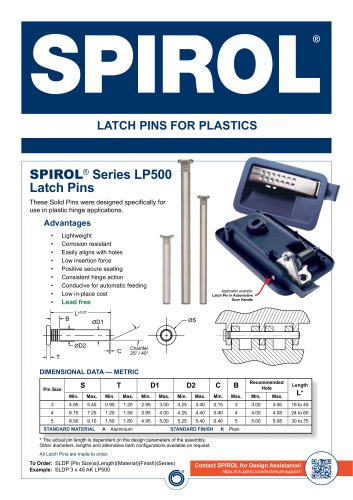 Latch Pins for Plastics
2 Pages
 Railroad Nuts - AAR Series
2 Pages
 Series RH600 Twist-Lok™ Pins
2 Pages
 Cosmestic Pins 550 series
2 Pages
 Medical Device Applications
2 Pages
 Aerospace Applications Flyer
2 Pages
 Tables Lift and Roll
2 Pages
 Tables Standard
2 Pages
 SPD, CXA, CXD, CXE CRD
2 Pages
 HC series HC series
2 Pages
 PH series PH series
2 Pages






Archived catalogs
 880 Series
2 Pages

- Chuck
- Feeder
- SPIROL metal insert
- SPIROL threaded insert
- Mounting machine
- Automated feeder
- SPIROL round insert
- Drilling chuck
- Metal washer
- Round washer
- SPIROL metal pin
- Automatic assembling machine
- Drilling tool holder
- Vibratory feeder
- Steel washer
- SPIROL brass insert
- SPIROL plastic insert
- Knurled insert
- SPIROL steel pin