
- Catalogs
- Spirax Sarco
- SC20 Sample Coolers


SC20 Sample Coolers

SC20 Sample Coolers
Catalog excerpts

The Spirax Sarco SC20 sample cooler is used to cool samples of boiler water or steam. The cooler consists of a stainless steel coil, through which the sample flows, and a stainless steel body, through which cooling water flows in the opposite direction. A pre-drilled mounting bracket is incorporated into both end caps. The SC20 is also available with a clamp adaptor for connecting to an industry standard ½" sanitary clamp fitting. Principal features: - For boiler water, steam, or condensate sampling. - Stainless steel body and coil to minimise corrosion. - Counter current flow for efficient cooling. Available types: BSP connections (6 mm O/D tube). Sizes and pipe connections ½" BSP ½" NPT ½" BSP or ½" NPT 6 mm O/D Sample tube inlet and 6 mm O/D* outlet connections 6 mm O/D with Clamp adaptor ½" adaptor for versions clamp fitting * A ¼" NPT male x 6 mm O /D stud coupling is provided. Cooling water inlet and outlet connections BSP version NPT version Clamp adaptor versions BSP version NPT version NPT connections (6 mm O/D tube). A ¼" NPT male x 6 mm O/D stud coupling is supplied loose for connecting the sample inlet tube to an NPT inlet valve or fitting. BSP sample cooler kit (SCS20), complete with sample inlet valve, cooling water inlet valve, and carbon steel fittings. A kit (SCS20), as above, but with stainless steel fittings. A sample cooler (BSP or NPT) with a clamp adaptor suitable for connection to an industry standard ½" sanitary clamp fitting (clamp not supplied). Special sanitary sample coolers (SSC20) are also available in BSP and NPT. They have a stated coil internal finish. See separate literature for further details. Sample inlet valve Alternative clamp adaptor Note: The SC20 sample cooler is not polished or specially treated internally, and the internal finish of the coil is not specified. Stainless steel couplings are also available separately:¼" BSP male x 6 mm O /D tube. ¼" NPT male x 6 mm O /D tube. Pressure / temperature limits Temperature °C Cooling water OUT to drain or tundish � The product must not be used in this region. Body Maximum design pressure 10 bar g @ 100°C Maximum design temperature 100°C @ 10 bar g Designed for a maximum cold hydraulic test pressure of 16 bar g Note: The pressure / temperature limits for the clamp adaptor are dependant on the manufacturer's recommendations Materials Coil Body Austenitic stainless steel Austenitic stainless steel Grade 316L Cooling water inlet valve Sample OUT to drain or tundish Local regulations may restrict the use of this product to below the conditions quoted. In the interests of development and improvement of the product, we reserve
Open the catalog to page 1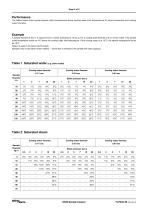
Performance The tables below show typical sample outlet temperatures above cooling water inlet temperatures for several pressures and cooling water flowrates. Example A sample flowrate of 30 I/h is required from a boiler operating at 10 bar g. For a cooling water flowrate of 0.3 I/s from Table 1 the sample outlet temperature would be 4°C above the cooling water inlet temperature. If the cooling water is at 15°C, the sample temperature would be 19°C. Table 2 is used in the same way for steam. Samples may not be taken where marked '-' as the flow is limited by the sample inlet valve capacity. Table...
Open the catalog to page 2
Weights (approximate) Cooler 3.1 kg Spare parts The spare parts available are listed below. No other parts are supplied as spares. Available spares: Component Stock number Sample inlet valve BSP 4037900 Sample inlet valve NPT 4037990 Stud coupling carbon steel BSP 0962373 Stud coupling stainless steel BSP 0963243 Stud coupling %" NPT male x 6 mm stainless steel (for connecting SC20 to an NPT valve or fitting) 0963209 Safety information, installation and maintenance For full details see the Installation and Maintenance Instructions supplied with the product. WARNING: - To avoid the risk of scalding,...
Open the catalog to page 3All Spirax Sarco catalogs and technical brochures
 Safety valves overview
12 Pages
 Exhaust Vapour Condenser
2 Pages
 BBV Bottom Blowdown Valve
2 Pages
 Condensate recovery solutions
16 Pages
 TN2000
1 Page
 VHT Vent Heads
1 Page
 Flash Vessel
4 Pages
 Boiler feedback systems
8 Pages
 Steam Trapping Overview
22 Pages
 BDV60 Blowdown vessels
7 Pages
 VHT vent heads
2 Pages
 STAPS Sales Brochure
10 Pages


Archived catalogs
 M850 Flow Computer
6 Pages
 Spirax Sarco the products
24 Pages