

Radar Article

Radar Article
The document highlights SPINNER GmbH's advancements in high-frequency technology, focusing on rotary joints used in radar and satellite communication systems. SPINNER is renowned for its innovation, quality, and reliability, particularly in mobile communication technology.
SPINNER has been a leader in developing rotary joints since the 1960s, catering to both civilian and military applications. These joints range from simple single-channel to complex multi-part systems used in various environments, including land, sea, air, and space.
The company has introduced solutions like Fast Ethernet and optical transmission links in modern radar systems. SPINNER's growth is attributed to its ability to quickly adapt to customer needs and its commitment to innovation.
SPINNER's dual-channel rotary joints are crucial for SatCom applications, enabling simultaneous transmission of signals. The trend towards higher frequency bands necessitates new solutions, such as compact waveguide-coaxial combinations, to meet increasing demands.
SPINNER employs precise manufacturing techniques using CNC machinery and collaborates with precision suppliers. The company emphasizes high-quality production through rigorous training and motivation of its workforce.
The document provides detailed specifications for dual-channel rotary joints, including frequency ranges, power capabilities, and insertion loss values. These components are designed to meet stringent aerospace standards.
SPINNER continues to set industry standards with its innovative solutions and commitment to quality, positioning itself as a leader in the high-frequency technology sector.
The document introduces SPINNER's S³ technology, which stands for Slim Sized Slip Ring. This technology is designed to enhance the reliability and efficiency of transmission channels by using multiple, well-defined contact points. The slip rings are developed to be low-wear and low-maintenance, adhering to standards such as ROHS, REACH, and DIN EN 60950.
The S³ slip ring is compact, with a wall thickness of less than 10 mm, and can transmit up to 10 A per channel. It is suitable for signal and data transmission and can be combined with various RF couplings. The slip ring's dimensions include an internal diameter of 32 mm and an external diameter of 50 mm, with a maximum of 10 channels.
The technology is initially applied in satellite communications, enabling compact and lightweight designs for antenna motor supply. It supports in-flight entertainment systems, providing telephony and internet services on flights.
The document also discusses the Ku-Band Ortho Mode Transducer (OMT), which is part of SPINNER's satellite communication portfolio. The OMT is designed for polarization duplexing, separating or combining transmit and receive signals. It features a band-stop filter for transmit frequencies and ensures high isolation values.
The OMT is constructed from seawater-proof chromated aluminum alloy, ensuring durability and resistance to electro-chemical corrosion. The design avoids unnecessary soldering and contact points, reducing losses and enhancing power rating.
SPINNER has developed a media coupling module for phased array antennas, which includes channels for dry air and cooling media. This module is designed to meet a wide range of customer requirements and has been thoroughly tested to ensure performance.
The document discusses the design and specifications of various components used in radar and satellite systems. Key specifications include a broadband VSWR of typically 1.05 within a transmit frequency range of 13.75 GHz to 14.5 GHz, and an insertion loss towards the round waveguide door of only a few hundredths of a dB. The band-stop filter at the receive path is adjusted to a stop band of 13.75 GHz to 14.5 GHz, resulting in a VSWR value at the orthogonal waveguide port of below 1.20 in a range between 12.25 GHz and 12.75 GHz.
The document outlines the development and integration processes for media modules and rotary joints. It highlights the successful delivery of prototypes within a specified time frame of less than six months, emphasizing the importance of meeting customer requirements and ensuring high-quality performance.
The document references measurement methods according to standards IEC 61300-3-6 and IEC 61300-3-4 for return loss and insertion loss, respectively. It also mentions environmental conditions such as temperature range, humidity, vibration, and shock values that the components can withstand.
Recommendations include the possibility of specific tunings of the band-stop filter and customer-specific circular waveguide flanges upon request. The document also suggests the use of FC/PC adapters instead of flying cables for ease of integration without handling highly damageable optical fibers.
The document includes technical data for media modules, fiber optic joints, and rotary joint systems. For example, the media module consists of channels for dry air and cooling water, with specific flow rates and pressure differences. The fiber optic channel characteristics include return loss, insertion loss, and optical power specifications.
The document emphasizes the importance of modularity and integration capabilities of the components, allowing them to be used in a wide range of applications. It also highlights the innovative capabilities of SPINNER in developing compact and high-performance solutions for radar and satellite systems.
The document outlines various rotary joints and modules used in radar and satellite communication systems. Key specifications include interface types, frequency ranges, peak and average power, and VSWR (Voltage Standing Wave Ratio) values for different channels and models. For instance, the frequency range for certain channels is specified between 5.4 to 5.9 GHz and 9.0 to 9.6 GHz, with peak power ranging from 2 W to 100 kW depending on the model.
The document describes the integration of SPINNER Fast Ethernet modules into radar systems, highlighting their ability to automatically detect and adapt to different Ethernet standards (10 Base-T, 100 Base-TX, or 1000 Base-T). This feature provides flexibility and reduces the need for hardware modifications. The modular design also contributes to weight and size reduction, facilitating easier integration into radar platforms.
The document emphasizes the importance of maintaining low insertion loss and stable RF parameters during rotation, which are critical for radar system performance. The use of contactless coupling systems and precise assembly techniques are recommended to achieve these standards.
The rotary joints and modules are used in various applications, including marine X-band radar systems for automatic identification and tracking of targets, and Ku-band satellite communication systems. The document also mentions the successful implementation of these technologies in the Indian Army's AKASH C band radar system.
Several models are detailed, such as the BN 635730 and BN 635731, each with specific design features and applications. The BN 635730 is noted for its extended frequency range and low insertion loss, while the BN 635731 is designed for dual-mode H11 circular waveguide applications, offering high stability and excellent signal separation.
The document concludes with a focus on the continuous development and expansion of SPINNER's rotary joint portfolio, addressing customer demands for cost-effective and high-performance solutions in radar and satellite communications.
The document discusses the development and production of rotary joints by SPINNER, focusing on their application in satellite communication and air traffic control systems. The emphasis is on improving RF performance, mechanical robustness, and cost-effectiveness.
The rotary joints are designed for the Ku-band and feature both contacting coaxial and contactless waveguide channels. Key specifications include:
- Frequency range: 14 to 14.5 GHz for Channel 1 and DC to 4.0 GHz for Channel 2.
- Peak power: 10 kW for Channel 1 and 1 kW for Channel 2.
- VSWR: Maximum of 1.2 for Channel 1 and varying for Channel 2.
- Insertion loss: Maximum of 0.2 dB for Channel 1 and 0.4 dB for Channel 2.
The development involved redesigning key RF components to meet customer requirements, focusing on competitive pricing and improved performance. The SPINNER team utilized advanced simulation tools and close collaboration between design and RF development teams to achieve a robust design.
Prototypes exceeded specifications, with RF parameters aligning closely with simulations. The mechanical design outperformed competitors, allowing timely delivery to customers. The use of CNC machines ensured precision and repeatability in production.
A new 6-channel rotary joint was developed for air traffic control radars, operating in S- and L-band frequencies. Key features include:
- Peak power of 35 kW and average power of 3 kW.
- Low insertion loss and high isolation values.
- Non-contact design ensuring over 50 million revolutions.
SPINNER introduced cost-optimized single-channel R120/WR75 rotary joints for satellite communication systems. These joints maintain high quality standards and offer low insertion loss and excellent heat dissipation.
The document highlights SPINNER's commitment to delivering high-performance, cost-effective rotary joints through innovative design and manufacturing processes, meeting the demands of global markets.
This document discusses the technical specifications and applications of rotary joints used in satellite communication systems, particularly in the Ku-band and Ka-band frequencies. It highlights the importance of these components in ensuring efficient data transmission in areas lacking fast internet connections.
The document details the design and functionality of SPINNER's rotary joints, emphasizing their high-frequency technical attributes, mechanical precision, and cost-effectiveness. The rotary joints are designed to ensure low-loss and rotation angle-independent transfer of signals between stationary transmitters and moving antennas. The document also introduces new single-channel R120 / WR75 rotary joints designed in an L shape, suitable for outdoor use with protection class IP65.
Rotary joints are crucial in VSAT systems for satellite communication, enabling precise antenna positioning. They are also used in radar systems to reduce line losses and enhance signal integrity. The document describes the transition from traditional RF modules to media couplers and contactless signal transmission modules, which offer wear-free operation and support for Gigabit Ethernet.
The document provides detailed technical characteristics, including VSWR and insertion loss measurements for specific rotary joint models. It also outlines the Ethernet standards supported by the contactless digital data transmission modules, ensuring compatibility with various data rates and providing high reliability through integrated diagnostics and functional surveillance systems.
The document concludes with a case study on the Iridium NEXT program, where SPINNER was selected to provide Ka-band rotary joints for MDA's antenna systems. The selection was based on weight and performance considerations, with the rotary joints facilitating communication between satellites and network gateways.
The document discusses the development of a dual band waveguide rotary joint by SPINNER, designed to operate as a dual band solution for both up-link and down-link. The challenge was to maintain the integrity of the rotary joint while meeting electrical requirements such as VSWR, insertion loss, and power levels. The solution covers both transmission (Tx) and reception (Rx) bands in a single channel waveguide rotary joint.
MDA provides advanced information solutions that capture and process large amounts of data, improving decision-making and operational performance for businesses and governments globally. They focus on markets with strong repeat business potential, offering a range of information solutions from complex systems to tailored services and electronic products.
MDA won a contract to supply 486 high-performance Ka-band antennas for the Iridium NEXT satellite constellation, which is a significant space program aimed at replenishing Iridium Communication Inc.'s satellite network. The constellation will consist of 66 operational Low Earth Orbit satellites, 6 in-orbit spares, and 9 ground spares, totaling 81 satellites.
SPINNER has developed new generations of optical rotary joints for radar and satellite applications, addressing the need for high data volume transmission at increasing data rates. They have optimized a single channel rotary joint and developed a new 6-channel rotary joint, both of which have passed stringent qualification tests. These products are designed for use in both civilian and military applications, with a focus on maintaining high quality and performance.
The single mode single channel fiber optic rotary joint (BN 549397) is designed for low insertion loss and high reflection loss, operating over a temperature range of -32°C to +71°C. It uses fiber optic collimators and special adhesive technology to achieve excellent optical parameters. The 6-channel rotary joint (BN 549599) is the smallest available on the market, designed for applications requiring multiple signal transmissions without interference.
The document provides detailed technical specifications and descriptions of various fiber optic and waveguide rotary joints developed by SPINNER. These components are crucial for transmitting multiple signals in rotating applications without interference.
The BN 549599 is a multi-channel fiber optic rotary joint designed for transmitting several signals simultaneously. It uses a Dove prism to maintain signal integrity during rotation. Key specifications include a return loss of 55 dB and an insertion loss of up to 4.5 dB. The joints are optimized for temperatures ranging from -40 °C to +85 °C and support wavelengths from 1270 nm to 1650 nm.
The R70 and R100 waveguide joint families expand SPINNER's portfolio, offering joints in I, L, and U styles with excellent RF properties. These joints are characterized by low insertion loss and high power handling capabilities, with a frequency range of 8.5 to 10 GHz for R100 and 5.85 to 7 GHz for R70. The design emphasizes precision and durability, with a monolithic construction reducing component count.
SPINNER's hybrid rotary joints combine traditional rotary joint technology with additional transmission methods such as Ethernet and non-contact power transmission. These joints are tailored to meet specific customer requirements and are designed to integrate multiple transmission paths in a compact form.
The document includes tables summarizing key technical data for various models, such as interface types, material specifications, frequency ranges, power ratings, and insertion loss values. These data points highlight the performance and application suitability of each joint type.
The document outlines the specifications of a power combiner and rotary joints used in radar and satellite applications. The power combiner features 8 N-f ports with a frequency range of 2.7 to 2.9 GHz, peak power capability of 2 kW at input ports and 16 kW at the output port, and average power capability of 200 W at input ports and 1.6 kW at the output port. It also specifies input and output VSWR, insertion loss, amplitude and phase unbalance, and isolation levels.
The combiner is designed to dissipate heat effectively even with asymmetrical loads and operates within a temperature range of -30 to +50 °C. SPINNER developed pulse-resistant absorber elements for this purpose. The combiner was integrated into a radar transmitter, enhancing system availability.
Multi-Link Holland uses SPINNER rotary joints for satellite uplinks, particularly for Formula One race coverage. The BN 635709 rotary joint for Ku-band systems offers wide transmission bandwidth, excellent performance, and long service life. It supports a frequency range of 10.7 to 14.5 GHz with peak power up to 5 kW.
The document discusses the increasing focus on Ka-band for satellite communications, covering frequencies from 26.5 to 40 GHz. SPINNER developed a new dual-channel rotary joint for Ka-band applications, offering excellent electrical and mechanical performance. The design is contact-free, reducing wear and allowing for compact dimensions.
The document highlights the growing demand for Ka-band applications due to increased SatCom bandwidth needs and the overcrowding of the radio frequency spectrum. It mentions service providers like Iridium and Eutelsat utilizing Ka-band technology for broadband network access in mobile, maritime, and airborne systems.
SPINNER's new dual-channel Ka-band rotary joint meets both military and civilian requirements, offering outstanding electrical properties and long lifespan, making it a leading product in the market.
The document discusses the design and application of RF rotary joints, focusing on non-contacting dual-band rotary joints and single-channel rotary joints for millimeter-wave applications.
1. Dual Band Rotary Joint: Non-contacting design with advantages such as no abrasion and compact size. It supports high frequencies and has a long lifespan of over 20 million revolutions. Dimensions are 39.1 mm in length and 63.5 mm in flange diameter.
2. Single Channel Rotary Joint: Designed for 94 GHz applications, particularly for military use in foggy conditions. It features a long lifespan of at least 100 million rotations and a peak power capacity of 250 W.
The design process involved close collaboration between designers, RF engineers, and production specialists to ensure precision and minimize development steps. The rotary joints are produced using high-precision CNC machines and are gold-plated for optimal electrical properties and corrosion resistance.
1. Dual Band Rotary Joint: Offers low insertion loss, VSWR, and high isolation values, making it suitable for mobile satellite communication systems where space is limited.
2. Single Channel Rotary Joint: Suitable for high-frequency applications, providing excellent RF performance with a VSWR typically below 1.2 at 94 GHz.
The dual-channel rotary joint covers military and civil frequency ranges, offering solutions for both sectors. The single-channel rotary joints are designed for a wide range of applications, including body scanners and imaging radar sensors.
The document highlights SPINNER's innovative approach in developing rotary joints that meet stringent RF requirements and offer unmatched performance in their respective applications.
The document discusses the R84 family of broadband single-channel waveguide rotary joints, designed for SatCom applications, highlighting their superior electrical and mechanical qualities. These products are suitable for both broadband FMCW sensors and pulsed narrow-band systems.
The R84 series features a novel method for tuning ball bearings, reducing installation times and ensuring a backlash-free bearing. Key specifications include a frequency range of 7.0 to 8.6 GHz, maximum average power of 1 kW, and peak power of 10 kW. The joints are made predominantly of aluminum, ensuring lightweight and suitability for airborne applications.
The R84 rotary joints offer several benefits, such as minimal insertion loss and VSWR, high heat dissipation, and a robust, vibration-resistant design. They also provide a high degree of match between simulated and actual performance, with no need for special adjustments during installation.
The design process incorporates RF calculation software and experience to optimize geometries and performance. The use of precise turned and milled parts from solid material avoids high production tolerances associated with welded structures.
SPINNER is advancing the miniaturization of radar systems, integrating additional transmission systems like fiber optics and media joints. The company offers hybrid systems combining RF rotary joints, slip rings, and fiber-optic rotary joints, which are becoming standard among European and Asian manufacturers.
SPINNER's hybrid rotary joint assemblies include features like non-contacting waveguide and coaxial hollow wave products, suitable for low and high-power applications. The integration of slip rings and fiber-optic channels allows for unlimited transmission bandwidth, crucial for modern radar systems.
SPINNER, in partnership with Schleifring, leads in providing hybrid systems for highly integrated rotary joint assemblies, offering significant cost reductions and reliability improvements for radar applications across various sectors.
The document discusses advanced rotary joint technologies developed by SPINNER and its partner Schleifring, focusing on their applications in radar and satellite communication systems. These technologies emphasize compact design, high performance, and integration capabilities.
- SPINNER offers contactless waveguide and coaxial hollow-shaft designs for RF signal combination, suitable for both low and high-power applications.
- SPINNER and Schleifring provide unique contactless fast Ethernet solutions with a free inner bore of approximately 25 cm, optimizing hybrid design lengths.
- RF modules are designed for high isolation and low VSWR, with maintenance-free contactless transmission paths.
- Power amplifiers in phased array antenna systems require efficient cooling, with watertight media joints for water-cooled systems.
- SPINNER integrates various encoder types (inductosyn, optical, magnetic) into hybrid systems, enhancing rotary joint designs for land, marine, and airborne radar applications.
- SPINNER's compact dual-channel X/S-band rotary joint with encoder is designed for coastal surveillance radar systems, offering high-resolution capabilities and long-range visibility in various weather conditions.
- The rotary joint features low insertion loss, VSWR, and high isolation values, with an easily accessible angle encoder configuration for high system availability.
- SPINNER has developed a broadband dual-channel coaxial rotary joint for SatCom radomes, addressing the demand for low-profile designs to reduce drag and save space.
- For the coastal surveillance radar system, the rotary joint operates in the frequency ranges of 9.1 to 9.5 GHz and 3.0 to 3.1 GHz, with peak power of 80 kW and 40 kW respectively.
- The SatCom rotary joint supports frequency ranges from DC to 16 GHz and DC to 13 GHz, with peak power of 1 kW and average power varying by frequency range.
- Both systems emphasize low insertion loss, stable VSWR, and high isolation, with additional features like IP68 protection and phase adjustable connectors for radar systems.
SPINNER's advancements in rotary joint technology offer significant improvements in performance, integration, and design flexibility for radar and satellite communication systems, meeting the demands of modern applications with innovative solutions.
The document provides detailed information on various technical developments and projects undertaken by SPINNER, focusing on rotary joints and radar systems. It includes specifications, design innovations, and applications in military and civil sectors.
SPINNER has developed a new rotary joint design that reduces the profile height by at least 2.5 cm, aiding in fuel efficiency for aircraft. The design sets new standards in shape, size, and RF properties, with low insertion loss and VSWR in specific frequency ranges. It features excellent channel isolation and operates in temperatures from -55 to +70°C, suitable for military applications. The joint is lightweight at 130 g and offers protection grades of IP 54 and IP 65 with a special sealing assembly.
SPINNER developed a 14-channel rotary joint for the Flight Level Radar (FLR), part of the Akash system. It includes 14 RF channels, a 154-way slip ring, and three Fast Ethernet channels. The FLR can track up to 64 targets and guide missiles, featuring a 360° swiveling antenna and ECCM functions. The design ensures high power handling without a pressurized waveguide, addressing thermal expansion and heat dissipation challenges.
SPINNER designed a 3-channel rotary joint with a slip ring for ASELSAN, a Turkish defense company. The compact design required high integration density, with 80% of parts newly developed. The joint passed stringent military tests for shock and vibration resistance. The product exceeded initial specifications, enhancing ASELSAN's system capabilities.
SPINNER is developing 31 rotary joints for EADS's ASR-S radar, used in military and civil air traffic control. The radar combines a primary S-Band radar with a Mode-S secondary radar, featuring a separate weather channel and functions for detecting bird flocks and wind farms. The complex system includes a 6-channel rotary joint and a 30-way slip ring, meeting ISO 9100 standards for aviation products. SPINNER delivered the first pre-series rotary joint on schedule, with further deliveries planned until 2014.
The document discusses the development and specifications of the ASR-S radar system, designed for both civil and military air traffic control, and the advancements in satellite technology by Surrey Satellite Technology Limited (SSTL).
The ASR-S is an advanced air traffic control radar system developed in compliance with international standards (Eurocontrol, ICAO) and in collaboration with the German armed forces. It is designed to handle extreme flight maneuvers typical of military air bases, such as formation flights and high-speed curves.
- Separate weather channel for target detection in adverse weather conditions.
- Functions for identifying bird flocks and wind farms.
- Combination of "S band solid state" primary radar and "mode S monopol" secondary radar.
- Mobile or fixed installation options.
- Redundancy in critical subsystems for uninterrupted operation.
The secondary radar provides specific information about airborne objects using a transponder (MSSR2000) to capture data, including altitude, speed, and identification. It also distinguishes between friendly and enemy objects in military applications.
The radar system incorporates a sophisticated 6-channel rotary joint, essential for its complex design. This includes:
- Two waveguide channels for primary radar.
- Three L band coaxial channels for secondary radar.
- One coaxial channel for weather radar.
- A 30-way slip ring for reliable AC/DC signal transmission.
- An analogue Inductosyn® absolute angle sensor for precise positioning.
The project adheres to ISO 9100 aviation standards. SPINNER delivered the first pre-series rotary joint to EADS within a year for system qualification, with plans to deliver 30 more by 2014.
Surrey Satellite Technology Limited (SSTL) is a leader in small satellite missions, having launched 34 satellites over 28 years. They specialize in cost-effective and rapid satellite design, construction, and launch.
SSTL selected a single-channel coaxial rotary joint from SPINNER for their Antenna Pointing Mechanism (APM) on the NigeriaSat-2 satellite, which offers 2.5 m resolution earth imaging and high data storage capacity.
SPINNER's new single-channel coax rotary joint, BN 835077, supports a transmission range up to 50 GHz, suitable for various microwave applications. It ensures constant RF conditions even with movement, featuring low transmission loss and excellent VSWR.
The document highlights the collaboration between SPINNER and EADS in developing the ASR-S radar system and the successful application of SPINNER's rotary joint technology in SSTL's satellite missions, emphasizing innovation and quality in air traffic control and satellite technology.
The document discusses the implementation of SPINNER MNCS® in a government complex to enhance cooperation between offices and reduce costs. It highlights the advantages of passive components over active systems, such as lower electricity costs and minimal maintenance. The MNCS® system covers a large area efficiently, reducing material consumption and fire load, and supports multiple mobile communication standards.
The SPINNER MNCS® system is installed in a 558,400 m2 area, divided into three zones, using eight multi-operator high-power antenna combiners. It supports GSM900, GSM1800, and W-CDMA standards.
Modern mobile satellite communication systems provide broadband network access for various terminals. These systems, known as SatCom on-the-move, are used globally for commercial and governmental purposes. The Ku-band is preferred for its balance between antenna size and weather resistance.
Two technologies are used for antenna beam steering: electronically phased-array antennas and mechanically steered pencil beam antennas. The latter requires compact rotary joints for signal transmission.
SPINNER has developed two new rotary joint families for SatCom systems: single channel waveguide rotary joints for Ku-band and dual channel coaxial rotary joints. These products offer modularity, excellent performance, and reliability.
These joints support RF and DC transmission, with models available in I, L, and U shapes. They are optimized for SatCom use, offering improved RF parameters and integration flexibility.
Suitable for downlink and uplink frequencies, these joints feature high power transfer capability and a dustproof design. They are available in various configurations to meet diverse customer needs.
The document includes detailed specifications for various rotary joint models, highlighting frequency ranges, power capabilities, VSWR, insertion loss, and isolation levels.
SPINNER has introduced new Ku-band rotary joints characterized by low insertion loss and efficient heat conductivity. These joints are dust-tight and protected against jet water (IP65), featuring a dynamic seal that slightly increases torque and housing length. The Ku-band single channel waveguide rotary joints offer a wide transmission band, while the dual channel family provides various shapes with excellent RF data.
SPINNER received an order for a 14-channel rotary joint slip ring assembly for the Flight Level Radar (FLR), a core component of the Akash system. The FLR can track up to 64 targets and guide eight missiles simultaneously. It features electronically steered beams for agility and 360° azimuth coverage, equipped with advanced ECCM features.
SPINNER offers cost-efficient RF rotary joints for TV satellite systems on moving vehicles. These miniature rotary joints are compact, maintenance-free, and available in I, L, and U shapes with 50 or 75 ohms impedance. They support a frequency range of 0 to 2.15 GHz and can transmit DC voltage for power supply.
SPINNER will supply rotary joints and slip rings for the NBS C-RAM systems to protect German forces in Afghanistan. These systems, an improved derivative of the Skyshield, include control elements and 35 mm guns. The multi-channel rotary joint supports X- and L-band with integrated fiber optical rotary joint for fast data transfer.
SPINNER's rotary joints are used in ground-based satellite communication systems, allowing 360° rotation and avoiding cable entanglement. The 3-channel assembly includes Rx and Tx ports with a spare Rx port for increased system availability.
SPINNER's SatCom portfolio attracts global interest, particularly from US customers. A significant order was received for a single-channel rotary joint for marine SatCom antennas on private yachts.
The document discusses the performance of rotary joints, highlighting their excellent VSWR values across the frequency range, ensuring reliable signal transmission with minimal loss. A specific rotary joint, BN 532333, is mentioned for its typical test performance.
PASSUS Sp. z o.o. has been a representative for SPINNER in Poland for ten years, achieving significant sales growth due to the booming mobile communication market. SPINNER awarded PASSUS the "Distributor Award 2008" for their excellent work. Additionally, SPINNER successfully developed a single-channel waveguide rotary joint for Raytheon, USA, for use in military aircraft, overcoming technical challenges and delivering on time.
The document details the development of the 3-D CAR radar system, a collaboration between Indian DRDO and Poland's PIT. The radar is designed for high mobility and comprehensive coverage, capable of tracking multiple targets and calculating projectile heights. SPINNER supplies key RF components for these radar systems, including a complex rotary joint with slip ring assembly.
SPINNER participated in the European Microwave Week in Amsterdam, showcasing innovations in radar, measurement technology, and mobile telecommunication. The event was successful, leading to plans for participation in the 2009 event in Rome, with a focus on radar and measurement technology.
SPINNER has developed a family of miniature rotary joints for civilian and military applications. These joints are used in various systems, including radar, TV satellite dishes, GPS systems, and CCTV installations. They offer reliable electrical contact during rotation and are available in different forms and impedances, supporting a wide frequency range.
The document discusses various advanced technologies and products developed by SPINNER, focusing on miniature rotary joints, diplexers, and multi-channel rotary joints for satellite ground stations.
SPINNER's miniature rotary joints are designed to ensure reliable and stable electrical contact during rotation, eliminating the need for fixed cable connections. These joints are compact, service-free, and available in various designs, including I, L, and U shapes with 50 or 75 ohms impedance. They operate within a frequency range of 0 to 2.15 GHz and can transmit both RF signals and DC power. The design minimizes insertion loss, making them suitable for mobile devices like GPS systems.
SPINNER introduces a new generation of stripline diplexers for combining CDMA800/GSM900 with GSM1800/PCS/UMTS. These diplexers are the lightest available, weighing only 0.9 kg, which reduces transport costs and associated rental fees for BTS masts. The monolithic aluminum housing ensures optimal sealing (IP 68) and prevents corrosion. The diplexers offer a low intermodulation distance of -165 dBc and low insertion loss, allowing for longer feeder lines without upgrading to larger types. They meet all international standards and are available in single and double versions.
The document describes a high-tech 4-channel rotary joint based on waveguide technology, designed for an Indian satellite ground station. It features two C-band and two Ku-band waveguide channels. The C-band channels use the doorknob transition principle, while the Ku-band channels are designed as Boronski ring couplers. This design minimizes the impact of rotation angle on transmission behavior. The rotary joint is suitable for high power levels, such as those in radar applications, and SPINNER's expertise in RF and fiber optics allows for the development of combined RF/fiber optical rotary joints.
SPINNER's advanced manufacturing technologies ensure high dimensional accuracy, resulting in rotary joints that closely match simulations and reduce development times. The document also provides contact information for SPINNER's global offices.
Catalog excerpts

spotlight High Frequency Performance Worldwide rotary joint articles
Open the catalog to page 1
SPINNER GmbH • Erzgiessereistrasse 33 Free subscription with specifying activity and company belonging
Open the catalog to page 2
SPINNER setzt maSSstäbe – zu Lande, zu Wasser und in der Luft er Name SPINNER steht seit Jahrzehnten vor allem für Innovation, Qualität und Zuverlässigkeit, und der 7-16 Stecker, der meistbenutzte im Mobilfunkbereich und von SPINNER entwickelt, ist nur ein Beleg dafür. Ein weiteres Feld, auf dem SPINNER schon seit den frühen sechziger Jahren neue Standards setzt, ist die Entwicklung von Drehkupplungen für zivile und militärische Radar- oder SatellitenKommunikationsanlagen. In diesem bis heute technisch sehr anspruchsvollen Feld der HF-Technik reicht die Bandbreite von der einfachen 1-Kanal Hohlleiter-...
Open the catalog to page 3
radar & Satellite mit präzision zum erfolg Fertigung von 2-Kanal Drehkupplungen für SatCom-Anwendungen auf modernen SPINNER CNC-Maschinen im anspruchsvollen Zusammenspiel hochpräziser Fräs- und Drehteile und exakter Simulationsmethoden zur Entwicklung und Verifizierung hoher Design-Ansprüche elephonie, Rundfunk und Internet über Satelliten – die stetig zunehmenden Anwendungen im SatCom-Bereich kombiniert mit immer höheren Ansprüchen an Übertragungsleistung und Einsatzbedingungen haben in den vergangenen Jahren zu einem deutlichen Anwachsen von aktuell verfügbaren 2-Kanal Drehkupplungen geführt....
Open the catalog to page 4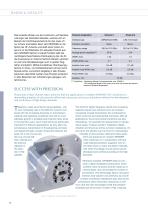
radar & Satellite Das fundierte Wissen um die Funktionen und Wechselwirkungen der abstrakten Bauteile, welches sich im Bereich der Hochfrequenztechnik für den Laien oft nur schwer erschließen lässt, setzt SPINNER an die Spitze der HF-Industrie und stellt einen hohen Anspruch an die Mitarbeiter. Ein aktuelles Produkt aus dem SPINNER SatCom 2-Kanal Portfolio stellt die nachfolgend beschriebene Drehkupplung dar, die für die Anwendung im Airborne SatCom Bereich optimiert ist und hohe Sendeleistungen auch in großen Flughöhen ermöglicht. Mittels kontaktloser Übertragungstechnik im Koax- und Hohlleiterbereich...
Open the catalog to page 5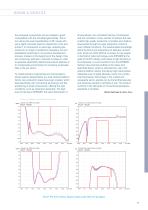
radar & Satellite all procedures, the consistent training of employees and the motivation of only wanted to achieve the best enable high-quality production of smaller and mediumsized series through to larger production orders of many different products. The substantiated knowledge about functions and interactions of abstract components, which are often difficult to access for lay people in the field of radio technology, puts SPINNER at the peak of the RF industry and makes a high demand on its employees. A current product from the SPINNER SatCom dual channel portfolio is the rotary joint described...
Open the catalog to page 6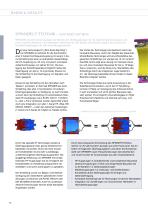
radar & Satellite SPINNERs s3 technik – slim sized slip ring SPINNER erweitert seine Lösungen im Bereich der Drehkupplungen für die Satellitenkommunikation um einen weiteren Baustein: Ein kompakter Schleifring mit sehr dünner Wandstärke ergänzt die Familie der Standard Kupplungen für alle Anwendungsbereiche. ie neue Technologie S³ („Slim Sized Slip Ring“) von SPINNER ist optimiert für die Kombination einer 2-Kanal Hochfrequenzkupplung mit einem 2-Kanal Schleifring bei einer unveränderten Gesamtlänge der HF-Kupplung (ca. 55 mm) und einem minimalen Außendurchmesser von kleiner 50 mm. Die Auslegung...
Open the catalog to page 7
radar & Satellite S3 slip ring study 10 mm max. SPINNER's s3 technology – slim sized slip ring SPINNER is expanding its solutions in the field of rotary joints for satellite communications to include a further component: A compact slip ring with very thin walls now complements the range of standard couplings for all fields of use. he new S³ technology (Slim Sized Slip Ring) from SPINNER is optimized to combine a dual channel RF joint with a dual channel slip ring with an unchanged overall length of the RF coupling (approx. 55 mm) and a minimal external diameter of less than 50 mm. The design...
Open the catalog to page 8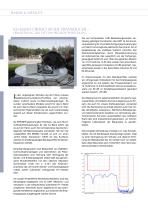
radar & Satellite Ku-Band Ortho Mode Transducer – Erweiterung des SATCOM Produktportfolios Die auf hochpräzisen CNC-Bearbeitungszentren einstückig gefertigte Konstruktion des OMT ist die Grundvoraussetzung für minimalste Fertigungsschwankungen und damit hervorragende elektrische Kennwerte. So ist beispielsweise die erzielbare Isolation zwischen den Rechteckhohlleitertoren durch Polarisationstrennung ein Gütemerkmal, das wesentlich von der Fertigungsgenauigkeit bestimmt wird. Über den gesamten Bereich von 10,75 GHz bis 14,50 GHz werden hier (ohne Bandsperrfilter gemessen) mindestens 40 dB garantiert,...
Open the catalog to page 9
radar & Satellite Typischerweise steht am axialen Hohlleiteranschluss ein breitbandig hervorragendes VSWR von typisch 1,05 (1,10 garantiert im Sendefrequenzbereich 13,75 GHz bis 14,5 GHz) zur Verfügung, während die Einfügedämpfung hin zum Rundhohlleitertor nur wenige hundertstel dB beträgt (Garantiewert 0,10 dB). In der Standardausführung wird das Bandsperrfilter im Empfangspfad auf einen Sperrbereich von 13,75 GHz bis 14,5 GHz abgeglichen, was ein VSWR am orthogonalen Hohlleitertor von kleiner als 1,20 im Bereich zwischen 12,25 GHz und 12,75 GHz sowie kleiner als 1,25 zwischen 10,75 GHz und...
Open the catalog to page 10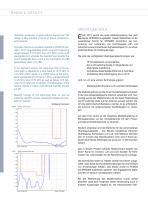
radar & Satellite medienmodul sequently enhanced. It goes without saying that this design is also superior in terms of lowest possible intermodulation. Typically, there is an excellent broadband VSWR of typically 1.05 (1.10 guaranteed within a transmit frequency range between 13.75 GHz and 14.5 GHz) at the axial waveguide port, whereas the insertion loss towards the round waveguide door is only a few hundredths of a dB (guaranteed value: 0.10 dB). In the standard version, the band-stop filter at the receive path is adjusted to a stop band of 13.75 GHz to 14.5 GHz which results in a VSWR value...
Open the catalog to page 11
radar & Satellite Ethernet module 3x 100 Mbit media module leakage return cooling water The media joint was designed for a customer project, in which a phased array antenna is used. The media module became necessary, since the RF performance is to be generated directly on the antenna for this radar system. In order to cool the electronic components, it is needed to supply the antenna with the corresponding coolant. In the left picture, the integrated media joint is shown in the assembly process prior to the final completion with the power and signal slip ring module. flow & return cooling water...
Open the catalog to page 12All Spinner catalogs and technical brochures
 GSM-R Components
4 Pages
 Easy-Dock Push-Pull Adapter
4 Pages
 EasyDock Articulated Lines
4 Pages
 Space Systems Rotary Joints
4 Pages
 Fiber Optic Rotary Joints
12 Pages
 Radar & Satellite Edition B
122 Pages
 ATC Rotary Joints Edition A
38 Pages
 Coaxial Switches Edition D
24 Pages
 BROADCAST
223 Pages
 Mobile Communication
202 Pages
 TETRA COMPONENTS
4 Pages
 MultiFit?
8 Pages
 Jumper Cables
4 Pages
 Rotary Joints
96 Pages
 Broadcast Components and Systems
160 Pages
 Components for Mobile Communication
168 Pages
 Surge Protectors
32 Pages
 Coaxial Switches
24 Pages
 Connector Catalogue
92 Pages


- Circular connector
- Screw-in connector
- Socket electrical connector
- Technology switch
- Multipole switch
- Straight connector
- RF connector
- Electronic filter
- Electromechanical switch
- Screw connector
- DIN connector
- Right-angle electrical connector
- Coaxial connector
- Passive electronic filter
- IP68 connector
- Low-pass electronic filter
- Touch switch
- Combined connector