
- Catalogs
- SPIETH-MASCHINENELEMENTE GmbH & Co KG
- Application documentation

Application documentation

Application documentation
SPIETH Hydrodynamic Radial-Slide-Bearings are essential in modern machinery, particularly in mechanical engineering and machine tool construction, due to their high damping properties, concentric accuracy, durability, and shock resistance.
Hydrodynamic Lubrication
These bearings use a lubricant-filled wedge-shaped gap to create a liquid thrust, allowing the spindle to float above the lubricant layer. Mineral oils, especially spindle oils, are selected based on working conditions to ensure proper lubrication and heat transfer. Common lubrication systems include splash, centrifuge, and external lubrication, with external lubrication by a pump being the most efficient. Seals are used to prevent lubricant escape and protect against dirt and moisture.
Adjustable SPIETH Radial-Slide-Bearing
These bearings are preferred for applications requiring optimal bearing play and smooth operation, such as in grinding machines and lathes. They feature a steel hull with clamping screws and a bronze bearing bush for precise adjustment. The housing bore must be machined to specific tolerances, and spindle surfaces must meet specific roughness and hardness requirements. Detailed instructions are provided for mounting and adjusting bearing play.
Table of Dimensions
A detailed table provides dimensions and specifications for various bearing sizes to ensure proper selection and application.
Calculation of Bearing
Methods for determining load capacity and other critical parameters are provided, using graphical methods and technical literature. Load capacity is calculated based on geometric dimensions and lubrication gap, with specific formulas provided.
Load Bearing Capacity and Pressure Calculation
Formulas for calculating load-bearing capacity and average high loading pressure are outlined, with dynamic viscosity under working temperatures being a critical factor.
Heating of the Bearing
Two cases of heat emission are considered: at the bearing surface and to the coolant, with high temperatures determined using specific scales.
Viscosity of Standard Lubricants
Nomogram III provides dynamic viscosity of standard lubricants based on working temperature.
Standard Values for Bearing Play
Nomogram IV lists standard values for bearing play, depending on bearing size and allowed high temperature.
Calculation Examples
Examples are provided for heat emission cases, detailing parameters such as diameter, load capacity, revolutions per minute, peripheral speed, average surface pressure, working viscosity, high temperature, friction loss, coolant quantity, working temperature, kinematical viscosity, and bearing play.
Legend
A legend explains symbols used, such as F for load capacity and η for dynamic viscosity.
Assembly Example
An example describes the mounting of adjustable hydrodynamic sectionalised radial slide bearings GLM in the headstock, with details on axial guiding and sealing against oil loss.
Catalog excerpts

SPIETH Hydrodynamic Radial-Slide-Bearings Series GLM Works Standard SN 03.01
Open the catalog to page 1
1.1. SPIETH Hydrodynamic Radial-Slide-Bearing 4 2. Adjustable SPIETH Radial-Slide-Bearing 5 2.5. Mounting and adjustment of play 8 3. Table of dimensions for Radial-Slide-Bearing Series GLM 10 4.1. Ascertainment of load capacity 11 4.2. Ascertainment of heating of the bearing 11 4.3. Viscosity of standard lubricants 13 4.4. Standard values for bearing play 13
Open the catalog to page 3
1. General In modern and powerful machines the importance of the spindle bearing is increasing. Solutions for these tasks are offered by roller bearings as well as by slide bearings. Increasing demands for long tool life as well as for surface performance, shape accuracy, and fabrication tolerances of the work pieces has been shown in the last years, that especially at hydrodynamic sectionalised surface slide bearings – with its caused by the lubricating film high damping properties and concentric accuracy – the smoothness as well as the insusceptibility to shock together with its high durability...
Open the catalog to page 4
The external lubrication by a pump is the most secure and efficient lubrication system. Especially for high sliding speeds which need a high quantity of oil for cooling the external lubrication supply by a pump is absolutely necessary. For this lubrication system any spindle position can be allowed. There is only the need for sufficient pump pressure to negotiate circuit and duct resistance to ensure an adequate quantity of oil for the temperature equation. As said before, the carrying liquid thrust will be created by itself after the rotation of the spindle has started. 1.5. Sealing Slide bearings...
Open the catalog to page 5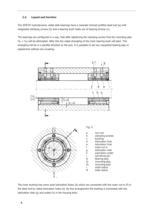
2.2. Layout and function The SPIETH hydrodynamic radial slide bearings have a meander formed profiled steel hull (a) with integrated clamping screws (b) and a bearing bush made out of bearing bronze (c). The bearings are configured in a way, that after tightening the clamping screws first the mounting play (S1 + S2) will be eliminated. After this the radial strangling of the inner bearing bush will start. This strangling will be in a parallel direction to the axis. It is possible to set any requested bearing play or adjustment without any scraping. Fig. 3: a b c d e f g h i S S1 S2 r R iron hull...
Open the catalog to page 6
The lubrication flutes are dividing the bushing bore in a few sliding surfaces. During the adjustment of bearing play, these sliding surfaces are changing their original radius in the way, that there will arise a wedge crack between sliding surface and spindle. The tightest point of this wedge crack will be in the middle of the sliding surface and will expand in both directions to the lubrication flutes. SPIETH hydrodynamic radial slide bearings are independent of the rotation direction of the spindle as the lubricant can flow under the developed pressure in the squeezed wedge crack and can thereby...
Open the catalog to page 7
2.4.2. Spindle For an accurate concentricity the spindle contact surface has to be done cylindrically according to tolerance g5. Recommended quality of the spindle is a surface roughness of 0,4 – 0,63 µm best realized by smooth grinding. The material of the spindle is dependent of the requirements. For high operational demands the spindle should be case hardened (≈ HRC 64) or nitrogen hardened (≈ HV 8500 N/mm2). Regarding to the for bearing play adjustment necessary control of contact pattern we recommend following for using two bearings with the same size: The diameter of the first to insert...
Open the catalog to page 8
2.5.5. As the bearing play is now 0,01 mm bigger than the wanted movement play, remove the spindle and apply a coating of inking paste. To assess the contact pattern by the left ink impression, the coating of the inking paste has to be kept real thin. 2.5.6. Reinsert the spindle into the radial-plain-bearing and generate a contact pattern by radial and axial movements of the spindle. Remove the spindle and assess the ink impressions left. 2.5.7. If the contact pattern in the radial-plain-bearing is equally at all sliding sections, the final movement play can be set by tightening the clamping...
Open the catalog to page 9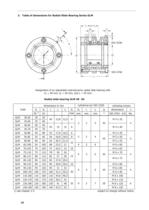
3. Table of dimensions for Radial-Slide-Bearing Series GLM Designation of an adjustable hydrodynamic radial slide bearing with Radial slide bearing GLM 40 ' 65 1) see chapter 2.3. subject to change without notice.
Open the catalog to page 10
4. Calculation of Bearing With the here presented method the designer is given the possibility to collect the for bearing definition needed but unknown values by graphic method. This method is easy and sufficient enough. 4.1. Ascertainment of load capacity (Nomogram I) The SPIETH hydrodynamic radial slide bearing Type GLM has nearly wedge shaped retain fields in defined geometric dimensions. Therefore the load bearing capacity is according to technical literature: F = C⋅η⋅u⋅b ⋅ l2 ho 2 The smallest operational lubrication gap is according to technical literature about the size of h o ≈ 2µm Due...
Open the catalog to page 11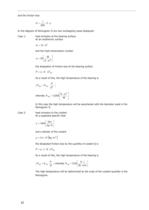
and the friction loss P= 1 ⋅F⋅u 200 In the diagram of Nomogram II are two overlapping cases displayed: Case 1: heat emission at the bearing surface. At an exothermic surface A ≈ 10 ⋅ d 2 and the heat transmission number W α = 20 K ⋅ m 2 the dissipation of friction loss at the bearing surface P = α ⋅ A ⋅ ∆Tair As a result of this, the high temperature of the bearing is ∆Tair ≈ K air ⋅ P d2 ; K ⋅ m 2 whereby K air = 0,005 W In this case the high temperature will be ascertained with the diameter scale in the Nomogram II. Case 2: heat emission to the coolant At a supposed specific heat Nm c = 1900...
Open the catalog to page 12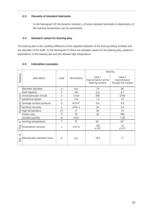
4.3. Viscosity of standard lubricants In the Nomogram III the dynamic viscosity η of some standard lubricants in dependency of the working temperature can be ascertained. 4.4. Standard values for bearing play The bearing play is the resulting difference of the adjusted diameter of the bearing sliding surfaces and the diameter of the shaft. In the Nomogram IV there are standard values for the bearing play, graded in dependence of the bearing size and the allowed high temperature. 4.5. Calculation examples N'gr. IV N'gr. III Nomogram I and II Reading bearing code dimensions case 1 heat emission...
Open the catalog to page 13All SPIETH-MASCHINENELEMENTE GmbH & Co KG catalogs and technical brochures
 catalogue
98 Pages
 Clamping Nuts
8 Pages
 Radial Plain Bearings
6 Pages
 Guide Gibs
8 Pages
 Guide Bushings
16 Pages
 Clamping Sets
22 Pages
 Locknut
22 Pages
 Introduction
11 Pages
Archived catalogs
 Product Range
8 Pages
 Tension Nut Type AM
8 Pages
 Precision Locknut heavy MSW
12 Pages
 Precision Locknut MSR/MSA
12 Pages


