


FDG-15

FDG-15
The FDG-15 Flux Density Generator is designed for 3-axial magnetic excitation of devices under test. It is suitable for testing components in research and development and can be combined with a climatic chamber.
The generator can produce a magnetic flux in any spatial direction with an accuracy of at least ± 1° relative to the sensor axis. It can cancel the earth's magnetic field to ≤ 1 µT and maintains a flux homogeneity of ≤ 1%.
The FDG-15 generates a static flux density up to 3 mT in any direction within the coil system, with a maximum deviation of 1% in homogeneity. It consists of three orthogonal Helmholtz coils connected to a DC power supply. It can generate flux densities below 1 µT for precise applications and can be used within a climatic chamber.
- Magnetic Unit: Frequency range is 0 Hz, maximum flux density is 3 mT, and step width is 1 µT.
- Homogeneous Field: Cube edge size is 20 mm with a deviation of ± 1%.
- Dimensions: 367 mm x 368 mm x 380 mm.
- Environmental: Operates without temperature control of coils from -40 °C to 125 °C, with a maximum coil temperature of 150 °C.
- Total Weight: 18 kg.
- Power Supply: 110/230 V AC (50/60 Hz), output voltage 0-30 V DC, output current 0-5 A DC, resolution 10 mV / 1 mA.
- Environmental Conditions: IP20, 0-40 °C, ≤80% relative humidity, ≤2000 m above sea level.
- PC Interface: RS232/USB.
- Fuse: T3 A / 250 V.
Catalog excerpts

FDG-15 Flux Density Generator 3-axial magnetic excitation of devices under test Magnetic flux generator for any spatial direction Accuracy of magnetic field vector with respect to sensor axis at least ± 1° Earth magnetic field cancellation ≤ 1 µT Homogeneity of flux ≤ 1 % Range of use Testing of components in research and development Possible combination with a climatic chamber Description The flux density generator type FDG-15 is a reliable tool for generating a static flux density of up to 3 mT in any direction inside the coil system. The homogeneous magnetic field has a maximum deviation of only 1 percent in the specified dimension. The flux density generator consists of 3 orthogonal Helmholtz coils. Each Helmholtz coil is connected to a DC Power Supply which generates a constant positive current. If it is necessary to compensate also the smallest magnetic fields like the earth magnetic field, it is possible to generate flux densities of less than 1 μT. Due to the design of the exciter, it can be placed within a climatic chamber and tested regarding both parameters – magnetic excitation and variable climatic conditions.
Open the catalog to page 1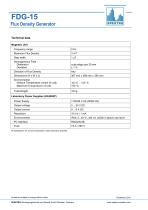
FDG-15 Flux Density Generator Technical data Magnetic Unit Frequency range Maximum Flux Density Step width Homogeneous Field Dimension Deviation cube edge size 20 mm ±1% Direction of Flux Density Environmental Without Temperature control of coils Maximum Temperature of coils Total Weight Laboratory Power Supplies (KA3005P) Power Supply Output voltage Output current All specification are at room temperature unless otherwise specified All data are subject to change without notice SPEKTRA Schwingungstechnik und Akustik GmbH Dresden, Germany
Open the catalog to page 2All SPEKTRA Schwingungstechnik und Akustik GmbH Dresden catalogs and technical brochures
 CS Q-LEAP™ P-SINE with SE-09
2 Pages
 DRE-01
4 Pages
 SQ-4.2
2 Pages
 SQ-4.1
2 Pages
 S-TEST/16 Lab
2 Pages
 S-TEST/16 Fab
2 Pages
 S-TEST/2
2 Pages

Archived catalogs


- Test cabinet
- Automation software solution
- Analysis software solution
- Measuring machine
- Windows software
- Calibration system
- Control software
- Environmental test chamber
- Measurement software
- Interface software
- Visualization software solution
- Quality software
- Automated software
- Development software
- Portable calibrator
- Test set
- Power amplifying integrated circuit
- Precision calibration equipment
- Test software