


3D Constraint Manager

3D Constraint Manager
GGCM is a non-linear equation solver designed for complex design and engineering problems. It offers full variational solving, fine control over solver behavior, and powerful failure diagnostics. Rigid Equivalence Classes are defined as virtual subassemblies to enhance problem identification and solution.
The General Geometric Constraint Manager (GGCM) is a high-performance, fully-variational non-linear equation solver. It is suitable for assembly management, part design, curve and surface editing, and kinematic motion simulation. GGCM is licensed from ALS Geometric Software and provides a simple C/C++ API for integration.
GGCM excels in solving complex variational problems quickly, with performance gains increasing with problem size and complexity.
GGCM uses a non-separable approach to solve fully-, over-, and under-constrained problems without breaking them into smaller parts, making it ideal for large assemblies and kinematics.
Custom objects and constraints can be created, including midpoint, symmetry, and Bspline curves, which are crucial for part design and physical property analysis.
GGCM can solve complex systems involving forces, moments, and physical simulations using non-linear equation solving capabilities.
Expression constraints extend to inequalities, enabling relative placement of assembly parts and collision avoidance.
RECs are groups of assembly parts that move rigidly relative to each other, aiding in design intent validation and kinematic group identification.
GGCM provides diagnostics to identify the smallest part of a failing problem, useful in complex assemblies.
GGCM is used in assembly management, constraint management, multi-axis robotics, and collision avoidance.
GGCM includes a bridge to the 3D ACIS Modeler for integration, and Spatial's Rapid Application Development Framework (RADF) supports rapid development of ACIS-based applications.
Spatial has headquarters in the U.S., Asia, and EMEA, providing support and services for 3D software development.
Catalog excerpts

Product Highlights .. Non-linear equation solver for simple through complex problems .. Fully Variational - user-defi ned expressions solved simultaneously with other constraints .. Fine control over solver behavior for underconstrained confi gurations .. Powerful failure diagnostics for precise problem identifi cation .. Rigid Equivalence Classes defi ned as virtual subassemblies www.spatial.com DATASHEET Product Overview General Geometric Constraint Manager (GGCM) is a fully-variational non-linear equation solver for simple through complex design and engineering problems. The component provides variational solving for applications requiring assembly management, part design, curve and surface editing, and smooth kinematic motion simulation. GGCM, licensed from ALS Geometric Software, SA (ALS), off ers advanced solvability, fl exibility, extendibility and superior performance. GGCM provides a simple C/C++ API for easy integration with software applications. High-Performance GGCM is a high-performance solver, with the ability to solve complex variational problems at a speed equivalent to history based solvers. Relative performance gains increase signifi cantly as the size and complexity increases, making GGCM ideal for solving large, challenging problems. Solvability GGCM uses a non-separable approach to solving complex fully-, over-, and under-constrained problems. A solution is determined without breaking the problem into smaller independent ones, which is not always possible or accurate. A non-separable approach makes the component uniquely capable of solving the most challenging problems related to large assemblies, surface modifi cations, linkages, and kinematics requiring smooth and controllable behavior. Extendibility Custom objects and constraint types can be created including midpoint, symmetry, shape area, conic arcs, and Bspline curves. Custom constraints are evaluated the same as pre-defi ned constraints and are especially important in part design, curve editing with specifi c chord-length rules and for analyzing physical properties with constraints for force/moments analysis, or belt/pulley systems. Expression Constraints Complex systems and conditions can be defi ned and solved variationally with the rest of the model using non-linear equation solving capabilities. Systems involving forces and moments, equilibrium analysis, physical simulation, advanced curves and surfaces, elasticity, and curvature can be solved with expression constraints. Solutions can be produced that are either smooth (minimize overall movement) or discrete (maintain parts of the model as unmoved). Inequalities The full power and capabilities of expression constraints are extended to inequalities. This enables relative placement of assembly parts with respect to each other, collision avoidance in kinematics and digital prototyping. Inequalities also serve to enforce convexity of curves and surfaces for advanced part design. Rigid Equivalence Classes Rigid Equivalence Classes (REC) are groups of assembly parts whose constraints force them to move rigidly relative to each other. RECs are automatically identifi ed in calculations and included in reports. RECs are essential for highlighting design intent, validating constraint systems, and identifying kinematic groups that are allowed to move independently in large assembly design. Failure Diagnostics Powerful failure diagnostics are provided for immediately identifying the smallest part of a failing problem. This capability is useful in assembly management where it is often very hard to identify sets of confl icting constraints in large and complex assemblies. A clear indication of where the problem lies is provided. Many other application areas benefi t from the quality and usefulness of error diagnostics. Typical Applications GGCM provides non-linear equation solving for applications such as assembly management, constraint management, multi-axis robotics and collision avoidance. General Geometric Constraint Manager Applications: Assembly Management, Constraint Management, Multi-axis Robotics, Collision Avoidance
Open the catalog to page 1
www.spatial.com Assembly Management GGCM provides the set of simple constraints required to position assembly components with respect to each other. These can be applied in combination with each other and with fully customizable ‘expression’ constraints to build complex assembly relationships. Powerful diagnostics provide applications with mechanisms to identify confl icting constraints and systems of bodies that are rigid, massively simplifying assembly design problems. Constraint Management GGCM provides unifi ed 2D/3D constraint management. Dimensions, constraints and user expressions position...
Open the catalog to page 2All SPATIAL catalogs and technical brochures
 3D Springback
1 Page
 HOOPS Visualize
2 Pages
 3D InterOp Suite
2 Pages
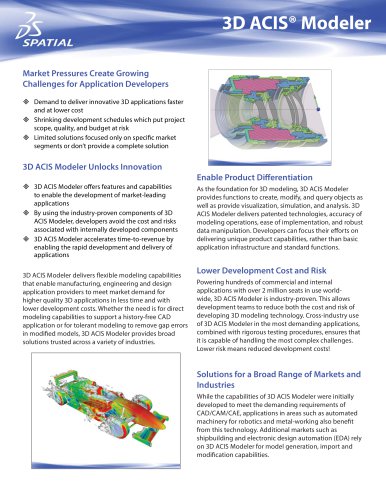 3D ACIS® Modeler
2 Pages
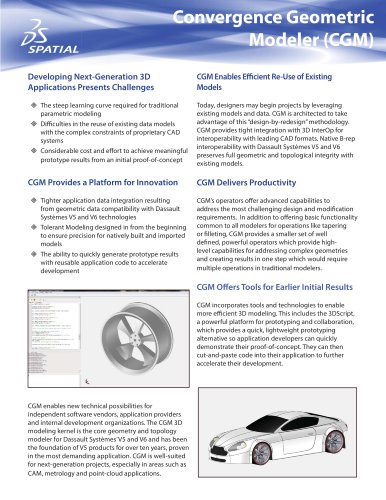 CGM
CGM2 Pages
 EDA 3D Analysis Suite
2 Pages
 3D Mesh Datasheet
2 Pages


- Automation software solution
- Management software solution
- Analysis software solution
- Real-time software
- Windows software
- Computer-aided design software
- Design software solution
- Measurement software
- Interface software
- Visualization software solution
- Quality software
- Simulation software solution
- Programming software
- Automated software
- Development software
- Engineering software
- Creation software
- Optimization software
- 2D software