
- Catalogs
- SP Scientific Products
- Robotic Filling Steps for RTU Containers


- Products
- Catalogs
- News & Trends
- Exhibitions
Robotic Filling Steps for RTU Containers
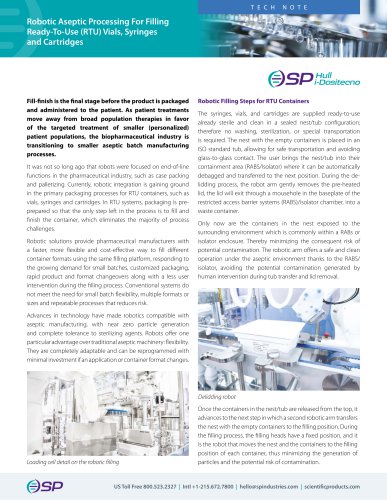
Robotic Filling Steps for RTU Containers
The document discusses the transition in the biopharmaceutical industry towards smaller aseptic batch manufacturing processes, driven by the need for personalized patient treatments. Robotic integration in primary packaging processes for Ready-To-Use (RTU) containers like vials, syringes, and cartridges is highlighted as a solution to meet these demands.
Robots, previously used for end-of-line functions, are now being integrated into primary packaging processes. This integration offers faster, more flexible, and cost-effective filling solutions for different container formats, addressing the need for small batch flexibility and reducing human intervention.
Robotic systems provide flexibility, adaptability, and minimal investment for reprogramming if application or container formats change. They are compatible with aseptic manufacturing, generating near-zero particles and tolerating sterilizing agents.
RTU containers are supplied sterile and clean, eliminating the need for washing or sterilization. The process involves placing the nest/tub in a containment area, where robotic arms handle debagging, delidding, and transferring containers to the filling position. This minimizes contamination risks and ensures a clean operation.
After filling, containers are stoppered in a synchronized manner to minimize exposure to the environment. The robotic arm then returns the filled nest to its original position for further processing. This integration ensures reliable repeatability, reducing particle generation and air disturbance.
The SP i-Dositecno SY Syringe Filler is a versatile machine capable of processing up to 200 units per minute. It supports various container types and includes features like IPC statistic check weighing and complete line solutions for de-bagging, de-lidding, and labeling.
Catalog excerpts
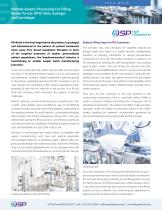
Robotic Aseptic Processing For Filling Ready-To-Use (RTU) Vials, Syringes and Cartridges Fill-finish is the final stage before the product is packaged and administered to the patient. As patient treatments move away from broad population therapies in favor of the targeted treatment of smaller (personalized) patient populations, the biopharmaceutical industry is transitioning to smaller aseptic batch manufacturing processes. It was not so long ago that robots were focused on end-of-line functions in the pharmaceutical industry, such as case packing and palletizing. Currently, robotic integration is gaining ground in the primary packaging processes for RTU containers, such as vials, syringes and cartridges. In RTU systems, packaging is preprepared so that the only step left in the process is to fill and finish the container, which eliminates the majority of process challenges. Robotic solutions provide pharmaceutical manufacturers with a faster, more flexible and cost-effective way to fill different container formats using the same filling platform, responding to the growing demand for small batches, customized packaging, rapid product and format changeovers along with a less user intervention during the filling process. Conventional systems do not meet the need for small batch flexibility, multiple formats or sizes and repeatable processes that reduces risk. Robotic Filling Steps for RTU Containers The syringes, vials, and cartridges are supplied ready-to-use already sterile and clean in a sealed nest/tub configuration; therefore no washing, sterilization, or special transportation is required. The nest with the empty containers is placed in an ISO standard tub, allowing for safe transportation and avoiding glass-to-glass contact. The user brings the nest/tub into their containment area (RABS/Isolator) where it can be automatically debagged and transferred to the next position. During the delidding process, the robot arm gently removes the pre-heated lid, the lid will exit through a mousehole in the baseplate of the restricted access barrier systems (RABS)/isolator chamber, into a waste container. Only now are the containers in the nest exposed to the surrounding environment which is commonly within a RABs or isolator enclosure. Thereby minimizing the consequent risk of potential contamination. The robotic arm offers a safe and clean operation under the aseptic environment thanks to the RABS/ isolator, avoiding the potential contamination generated by human intervention during tub transfer and lid removal. Advances in technology have made robotics compatible with aseptic manufacturing, with near zero particle generation and complete tolerance to sterilizing agents. Robots offer one particular advantage over traditional aseptic machinery: flexibility. They are completely adaptable and can be reprogrammed with minimal investment if an application or container format changes. Delidding robot Loading cell detail on the robotic filling Once the containers in the nest/tub are released from the top, it advances to the next step in which a second robotic arm transfers the nest with the empty containers to the filling position. During the filling process, the filling heads have a fixed position, and it is the robot that moves the nest and the containers to the filling position of each container, thus minimizing the generation of particles and the potential risk of contamination. US Toll Free 800.523.2327 | Intl +1-215.672.7800 | [email protected] | scientificproducts.com
Open the catalog to page 1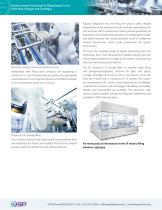
Robotic Aseptic Processing For Filling Ready-To-Use (RTU) Vials, Syringes and Cartridges Robotic integration into the filling line process offers reliable repeatability of the movements while carefully manipulating the nest and vials, which is essential to reduce particle generation, air disturbance and unexpected vial shaking. This helps prevent spills and other incidents that would otherwise result in unplanned manual interventions, which could compromise the aseptic environment. SP covers the complete range of aseptic processing tools and techniques, from cycle development, stability testing,...
Open the catalog to page 2All SP Scientific Products catalogs and technical brochures
 virtis Benchmark
18 Pages
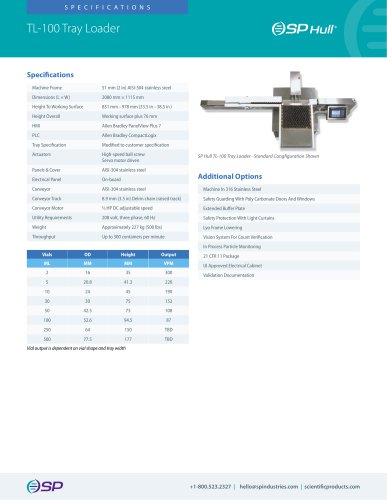 TL-100 Tray Loader
2 Pages
 Automation That Empowers
3 Pages
 LyoStar® 4.0
2 Pages
 LyoConstellation™ S30
2 Pages
 LyoConstellation™ S20
2 Pages
 LyoConstellation™ S10
2 Pages

- Test cabinet
- Chiller
- Automatic cleaning system
- Temperature test chamber
- Fully automatic filling machine
- Climatic test cabinet
- Liquids filling line
- Liquid recirculation chiller
- Humidity test cabinet
- Water cleaning system
- Air chiller
- Water recirculation chiller
- Stainless steel test chamber
- Stainless steel cleaning system
- Industrial cooling system
- Compact recirculation chiller
- Filling machine for the pharmaceutical industry
- Laboratory freezer
- Stability test chamber
- PLC-controlled filling line