
- Catalogs
- South Surveying & Mapping Instrument Co., Ltd
- SOUTH Mini LiDAR system SZT-250 Map 3D Map

- Company
- Products
- Catalogs
- News & Trends
- Exhibitions
SOUTH Mini LiDAR system SZT-250 Map 3D Map

1 / 2 PagesView full catalog
SOUTH Mini LiDAR system SZT-250 Map 3D Map
Product catalog summary
Overview: The Z-Lab LiDAR Mini LiDAR System SZT-R250 by South Surveying & Mapping Technology Co., Ltd. is a comprehensive solution for various surveying and mapping applications. It integrates advanced LiDAR technology with imaging sensors and UAV platforms to deliver high-precision data capture.
Specifications: The system features a RIEGL miniVUX-1UAV laser sensor with a maximum range of 250 meters and a field of view of 360°. It supports a measurement rate of up to 100,000 measurements per second with an accuracy of 5 cm at 50 meters for UAV applications. The imaging sensor is a 24.3 MP RGB camera, and the system operates within a temperature range of -10°C to 40°C.
Hardware Configuration: The SZT-R250 is equipped with a SPAN IMU-IGM-S1 POS system, offering gyro bias stability of 0.05° per hour and processed roll/pitch accuracy of 0.006°. The system's power consumption is 27 W, and it supports data storage on SDHC/SDXC cards up to 128 GB.
Software Solutions: The system includes Z-Lab LiDAR-ctrl, Z-Lab Pt-process, Z-Lab Mapper, and TerraSolid for processing and mapping. These tools facilitate point cloud browsing, rendering, cropping, and vectorized mapping, with capabilities for 3D viewing in Google Earth and direct measurements in panoramic views.
Applications: The SZT-R250 is suitable for a variety of applications, including topographic and cadastral surveys, traffic network development, forestry investigation, power transmission industry applications, disaster monitoring, and irrigation system development. It offers efficient data capture and high accuracy, making it ideal for challenging environments and complex terrains.
Performance Metrics: The system's performance varies with flight altitude and scanning speed, affecting point density and coverage area. For example, at a flight altitude of 50 meters and a scanning speed of 18 km/h, the point density is 38 points per square meter, covering 0.25 square kilometers per flight.
Operational Considerations: The document notes that complex terrains may reduce efficiency and recommends shifting the ground base station when the radio datalink radius exceeds 25 km. Multiple drives may be necessary in areas with dense traffic or obstructions.
See more
Catalog excerpts

LiDAR System Point density by flight speed and altitude
Open the catalog to page 1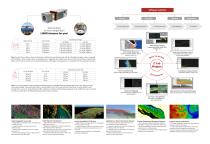
Several days or just a single day? LiDAR chooses for you! Z-Lab LiDAR-ctrl Inertial Explorer Z-Lab Pt-process Z-Lab Mapper TerraSolid Point Cloud Rendering (colorize to classify segment, density elevation, time, etc.) Point Cloud Cropping (cropped by gridding, facade, layer elevation, etc.) Point Cloud Accuracy Control (rectified by control points input & tie points matching) Note: the data shown above is based on flat terrain conditions for job reference only, and the estimated coverage per day is computed with 10 flights in total. Complex terrain of elevated areas or vegetated zones...
Open the catalog to page 2All South Surveying & Mapping Instrument Co., Ltd catalogs and technical brochures
 SOUTH MONITORING SYSTEM
21 Pages
 N4 Series
2 Pages
 N8 Series
2 Pages
 S750
S7502 Pages
 HX-U202 35W Radio
1 Page
 S86
S862 Pages
 S660N Brochure
2 Pages
 SOUTH Sky Cruiser UAV SYSTEM
2 Pages


Related Searches
- Measuring machine
- Touch screen tablet
- Wireless tablet
- Rugged tablet
- Bluetooth tablet
- WiFi tablet
- GNSS tablet
- Transceiver module
- Industrial tablet
- Windows tablet
- GPS tablet
- Radio antenna
- Android tablet
- Waterproof tablet
- 4 GB tablet
- Measurement monitoring module
- 8 GB tablet
- 4G LTE tablet
- Tablet PC
- Tablet with NFC reader
*Prices are pre-tax. They exclude delivery charges and customs duties and do not include additional charges for installation or activation options. Prices are indicative only and may vary by country, with changes to the cost of raw materials and exchange rates.