
- Catalogs
- Sourcetronic GmbH
- Manual ST2827 LCR Meter Series

Manual ST2827 LCR Meter Series

Manual ST2827 LCR Meter Series
- Package Inspection: Inspect the shipping container for damage and report any discrepancies with the packing list.
- Power Connection: Ensure the power supply voltage is within specified ranges and the power consumption is below 80VA.
- Fuse and Environment: Verify the fuse and ensure the environment is suitable for operation.
- Test Fixture and Warm-up: Use the test fixture properly and allow a warm-up period for optimal performance.
This manual is for the ST2827 Series Precision LCR Meter, detailing specifications, operational procedures, and safety warnings. Understanding these instructions is essential for accurate measurements and safe operation.
The ST2827 Series requires a low-noise environment and a reliable ground connection. It should not be used in environments with vibrations, dust, direct sunlight, or corrosive air. Operating temperature is 0℃ to 40℃ with ≤75% relative humidity.
Store the instrument in temperatures between 5℃ and 40℃ with humidity less than 85%RH, away from strong electromagnetic fields.
Use only the manufacturer's accessory test fixture or cable for accurate measurements. Ensure the fixture is clean and properly connected to the DUT.
A warm-up time of at least 15 minutes is required. The instrument dimensions are 430mm x 185mm x 473mm, weighing approximately 13kg.
The front panel includes keys and indicators for operation, while the rear panel features interfaces for LAN, USB, RS232, and IEEE-488.
The 4.3-inch TFT display is divided into zones for displaying test results and conditions. Users navigate menus using the cursor and soft keys.
Select measurement functions and set parameters such as test frequency, level, and speed. The instrument measures primary and secondary parameters of impedance components.
The
The ST2827 offers 11 AC and 14 DCR measurement ranges, with options to set the range to AUTO or HOLD.
The frequency range is from 20Hz to 1MHz, adjustable via soft keys or numeric input.
Measurement levels can be set based on RMS values, with options for voltage or current settings.
The device provides an internal DC bias voltage from -10V to +10V.
Options include FAST, MED, and SLOW, affecting integration time and display time.
The ST2827 can sort DUTs into up to 10 bins based on parameter limits.
Set up to 10 test points for frequencies, levels, or DC bias, with automatic sweep testing.
Four trigger modes: INT, MAN, EXT, and BUS, each for different testing scenarios.
Maintains a constant test voltage or current within specified ranges.
Open, short, and load corrections eliminate measurement errors.
Emphasizes the importance of connecting Hcur, Hpot, Lpot, and Lcur to form a complete measurement circuit.
Discusses the impact of stray capacitance and electromagnetic coupling on DUTs.
Provides steps for setting parameters, connecting the test fixture, and performing the test.
Describes measuring transformer parameters such as inductance, turn ratio, and mutual inductance.
- Use Kelvin test fixtures for high accuracy measurements.
- Ensure proper connection and correction to minimize test errors.
Comprehensive list of commands for various subsystems including MEAS, FREQuency, VOLTage, and more.
Commands for setting the DC isolation and bias functions.
Configure measurement functions, ranges, and monitoring settings.
Used for setting list sweep functions, including frequency, voltage, and current sweep points.
Control measurement speed and averaging.
Set the trigger source, delay, and measurement initiation.
Retrieve measurement results in ASCII format.
Manage correction functions like OPEN, SHORT, and LOAD.
Configure the bin comparator function, including enabling/disabling and setting modes.
Catalog excerpts

SOURCETRONIC − Qualitäts-Elektronik für Service, Labor und Produktion
Open the catalog to page 1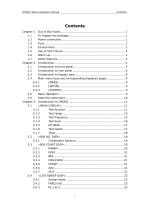
ST2827 Series Operation Manual
Open the catalog to page 2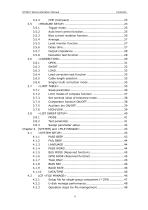
ST2827 Series Operation Manual
Open the catalog to page 3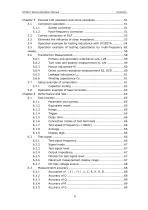
ST2827 Series Operation Manual Accuracy Accuracy Accuracy Accuracy
Open the catalog to page 4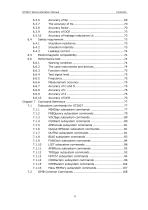
ST2827 Series Operation Manual
Open the catalog to page 5
ST2827 Series Operation Manual Announcement The description of the manual may not cover all contents of the instrument, and our company is subject to change and to improve the performance, function, inner structure, appearance, accessory and package of the instrument without notice. If there is puzzle caused by inconsistency of manual and instrument, then you can contact with our company by the address on the cover.
Open the catalog to page 6
ST2827 Series Operation Manual When you receive the instrument, some inspections are necessary, and the condition must be understood and available before installing the instrument. 1.1 To Inspect the package Inspect the shipping container for damage after unpacking it. It is not recommended to power on the instrument in the case of a damaged container. If the contents in the container do not conform to the packing list, notify us or your dealer. 1.2 Power connection 1) Power-supplying voltage range: 100~120Vac or 198~242Vac. Being related with the power setup on the rear panel. 2) Power-supplying...
Open the catalog to page 7
ST2827 Series Operation Manual 1.4 Environment 1) Please do not operate the instrument in the place that is vibrative, dusty, under direct sunlight or where there is corrosive air. 2) The normal working temperature is 0℃~40℃, relative humidity ≤75%, so the instrument should be used under above condition to guarantee the accuracy. 3) There is heat abstractor on the rear panel to avoid the inner temperature rising. In order to keep good airiness, please don’t obstruct the left and right airiness holes to make the instrument maintain the accuracy. 4) Although the instrument has been specially designed...
Open the catalog to page 8
ST2827 Series Operation Manual 1.7 Other features 1) Power: consumption power≤80VA. 2) Dimension (W*H*D): 430mm*185mm*473mm 3) Weight: About 13kg.
Open the catalog to page 9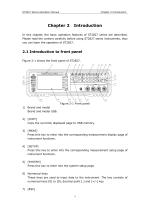
ST2827 Series Operation Manual In this chapter, the basic operation features of ST2827 series are described. Please read the content carefully before using ST2827 series instruments, thus you can learn the operation of ST2827. 2.1 Introduction to front panel Figure 2-1 shows the front panel of ST2827. 1 Figure 2-1 Front panel 1) Brand and model Brand and model USB. 2) [COPY] Copy the currently displayed page to USB memory. 3) [MEAS] Press this key to enter into the corresponding measurement display page of instrument functions. 4) [SETUP] Press this key to enter into the corresponding measurement...
Open the catalog to page 10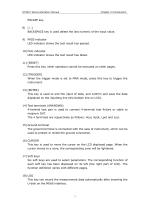
ST2827 Series Operation Manual ESCAPE key. 8) [←] BACKSPACE key is used delete the last numeric of the input value. 9) PASS indicator LED indicator shows the test result has passed. 10) FAIL indicator LED indicator shows the test result has failed. 11) [RESET] Press this key, other operation cannot be executed on other pages. 12) [TRIGGER] When the trigger mode is set to MAN mode, press this key to trigger the instrument. 13) [ENTER] This key is used to end the input of data, and confirm and save the data displayed on the inputting line (the bottom line on LCD). 14) Test terminals (UNKNOWN) 4-teminal...
Open the catalog to page 11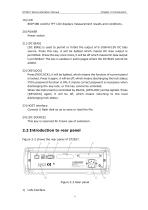
ST2827 Series Operation Manual 19) LCD 800*480 colorful TFT LCD displays measurement results and conditions. 20) POWER Power switch 21) [DC BIAS] [DC BIAS] is used to permit or forbid the output of 0-100mA/10V DC bias source. Press this key, it will be lighted which means DC bias output is permitted. Press this key once more, it will be off which means DC bias output is prohibited. The key is useless in some pages where the DC BIAS cannot be added. 22) [KEYLOCK] Press [KEYLOCK], it will be lighted, which means the function of current panel is locked. Press it again, it will be off, which means...
Open the catalog to page 12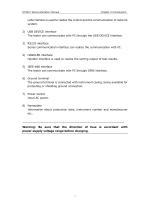
ST2827 Series Operation Manual LAN interface is used to realize the control and the communication of network system. 2) USB DEVICE interface The tester can communicate with PC through the USB DEVICE interface. 3) RS232 interface Series communication interface can realize the communication with PC. 4) HANDLER interface Handler interface is used to realize the sorting output of test results. 5) IEEE-488 interface The tester can communicate with PC through GPIB interface. 6) Ground terminal The ground terminal is connected with instrument casing, being available for protecting or shielding ground...
Open the catalog to page 13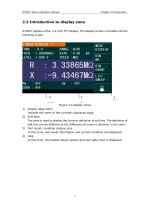
ST2827 Series Operation Manual 2.3 Introduction to display zone ST2827 applies a 65k, 4.3-inch TFT display. The display screen is divided into the following zones: Figure 2-3 display zones 1) Display page name Indicate the name of the currently displayed page. 2) Soft keys The zone is used to display the function definition of soft key. The definition of soft key can be different as the difference of cursor’s direction in the zone. 3) Test result/ condition display zone In this zone, test result information and current condition are displayed. 4) Help In this zone, information about system and...
Open the catalog to page 14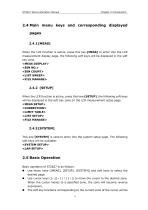
ST2827 Series Operation Manual 2.4 Main menu keys and corresponding displayed pages 2.4.1 [MEAS] When the LCR function is active, press this key-[MEAS] to enter into the LCR measurement display page, the following soft keys will be displayed in the soft key zone. 2.4.2 [SETUP] When the LCR function is active, press this key-[SETUP], the following soft keys will be displayed in the soft key zone on the LCR measurement setup page. 2.4.3 [SYSTEM] This key-[SYSTEM] is used to enter into the system setup page. The following soft keys will be available: 2.5 Basic Operation Basic operation of ST2827...
Open the catalog to page 15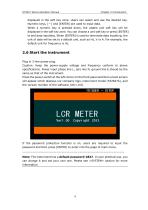
ST2827 Series Operation Manual displayed in the soft key zone. Users can select and use the desired key. Numeric keys, [←] and [ENTER] are used to input data. When a numeric key is pressed down, the usable unit soft key will be displayed in the soft key zone. You can choose a unit soft key or press [ENTER] to end data inputting. When [ENTER] is used to terminate data inputting, the unit of data will be set to a default unit, such as Hz, V or A. For example, the default unit for frequency is Hz. 2.6 Start the instrument Plug in 3-line power plug. Caution: Keep the power-supply voltage and frequency...
Open the catalog to page 16All Sourcetronic GmbH catalogs and technical brochures
 MPK-256
20 Pages
 Manual MPK-256 Microohmmeter
24 Pages
 Manual ST2822 LCR Meter Series
99 Pages
 Manual ST2829 LCR Meter Series
119 Pages
 Manual ST2830 LCR Meter Series
127 Pages
 Manual ST500 Frequency Inverter
180 Pages
 Measurement Technology
20 Pages

- Industrial tester
- Electronic filter
- Automatic test kit
- Multimeter
- Digital multimeter
- Benchtop tester
- Test set
- Frequency inverter
- AC electronic filter
- Insulation testing system
- Industrial test kit
- Industrial multimeter
- 1000 V multimeter
- Frequency multimeter
- AC/DC multimeter
- Three-phase electronic filter
- 3-phase frequency converter
- Benchtop test equipment
- Production tester
- Transformer tester