
- Catalogs
- Sony Semiconductors
- IMX291LQR

- Products
- Catalogs
- News & Trends
- Exhibitions
IMX291LQR

IMX291LQR
Sony has introduced two new back-illuminated CMOS image sensors, the IMX290LQR and IMX291LQR, designed for industrial applications. These sensors offer enhanced sensitivity in both visible-light and near-infrared regions, improving picture quality under low illumination conditions.
Specifications
The sensors feature a 2.9 μm-square unit pixel and a diagonal 6.46 mm (Type 1/2.8) square pixel array. They support Full HD resolution and offer two to three times the sensitivity compared to the existing IMX236LQJ model.
Technological Enhancements
The sensors utilize a back-illuminated structure with an expanded photodiode area, enhancing sensitivity in both visible and near-infrared light regions. The IMX290LQR includes DOL-WDR (Digital Overlap Wide Dynamic Range) technology, while the IMX291LQR does not.
WDR Functionality
The IMX290LQR supports both multiple exposure and DOL-type WDR functions, allowing for improved image quality under low light. The multiple exposure WDR outputs frames with varying exposure times, while the DOL-WDR outputs data for up to three frames with different storage times.
Interface Options
Both sensors offer versatile interface options, including low-voltage LVDS serial, MIPI CSI-2, and CMOS parallel interfaces. These interfaces support various output data rates and channel configurations to meet diverse application needs.
Performance Characteristics
The sensors provide high sensitivity characteristics, with the IMX290LQR achieving two or more times the sensitivity in visible light and three or more times in near-infrared light compared to previous models. They also support a range of drive modes and frame rates, enhancing their adaptability for different industrial applications.
Conclusion
The IMX290LQR and IMX291LQR sensors represent significant advancements in CMOS image sensor technology, offering improved sensitivity and versatile functionality for industrial imaging applications.
Catalog excerpts
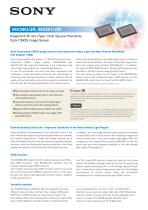
IMX290LQR, IMX291LQR Diagonal 6.46 mm (Type 1/2.8) Square Pixel Array Color CMOS Image Sensor Back-Illuminated CMOS image Sensors with Improved Visible Light and Near Infrared Sensitivity that Support 1080p Sony has developed the approx. 2.13M effective pixel backilluminated CMOS image sensors IMX290LQR and IMX291LQR with improved sensitivity in the visible-light and near infrared light regions for industrial applications. A new 2.9 μm-square unit pixel has been developed that combines a back-illuminated structure with technology for improving near infrared sensitivity to further enhance picture quality at low illumination while at the same time realizing Full HD cameras for industrial applications. This realizes two or more times the sensitivity in the visible-light region and three or more times the sensitivity in the near infrared light region than that of the existing Sony product (IMX236LQJ)*1. In addition, two types of WDR (Wide Dynamic Range) technology are also provided to further improve imaging performance. The new lineup includes the two types of the IMX290LQR, which has the DOL (Digital Overlap) -WDR function and the IMX291LQR, which does not have the DOL-WDR function. *1 See the New Product Information released in September 2013. Back-illuminated structure with 2.9 μm-square unit pixel High sensitivity characteristics (two or more times that of the existing product) Improved sensitivity in the near infrared light region (three or more times that of the existing product) Supports WDR (multiple exposure WDR, DOL-WDR) Versatile interface (CMOS parallel, low-voltage LVDS serial, MIPI CSI-2) * Exmor R is a trademark of Sony Corporation. The Exmor R is a Sony's CMOS image sensor with significantly enhanced imaging characteristics including sensitivity and low noise by changing fundamental structure of ExmorTM pixel adopted column parallel A/D converter to back-illuminated type. *STARVIS is a trademark of Sony Corporation. The STARVIS is back-illuminated pixel technology used in CMOS image sensors for surveillance camera applications. It features a sensitivity of 2000 mV or more per 1 μm2 (color product, when imaging with a 706 cd/m2 light source, F5.6 in 1 s accumulation equivalent), and realizes high picture quality in the visible-light and near infrared light regions. Back-Illuminated Structure + Improved Sensitivity in the Near Infrared Light Region Good sensitivity characteristics at low illumination and in the near infrared light region are a required performance of cameras for industrial applications. These new image sensors use a back-illuminated structure and also have an expanded photodiode area, which simultaneously improve sensitivity in both light regions compared to the existing front-illuminated structure. In addition, the new image sensors realize improved sensitivity characteristics two or more times in the visible-light region and three or more times in the near infrared light region (850 nm) compared to the existing Sony product (IMX236LQJ) with the same pixel size and increased sensitivity in the near infrared light region (Photograph 2). WDR Function The IMX290LQR supports both multiple exposure and DOLtype WDR functions. (The IMX291LQR supports only the multiple exposure-type WDR function.) The multiple exposure-type WDR function outputs one set of two or four frames with different exposure times. In this case, the gain can also be set separately for each frame in addition to the exposure time. The DOL-type WDR function outputs the data for up to three frames with different storage times line by line. By performing special signal processing with an ISP (Image Signal Processor) or other device at the image sensor rear-end, this enables improvement of picture quality under low illumination compared to the multiple exposure-type WDR function. Versatile interface The IMX290LQR and IMX291LQR are equipped with three different types of output interface (low-voltage LVDS serial, MIPI CSI-2, CMOS parallel) to meet diverse needs. The low-voltage LVDS serial interface has a maximum output data rate of 445.5 Mbps/ch and the number of output channels can be selected from 2ch, 4ch or 8ch. The MIPI CSI-2 interface has a maximum output data rate of 891 Mbps/lane and the number of output channels can be selected from 2 lanes or 4 lanes. The CMOS parallel interface has a maximum output data rate of 74.25 Mpixels/s.
Open the catalog to page 1
Condition: 400 lx F1.4 (Full HD image, 60 frames/s) Comparisons with the Existing Sony Product Condition1: 0.08 lx F1.4 (Full HD image, 30 frames/s) Existing IMX236LQJ Internal gain 48 dB Condition 2: 0 lx (850 nm IR) F1.4 (Full HD image, 30 frames/s) Existing IMX236LQJ Internal gain 0 dB Device Structure Item Output Image size 1945 (H) × 1097 (V) approx. 2.13M pixels 1305 (H) × 729 (V) approx. 0.95M pixels Unit cell size Optical blacks Front: 0 pixels, rear: 0 pixels Input drive frequency Low voltage LVDS serial 8 ch CMOS parallel Front:10 pixels, rear: 0 pixels Basic Drive Mode Low voltage...
Open the catalog to page 2All Sony Semiconductors catalogs and technical brochures
 IMX901-AMR
2 Pages
 IMX490
2 Pages
 IMX290NQV
2 Pages
 ISX016
2 Pages
 IMX390CQV
2 Pages
Archived catalogs
 SLD344YT
6 Pages
 SLD432S
5 Pages
 CXA3314ER
16 Pages
 CXB1818Q
17 Pages
 ICX205AK
24 Pages
 CXA2096N
17 Pages
 SLD433S4
5 Pages
 CXA4416GC
21 Pages
 CXA2984GC SP4T ANT SW
11 Pages
 SLD335YT
5 Pages
 CXM3807K
24 Pages
 CXM3648UR
11 Pages
 CXM3645ER
12 Pages
 CXM3642K
29 Pages
 CXM3641ER
22 Pages
 CXM3632ER
22 Pages
 CXM3630UR
15 Pages
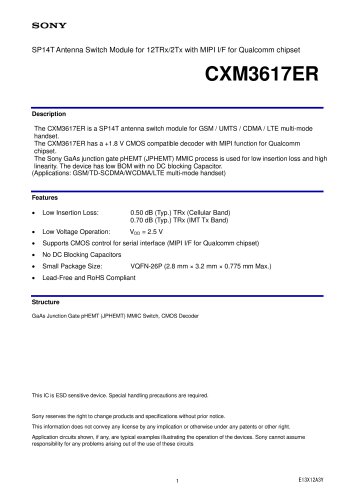 CXM3617ER
23 Pages
 CXM3614ER
14 Pages
 CXM3604UR
14 Pages
 CXM3599UR
15 Pages
 CXM3593UR
11 Pages
 SLD1332V
5 Pages
 CXM3592AUR
15 Pages
 CXM3583AUR
17 Pages
 CXM3582UR
17 Pages
 CXM3580UR
13 Pages
 CXM3580AUR
17 Pages
 CXM3572ER
14 Pages
 CXM3570ER
13 Pages
 CXM3569XR
13 Pages
 ICX418ALB
20 Pages
 CXD4728R
68 Pages
 ICX642BKA
23 Pages
 CXA3791EN
13 Pages
 SLD332F
6 Pages
 CXG1407XR
11 Pages
 IMX252LLR/LQR
2 Pages
 IMX230
2 Pages
 IMX377CQT
5 Pages
 IMX249LLJ/LQJ
2 Pages
 IMX323LQN
2 Pages
 IMX258
2 Pages
 IMX302LQJ
2 Pages
 CXD4017R
34 Pages
 CXA3197R
30 Pages
 IMX222LQJ
2 Pages
 IMX324
2 Pages
 IMX367LLA
2 Pages
 IMX412-AACK
2 Pages
 IMX385LQR
2 Pages
 IMX294CJK
2 Pages
 IMX253LLR/LQR
2 Pages
 IMX273LLR/LQR
2 Pages
 IMX183CLK-J/CQJ-J
2 Pages
 IMX249LLJ/IMX249LQJ
2 Pages
 IMX250LLR/LQR,IMX252LLR/LQR
2 Pages
 B/W Video Camera CCD ICX422AL
17 Pages
 B/W Video Camera CCD ICX279AL*2
18 Pages
 Color Video Camera CCD ICX239AKE
18 Pages
 Color Video Camera CCD ICX418AKL
22 Pages


- Display module
- LCD display panel
- Color display panel
- LED display panel
- RGB display panel
- Compact display panel
- GNSS receiver
- Compact receiver
- Industrial receiver
- OLED display
- High-definition display module
- Laser diode
- Satellite receiver
- Vision sensor
- Communication card
- Full HD display
- Fiber laser diode
- Sony visible image sensor
- Sony infrared image sensor