
- Catalogs
- Sony Semiconductors
- IMX273LLR/LQR

- Products
- Catalogs
- News & Trends
- Exhibitions
IMX273LLR/LQR

IMX273LLR/LQR
The document introduces a new lineup of CMOS image sensors designed for industrial applications. These sensors offer high resolution and high-speed imaging capabilities, featuring approximately 1.58M effective pixels for high-resolution imaging and 0.4M effective pixels for higher-speed imaging.
Key Features
- Global Shutter Function: Eliminates distortion and flash bands, ensuring high-quality image capture.
- High Frame Rate: Achieves up to 436.9 frames per second, enhancing processing speed for industrial applications.
- Compact Size: The sensors are compact, measuring 14 mm × 14 mm, facilitating easy integration into various devices.
- Expanded Lineup: Includes sensors with 3.45 μm and 6.9 μm pixels, supporting Sub LVDS and MIPI interfaces.
Technological Advancements
- Exmor Technology: Provides high-speed processing, low noise, and low power dissipation.
- Pregius Technology: Utilizes global shutter pixel technology for high picture quality.
Applications
- Suitable for defect and scratch inspection processes, barcode scanning, and shape checking.
- High sensitivity in near-infrared wavelengths enhances performance in low-light conditions.
Interface and Compatibility
- MIPI Interface: CSI-2-compliant, facilitating use in cellular and surveillance cameras.
- Pin Compatibility: Ensures easy camera design with the same footprint pattern for the drive board.
Additional Functions
- Includes external trigger mode, multiple exposure functions, and ROI mode for industrial applications.
- Supports synchronization of multiple image sensors for coordinated operation.
Product Specifications
- IMX273LLR/LQR and IMX296LLR offer 1.58M effective pixels with a 3.45 μm pixel size.
- IMX287LLR/LQR and IMX297LLR provide 0.4M effective pixels with a 6.9 μm pixel size.
Conclusion
The new CMOS image sensors by Sony are designed to meet the growing demands of industrial applications, offering high-speed, high-resolution imaging with advanced features and compatibility for diverse applications.
Catalog excerpts
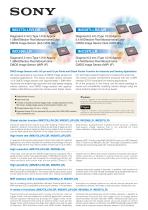
IMX273LLR/LQR Diagonal 6.3 mm (Type 1/2.9) Approx. 1.58M-Effective Pixel Monochrome/Color CMOS Image Sensor (Sub LVDS I/F) IMX287LLR/LQR QR Diagonal 6.3 mm (Type 1/2.9) Approx. 0.4 M-Effective Pixel Monochrome/Color CMOS Image Sensor (Sub LVDS I/F) IMX296LLR Diagonal 6.3 mm (Type 1/2.9) Approx. 1.58M-Effective Pixel Monochrome CMOS Image Sensor (MIPI I/F) IMX297LLR Diagonal 6.3 mm (Type 1/2.9) Approx. 0.4 M-Effective Pixel Monochrome CMOS Image Sensor (MIPI I/F) CMOS Image Sensors with 3.45 μm and 6.9 μm Pixels and Global Shutter Function for Industrial and Sensing Applications ustrial We have developed a new lineup of CMOS image sensors for industrial applications. This lineup includes optical size-type 1/2.9 CMOS image sensors with approximately 1.58M effective pixels that enable high resolution and high-speed imaging without distortion, and CMOS image sensors with approximately 0.4M effective pixels that achieve even higher resolu■ Global ■ High tion and higher-speed imaging by increasing the pixel size. The lineup includes monochrome products that use a MIPI interface (CSI-2-compliant) for sensing applications. All of the products in this lineup use the same package to ensure pin compatibility, enabling camera design using the same footprint pattern for the drive board. shutter function frame rate * Exmor is a trademark of Sony Corporation. The Exmor is a version of Sony's high performance CMOS image sensor with high-speed processing, low noise and low power dissipation by using column-parallel A/D conversion. of functions (external trigger mode, multiple exposure function, ROI mode, multiple image sensor synchronization function, etc.) lineup (3.45 μm pixel and 6.9 μm pixel, Sub LVDS, MIPI interface (CSI-2-compliant), etc.) * Pregius is a trademark of Sony Corporation. The Pregius is global shutter pixel technology for active pixel-type CMOS image sensors that use Sony's low-noise CCD structure, and realizes high picture quality. Global shutter function (IMX273LLR/LQR, IMX287LLR/LQR, IMX296LLR, IMX297LLR) Industrial applications require accurate imaging of fast-moving subjects, however conventional rolling shutter-type image sensors have problems properly capturing fast-moving subjects due to issues such as flash bands and distortion of the subject due to focal plane phenomena. Equipped with a global shutter function, enables high-quality image capture that is not affected by focal plane distortion or flash bands (Photo-2). High frame rate (IMX273LLR/LQR, IMX287LLR/LQR) In response to the growing demand for higher frame rates for industrial applications, the column-parallel A/D conversion technology of Sony's CMOS image sensors was used to realize a frame rate of up to 226.5 frame/s (ADC 10-bit) for the IMX273LLR/LQR, and up to 436.9 frame/s (ADC 10-bit) for the IMX287LLR/LQR. This made it possible to further increase the processing speed for industrial applications. High resolution (IMX273LLR/LQR, IMX296LLR) These type 1/2.9 optical size CMOS image sensors equipped with a global shutter function have approximately 1.58M effective pixels. This results in a smaller pixel size compared to competing products, but these products also realize high picture quality (Photo-1). This enables use for defect and scratch inspection processes that require higher resolution in addition to typical machine vision camera applications such as scanning barcodes and checking specific shapes. High sensitivity (IMX287LLR/LQR, IMX297LLR) Use of a 6.9 μm pixel size achieves sensitivity four times that of the IMX273LLR/LQR and IMX296LLR. This means that the same sensor output can be obtained even with a shorter shutter time, making it possible to increase inspection speeds in factories. In addition, high sensitivity is achieved even in the near-infrared wavelength band that generally has low quantum efficiency, thereby realizing superior performance. MIPI interface (CSI-2-compliant) (IMX296LLR, IMX297LLR) Due to increasing sensing application demand, these products use a MIPI interface (CSI-2-compliant) as the output interface. This facilitates diversion as a design platform for cellular device cameras and surveillance cameras, and helps to reduce product introduction cost. 2 A variety of functions (IMX273LLR/LQR, IMX287LLR/LQR, IMX296LLR, IMX297LLR) These products are equipped with a variety of functions, such as trigger mode, that are needed for industrial application cameras. Various exposure methods are provided for Trigger mode, which controls the exposure time using an external pulse, such as Fast Trigger mode, which reduces the delay from trigger input until the start of exposure, Multi Exposure mode, and other modes. Regarding functions that simultaneously control multiple cameras, in addition to conventional functions that use trigger input, an image sensor synchronization function has been newly introduced that uses sync signals output by the image sensor set as the master to control sensors set as slaves. Furthermore, the IMX273LLR/LQR supports ROI mode, which crops and outputs arbitrary areas
Open the catalog to page 1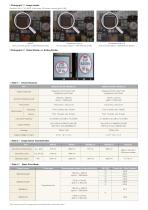
<Photograph 1> Image sample Condition: 20 lx F 4.0 (ADC 10-bit mode, 30 frame/s, internal gain 18 dB) IMX273 (3.75 μm pixels approx. 1.55M effective pixels) Competing product A (4.8 μm pixels approx. 1.31M effective pixels) Competing product B (4.5 μm pixels approx. 1.92M effective pixels) <Photograph 2> Global Shutter vs. Rolling Shutter <Table 1> Device Structure Item Output image size Diagonal 6.3 mm (Type 1/2.9) progressive scan mode Diagonal 6.3 mm (Type 1/2.9) progressive scan mode Number of effective pixels Unit cell size Front: 0 pixels, rear: 0 pixels Front: 0 pixels, rear: 0 pixels...
Open the catalog to page 2All Sony Semiconductors catalogs and technical brochures
 IMX901-AMR
2 Pages
 IMX490
2 Pages
 IMX290NQV
2 Pages
 ISX016
2 Pages
 IMX390CQV
2 Pages
Archived catalogs
 SLD344YT
6 Pages
 SLD432S
5 Pages
 CXA3314ER
16 Pages
 CXB1818Q
17 Pages
 ICX205AK
24 Pages
 CXA2096N
17 Pages
 SLD433S4
5 Pages
 CXA4416GC
21 Pages
 CXA2984GC SP4T ANT SW
11 Pages
 SLD335YT
5 Pages
 CXM3807K
24 Pages
 CXM3648UR
11 Pages
 CXM3645ER
12 Pages
 CXM3642K
29 Pages
 CXM3641ER
22 Pages
 CXM3632ER
22 Pages
 CXM3630UR
15 Pages
 CXM3617ER
23 Pages
 CXM3614ER
14 Pages
 CXM3604UR
14 Pages
 CXM3599UR
15 Pages
 CXM3593UR
11 Pages
 SLD1332V
5 Pages
 CXM3592AUR
15 Pages
 CXM3583AUR
17 Pages
 CXM3582UR
17 Pages
 CXM3580UR
13 Pages
 CXM3580AUR
17 Pages
 CXM3572ER
14 Pages
 CXM3570ER
13 Pages
 CXM3569XR
13 Pages
 ICX418ALB
20 Pages
 CXD4728R
68 Pages
 ICX642BKA
23 Pages
 CXA3791EN
13 Pages
 SLD332F
6 Pages
 CXG1407XR
11 Pages
 IMX291LQR
2 Pages
 IMX252LLR/LQR
2 Pages
 IMX230
2 Pages
 IMX377CQT
5 Pages
 IMX249LLJ/LQJ
2 Pages
 IMX323LQN
2 Pages
 IMX258
2 Pages
 IMX302LQJ
2 Pages
 CXD4017R
34 Pages
 CXA3197R
30 Pages
 IMX222LQJ
2 Pages
 IMX324
2 Pages
 IMX367LLA
2 Pages
 IMX412-AACK
2 Pages
 IMX385LQR
2 Pages
 IMX294CJK
2 Pages
 IMX253LLR/LQR
2 Pages
 IMX183CLK-J/CQJ-J
2 Pages
 IMX249LLJ/IMX249LQJ
2 Pages
 IMX250LLR/LQR,IMX252LLR/LQR
2 Pages
 B/W Video Camera CCD ICX422AL
17 Pages
 B/W Video Camera CCD ICX279AL*2
18 Pages
 Color Video Camera CCD ICX239AKE
18 Pages
 Color Video Camera CCD ICX418AKL
22 Pages


- Display module
- LCD display panel
- Color display panel
- LED display panel
- RGB display panel
- Compact display panel
- GNSS receiver
- Compact receiver
- Industrial receiver
- OLED display
- High-definition display module
- Laser diode
- Satellite receiver
- Vision sensor
- Communication card
- Full HD display
- Fiber laser diode
- Sony visible image sensor
- Sony infrared image sensor