
- Catalogs
- Sontheim Industrie Elektronik GmbH
- Product Catalog

Product Catalog

Product Catalog
Sontheim is a system supplier specializing in fieldbus-based communication, control, and diagnostic tasks for automotive and industrial systems. They offer modular hardware and software solutions for optimal networking, automation, and analysis, covering the entire product lifecycle from design to support.
Sontheim provides solutions in mobile automation, diagnostics, connectivity, and industrial automation. Their services include technology consulting, engineering, production, and support, with a focus on CAN, EtherCAT, and PROFIBUS technologies.
As experts in fieldbus technologies, Sontheim supports customer-specific developments in software, hardware, and firmware. They focus on efficient energy management and Industry 4.0 solutions. Their consulting services incorporate the latest standards and technologies, ensuring state-of-the-art developments.
Sontheim offers training on CAN, diagnostic applications, and standards like ODX and OTX. These workshops are tailored to customer needs and can be conducted on-site or at Sontheim's premises.
Sontheim manufactures electronic components and systems with flexibility, handling batch sizes from prototypes to large series. They emphasize quality and cost-optimization, supported by certifications.
Sontheim provides obsolescence management to monitor the product lifecycle, particularly focusing on semiconductors, ensuring customers can react early to lifecycle changes.
Sontheim offers robust, scalable solutions for automation, diagnostics, and connectivity in mobile machines, adhering to international standards. Their portfolio includes control units, display solutions, sensors, and telemetry systems with cloud infrastructure.
The eSys-SVCx product family includes powerful electronic control units for safety-related applications up to ASIL-C, featuring robust construction and AUTOSAR-compliant software.
Sontheim's CAN Display is designed for mobile machines, offering high-resolution visualization and control via CAN interface, supporting MDT® 2.0 applications and diagnostic standards.
The Ultrasonic Wind Sensor and Position Sensor provide environmental data measurement with CAN interface and J1939 protocol support, featuring robust construction and fast data handling.
Sontheim's diagnostics solutions include software, VCIs, and protocol stacks, with the MDT® 2.0 tool offering ODX and OTX standards, multi-platform support, and a high-performance runtime system.
MDT® 2.0 provides a standardized method for accessing diagnostic data using the OTX format as per ISO 13209. It supports ODX for service execution, enabling efficient diagnostic workflows. The tool offers multi-platform support, allowing applications to run on various operating systems like Windows, Linux, and QNX.
MDT® 2.0 includes an OTX wizard for simplified editing, native RMI support, and integration with Microsoft Project. It features a modern design with Visual Studio integration, supporting SVN, Git, and graphical modules for enhanced user experience.
This cloud service facilitates the monitoring and maintenance of diagnostic data, offering secure data exchange and integration with ERP systems. It supports HTTPS and SSL/TLS encryption for data security and allows for centralized license management and automated processes.
CLCM 2.0 is a web-based tool for managing diagnostic and communication descriptions of ECUs. It supports collaborative work, integrates with existing workflows, and provides tools like ODX Explorer, Grid View, and Vehicle View for efficient data management.
COMfalcon® is a versatile VCI with WLAN/LAN interfaces, supporting multiple CAN channels and various diagnostic protocols. It features robust housing, error frame detection, and ID-based level measurement for comprehensive network diagnostics.
The document provides detailed technical specifications for the COMfalcon® VCI, including interfaces, memory, and environmental conditions, ensuring compatibility with various automotive applications.
The document provides detailed technical specifications and features of various Vehicle Communication Interfaces (VCIs) used in automotive diagnostics. These devices facilitate communication between diagnostic tools and vehicle networks, primarily using CAN (Controller Area Network) protocols.
- A powerful VCI with WLAN/LAN and optional Bluetooth communication.
- Features four independent CAN channels, optional SD card integration, and IP65 protection.
- Supports LUA scripting for embedded applications and error frame detection for CAN network monitoring.
- Technical specifications include a Freescale PowerPC CPU, 64 MB RAM, and up to 32 GB memory.
- A compact CAN-to-Bluetooth gateway with an OBD interface.
- Equipped with a CAN interface according to ISO 11898-2 and optional 3D acceleration sensor for anti-theft protection.
- Features Bluetooth 4.1 connectivity and is compatible with Android and iOS devices.
- Technical specifications include a 32-bit microcontroller, 2 MB SPI-Flash memory, and IP20 protection.
- A smart ISOBUS gateway with Bluetooth connectivity.
- Features an ISOBUS interface according to ISO 11783 and a CAN interface according to ISO 11898-2.
- Optional WLAN connectivity and integrated MT-API interface for OEM applications.
- Technical specifications include a 32-bit microcontroller, 32 MB SDRAM, and IP20 protection.
- A fieldbus-to-USB adapter with a galvanically isolated CAN interface and RS232 channel.
- Supports CODESYS Gateway-driver and offers free configuration of baud rates.
- Technical specifications include a 32-bit microcontroller, USB 2.0 interface, and compact plastic housing.
- A top-selling VCI for connecting PCs or notebooks to CAN bus networks.
- Features shock-resistant aluminium housing and optional error frame detection.
- Supports hot plug and play and provides flexible data processing.
- Technical specifications include a Motorola Star12 CPU, Philips PDIUSB12 for USB, and galvanically isolated CAN channels.
- All devices support CAN data visualization, monitoring, and processing.
- They facilitate vehicle diagnostics and flash processes of electronic control units (ECUs).
- Each device is designed for specific use cases, offering various connectivity options and protection classes.
The document provides detailed technical specifications and features of various automotive diagnostic and connectivity tools, including CANUSB devices, protocol stacks, CANexplorer 4 software, and COMhawk® devices. These tools are designed for vehicle diagnostics, data logging, and communication tasks in automotive and automation industries.
The document lists several CANUSB models with varying capabilities, such as single or dual CAN channels, error frame detection, and level measurement. These devices are used for vehicle diagnostics and support standardized vehicle access via D-PDU-API and SAE J2534 API.
The document highlights the availability of various protocol stacks like DoIP, UDS, and J1939, which are essential for communication in automotive applications. These stacks are developed according to international standards and can be customized for specific requirements.
This software is a modular, intuitive tool for analyzing CAN networks. It supports user-defined measurement setups, data processing, and visualization. Key features include support for CANopen and J1939 protocols, data abstraction, and the ability to handle raw CAN data.
COMhawk® and COMhawk® xt are control devices for communication and diagnostic tasks, featuring multiple interfaces such as CAN, Ethernet, and WLAN. They are designed for rugged environments and support a wide range of applications in automotive and automation sectors.
The document provides detailed technical data for each device, including operating systems, CPU requirements, memory specifications, and environmental conditions. It also includes information on supported hardware and software features.
The tools and devices described are used for vehicle diagnostics, data logging, communication interfaces, and telemetry tasks. They are suitable for use in complex automotive systems and can be customized for specific project requirements.
The document provides detailed technical specifications and applications for the COMhawk® xt and COMhawk® xt light devices, as well as the IoT Device Manager and IoT Analytics Manager tools. These products are designed for telemetry, diagnostics, and data management in automotive and industrial environments.
This device serves as a versatile telemetry and diagnostic gateway, supporting various communication standards. It features a powerful ARM Cortex A9 processor, optional GNSS receiver, and a range of connectivity options including Ethernet, WLAN, and 2G/LTE. The device is robust, with an IP69K protection rating, and operates within a temperature range of −20 °C to +70 °C.
The COMhawk® xt includes up to 4 CAN interfaces, a BroadR-Reach Ethernet interface, and optional sensors such as a three-axis accelerometer and temperature sensor. It operates on a Linux OS, facilitating OEM application development.
A cost-effective version for simpler telematics tasks, featuring a single CAN channel with J1939 protocol support and 2G/LTE connectivity. It is suitable for both mobile and stationary applications, with an IP67 protection rating and an operating temperature range of −30 °C to +70 °C.
A cloud-based platform for managing telematics units, enabling live data monitoring, over-the-air updates, and telemetry data storage for analysis. It supports secure data transfer and can be customized for OEM-specific branding.
This tool provides data visualization and analysis capabilities, allowing OEMs to configure dashboards and monitor live data. It supports secure data transfer and can be integrated into existing infrastructures.
The document highlights the use of these tools and devices in automotive diagnostics, vehicle lifecycle support, and industrial automation. The eControl nano and eControl micro are also discussed as control systems for industrial environments, featuring robust designs and multiple communication interfaces.
The document provides detailed technical specifications and features of various automation control systems, including eControl micro, eControl mIO xt, ePC, and IPC-4. These systems are designed for industrial automation applications, offering a range of functionalities and interfaces to meet diverse operational needs.
- Features a CANopen master functionality for optimal control of IOs and drives.
- Technical specifications include a Freescale 400 MHz CPU, 128 MB RAM, and expandable memory via a microSD card up to 32 GB.
- Supports CODESYS programming according to IEC 61131-3.
- Offers a variety of robust IO modules and expansion capabilities.
- Equipped with a 10.1" touch display and a motion sensor for energy efficiency.
- Includes multiple interfaces: 2× CAN, 2× Ethernet, USB, and digital/analog inputs and outputs.
- Supports EtherCAT and OPC UA for network configuration.
- Technical specifications include an IMX6 Quad Core CPU, 1 GB RAM, and a Linux operating system.
- A modular embedded platform with a design principle allowing extensions without altering the basic system.
- Features Atom-CPU with passive cooling and a full metal housing for EMC protection.
- Includes interfaces like CAN, Ethernet, IOs, CFast, DVI, and USB.
- Offers Link2Go for easy addition of extension modules.
- Designed for scalability and performance in industrial environments.
- Features include multiple interfaces, scalable CPU and RAM, and robust design for harsh conditions.
- Technical specifications include options for Intel Celeron M and Core 2 Duo processors, up to 4 GB RAM, and various interface options.
- Support for various industrial protocols and standards, including CAN, EtherCAT, and OPC UA.
- Robust design suitable for harsh industrial environments.
- Modular and scalable architecture for flexibility and adaptability.
- Energy-efficient operation with integrated motion sensors and passive cooling options.
The document provides detailed technical specifications and features of various industrial automation products, including IPC-4, eControl terminal, Panel-PC 8000, and IO Modules. It covers aspects such as hardware specifications, interfaces, safety features, and operational capabilities.
The IPC-4 series includes models with different Intel processors, ranging from 600 MHz Intel Celeron M to 2.16 GHz Intel Core2Duo. It supports various data transmission standards and interfaces, including RJ45, VGA, USB, and DVI.
This is a mobile explosion-proof terminal designed for hazardous areas, featuring a 7'' touch display, Intel Atom CPU, and Windows Embedded 7 OS. It offers a robust design with IP54 protection, RFID capabilities, and a battery life of up to 6 hours.
A robust terminal for machine control and HMI purposes, equipped with a 1.1 GHz Intel Atom processor, 512 MB RAM, and a 7'' display. It supports flexible mounting options and various interfaces, including USB and Ethernet.
The document details several IO modules like DIO32, DI32, and Multi-IO, highlighting their capabilities in handling digital and analog signals. These modules feature galvanically isolated inputs, high process reliability, and are designed for use in complex machine networks.
Each product section includes comprehensive technical data such as CPU specifications, memory, interfaces, operating conditions, and protection classes. The document also provides order information and pin assignments for various modules.
The document provides detailed technical specifications and features of various IO modules used in industrial automation, focusing on network surveillance, safety measures, and CAN interface integration.
The IO modules include a guarding capability integrated for network surveillance. A relay contact serves as an additional safety measure, and the module enters STOP-mode if guarding by the master is absent.
The integrated CAN interface complies with DS 301 and 401 standards, ensuring flexible use in CAN bus networks. All interfaces adhere to ISO 11898 standards.
The Multi-IO is powered by 24 V with reverse polarity protection and EMC circuit protection against short overvoltage peaks.
Digital outputs can be configured with Highside or Lowside switches, toggling supply voltage to load.
Detailed pin assignments are provided for inputs and outputs, including bridging options for voltage connections.
Specifications include CPU type, CAN interface details, terminal block connections, operating system display, dimensions, weight, protection class, temperature ranges, humidity, power supply, and consumption.
The document specifies the number of inputs and outputs, circuit types, potential isolation, switching levels, input/output currents, signal delays, and sampling frequencies.
Details include the number of inputs/outputs, resolution, potential isolation, voltage ranges, and filter circuitry.
Emphasis on high-quality standards and certifications to ensure customer satisfaction and long-term relationships.
Features 160 digital inputs and 192 digital outputs, suitable for CAN networks with high process reliability and short conversion times.
An analog output module with 8 outputs, designed for high process reliability and continuous operation in complex networks.
A digital input module with 32 channels, featuring robust connections and galvanic isolation for safety-relevant environments.
Designed for flexibility in fieldbus networks, supporting rapid process changes with existing resources and numerous expansion options.
The document provides detailed technical specifications and features of various IO modules used in industrial automation, focusing on CAN interfaces and related components.
- Master Module: Central to the eControl IO system, featuring 16 digital inputs and outputs, 2 analog inputs and outputs, and a microcontroller for system control. It includes LED indicators and RJ45 ports for CAN bus connectivity, with settings adjustable via DIP switches.
- Expansion Options: Allows connection of up to six additional IO modules, including motor, analog, digital, and temperature modules, with automatic addressing.
- Rugged Design: Features robust Phoenix clamps and an aluminum housing for durability.
- Digital Inputs/Outputs: 16 each, with specific voltage and current ratings, and protection against thermal overload.
- Analog Inputs/Outputs: 2 each, with a 10-bit resolution and specified voltage/current ranges.
- Environmental Conditions: Operating temperature from 0°C to 60°C, with extended ranges available, and storage temperature from -20°C to 70°C.
- Power Supply: 24 V ±10%, with specific connection requirements.
- Design: Cost-effective with high performance, suitable for control cabinet installation.
- CANopen Protocol: Supports DS 301 and DS 401 standards, with baud rates up to 1 Mbit/s.
- Interfaces: Compact design with front panel access to interfaces, LEDs, and switches.
- IPC-4: A master unit for automation systems, offering scalable performance and multiple interfaces.
- TM-PT100/1000-L: Temperature measurement module supporting up to 8 sensors, with flexible connection options and fast measurement capabilities.
- EC-DIO32: Digital module with 32 configurable inputs/outputs, featuring a 16-bit microprocessor and designed for flexible fieldbus networks.
The document outlines a comprehensive range of IO modules and components designed for industrial automation, emphasizing flexibility, robust design, and compliance with industry standards.
The document provides detailed technical specifications and features of various industrial automation modules, including the EC-DIO32 RM35, CAN-RS232 Interface Converter, RS422 Multiplexer, IGI 16, and Relay Module. These modules are designed for flexible and efficient process automation in industrial settings.
- A digital 24 V remote IO module with 32 freely configurable inputs and outputs, divided into four blocks of eight interfaces each.
- Features include potential isolation via optocouplers, a sampling frequency of 2.5 kHz, and a signal delay of less than 100 μs.
- Equipped with EtherCAT and CAN interfaces for decentralized communication, and diagnostic features for monitoring power levels and switching habits.
- Compact aluminium housing with IP20 protection and integrated top hat rail mounting.
- Provides up to four RS232 channels with D-Sub9 plugs, compliant with CANopen specification.
- Features a 16-bit microcontroller and galvanically isolated CAN interface according to ISO 11898.
- Compact aluminium housing with IP20 protection, suitable for control cabinet installation.
- 24 V module with 10 inputs for incremental encoders, designed for TS35 top hat rail mounting.
- Features include a maximum baud rate of 500 kHz and a compact aluminium housing with IP20 protection.
- Designed for capturing positioning data with 16 incremental encoder inputs, compliant with CANopen specification.
- Features a 16-bit microcontroller and a CAN interface with galvanic isolation.
- Compact aluminium housing with IP20 protection, suitable for control cabinet installation.
- Controls up to eight heating cartridges with 400 V, featuring high process reliability and short conversion times.
- Equipped with an ARM7 microcontroller and a CAN interface according to ISO 11898.
- Compact housing with IP20 protection, designed for top hat rail mounting.
- All modules are designed for easy integration into existing systems, with configurable inputs and outputs, and robust interfaces for reliable operation.
- Diagnostic features and status LEDs provide real-time monitoring and error detection capabilities.
- Modules comply with relevant industrial standards and offer flexibility for various automation applications.
The document provides detailed technical specifications and features of various industrial automation products from Sontheim, including the mSiEcomTCtt, iMX6, SMC100, MC105, and EvoPrint® systems. These products are designed for use in harsh environments and offer a range of functionalities suitable for industrial applications.
This is a compact Computer-on-Module featuring an Intel Atom processor, suitable for harsh environments with an extended temperature range of -40 °C to +85 °C. Key features include COM Express mini, Type 10, multiple interfaces (3x PCI Express, 6x USB 2.0, 1x CAN interface), and onboard LAN. It supports up to 2 GB DDR2-800 RAM and is ideal for mobile embedded systems.
The iMX6 is an ultra-energy-saving Computer-on-Module based on ARM technology, offering scalable performance with Freescale i.MX6 processors. It supports up to 4 GB DDR3 memory and features numerous interfaces, including 3x USB 2.0 and 3x PCIe. It is designed for a wide temperature range and is suitable for various industrial applications.
The SMC100 is a stepper motion controller for bipolar 2-phase stepper motors, featuring a compact aluminium housing with IP20 protection. It offers free configuration and storage of operating data, with safety features like an emergency-stop function. It supports up to 10 A phase current and includes a CAN interface.
The MC105 is a motion controller for up to four DC motors, providing high ease of use with integrated logic for operation data management. It features safety functions, including an emergency stop, and supports EtherCAT fieldbus. The housing is compact with IP20 protection, and it supports 24 V DC motors up to 5 A.
EvoPrint® is an industrial printing system that integrates seamlessly into existing processes. It supports HP Inkjet Technology and offers features like active speed compensation and direction detection. The system is robust, with a maximum print speed of 180 m/min at 300 dpi resolution, and is suitable for various industrial applications.
The document outlines the comprehensive product life cycle, including design, development, production, integration, and support phases. This approach ensures close customer support and enables agile responses. Services offered include individual prototypes, series deliveries, and customized solutions.
The MDT® 2.0 is a standardized tool for accessing machine data, supporting ODX and OTX standards, and featuring an OPC UA server and client. Key features include high-performance runtime, multi-platform support, and innovative machine park monitoring. It allows for the creation and implementation of test bench workflows and ensures data reusability and integration into broader environments.
CANexplorer 4 is a modular, intuitive software for analyzing CAN networks in machines and vehicles. It supports user-defined measurement setups, modular design, and protocol support for CANopen and J1939. The software offers data processing, visualization, and abstraction capabilities, allowing for comprehensive analysis and monitoring of CAN data.
The eSys-IDC4E1 gateway connects different CAN buses via IP networks, featuring a robust design with four galvanically isolated CAN interfaces and an Ethernet connection. It includes diagnostic functions, error frame detection, and supports the SAE J2534 API for higher-level protocol implementation.
COMfalcon® is a powerful CAN interface with WLAN/LAN connectivity, offering four independent CAN channels and optional features like data logging and scripting. It is designed for monitoring, flashing, and analyzing CAN networks, with a rugged housing and error frame detection capabilities.
The document provides a detailed description of the Sontheim Modular Diagnostic Tool Chain, focusing on various diagnostic solutions for automation applications. It highlights the integration of hardware and software for CAN data visualization, network control, machine diagnostics, and ECU flash processes.
This section introduces the COMfalcon®, a modular diagnostic tool with features like CAN data visualization, parameterization, and machine diagnostics. Key specifications include a Freescale PowerPC CPU, 64 MB RAM, and multiple interfaces (CAN, RS232, RS485, RS422, LAN, WLAN). The device supports baud rates from 50 Kbit/s to 1 Mbit/s and operates within a temperature range of -20 °C to +60 °C.
An enhanced version of the COMfalcon®, the COMfalcon® plus offers additional features such as WLAN/LAN connectivity, optional Bluetooth, and LUA scripting for embedded applications. It supports error frame detection and ID-based level measurement, crucial for diagnosing network issues like short circuits.
The CANfox® is a fieldbus-to-USB adapter designed for flexibility and cost-effectiveness. It includes a galvanically isolated CAN interface and an RS232 channel, supporting baud rates up to 1 Mbit/s. The device is compatible with various Windows operating systems and offers hot plug and play functionality.
A popular interface device, the CANUSB connects PCs or notebooks to CAN buses. It features shock-resistant housing, optional error frame detection, and supports both CAN 2.0 A and B standards. The device is suitable for a wide range of operating systems and offers a maximum data transfer rate of 1 Mbit/s.
This section describes the PowerCAN-PCI V2, a high-performance CAN controller card for PCs with PCI slots. It features two galvanically isolated CAN channels, a Freescale Coldfire microcontroller, and supports transmission performance of 1 Mbit/s at 90% bus load.
The Sontheim Modular Diagnostic Tool Chain provides versatile and robust solutions for automation diagnostics, offering a range of interfaces and features to meet diverse application needs.
The document provides technical specifications and features of various automation and connectivity products, including CAN interface cards, the CIN board variant, and the IoT Device Manager. It highlights their capabilities, technical data, and application areas.
- Memory: Equipped with 8 MB RAM and 2 MB flash memory, suitable for complex fieldbus-controlling tasks.
- CAN Interface: Features two galvanically isolated CAN channels with a transfer rate of up to 1 Mbit/s, supporting mixed mode with 11-Bit and 29-Bit identifiers.
- Error Frame Detection: Includes logic for detecting and counting error frames to identify intermittent errors.
- Technical Specifications: Utilizes a Freescale Coldfire CPU, operates within 0 °C to +60 °C, and complies with ISO 11898 standard.
- Key Features: Includes a Freescale microcontroller, extensive software support, and is suitable for harsh environments.
- Interfaces: Offers four CAN interfaces, two single-wire CAN, eight digital inputs and outputs, and supports Ethernet and I²C.
- Error Frame Detection: Similar to CANUSB, it detects error frames for network monitoring.
- Technical Specifications: Operates from -20 °C to +85 °C, with options for 32 MB, 64 MB, or 128 MB RAM.
- Key Features: A cloud-based platform for managing telematics units, offering live data monitoring, fast data consumption analysis, and over-the-air updates.
- Data Management: Supports telemetry data storage for QA statistics, usage statistics, and service interval planning.
- Integration: Can be hosted on Sontheim's server or integrated into existing customer infrastructure, ensuring secure data transfer with SSL/TLS certification.
For inquiries, contact Sontheim Industrie Elektronik GmbH or Sontheim Electronic Systems L.P. via the provided phone numbers and email addresses.
Catalog excerpts

Product Catalog Automotive and Automation Solutions
Open the catalog to page 1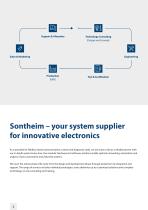
Support & Aftersales Technology Consulting (Design and Concept) Sales & Marketing Test & Certification Sontheim – your system supplier for innovative electronics As a specialist for fieldbus-based communication, control and diagnostic tasks, we are at your side as a reliable partner with our in-depth system know-how. Our modular hardware and software solutions enable optimal networking, automation and analysis of your automotive and industrial systems. We cover the entire product life cycle, from the design and development phase through production to integration and support. The range of services...
Open the catalog to page 2
Mobile Automation Industrial Automation
Open the catalog to page 3
Our services For 25 years, our customers worldwide have received a wide range of hardware and software components as well as automation and diagnostic technology services. Sont eim represents technically outstanding products, very close customer h service and the combination of individual components to a compete solution that suits your needs. We offer both standardl ized and customer-specfic products tailored to your individual requirements. i We apply our know-how in the area of fieldbus technology in various branches of the automation and automotive industry and thus cover a wide range of...
Open the catalog to page 4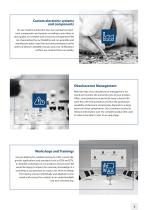
Custom electronic systems and components On our modern production lines we manufacture electronic components and systems according to your ideas in best quality, on schedule and of course cost-optimized. We are characterized by our flexibility and can assemble and manufacture batch sizes from just one prototype to series orders of almost 1,250,000 units per year. Our certifications confirm our constant focus on quality. Obsolescence Management With the help of our obsolescence management, we check and monitor the entire life cycle of your product. Often, semiconductors in particular have a shorter...
Open the catalog to page 5
Mobile Automation Controls Displays Sensors Diagnostics VCIs Industrial Automation Controls IO Modules Computer-on-Modules Drive Technology Printing Technology Connectivity Gateways CAN Interfaces CAN Interface Ca
Open the catalog to page 6
Mobile Automation Controls Displays Sensors Diagnostics Software VCIs Protocol Stacks Connectivity Telemetry Gateways Cloud Software
Open the catalog to page 8
We offer solutions for automation, dia nos ics and con ec ivty of mobile machines. Our g t n t i systems are future- roof, robust, scal ble and based on the latest inter atonal stan ards. p a n i d In addition to control units, display sou ions and sensors, our port olio includes inno a ive l t f v t tele etry systems with asso iated cloud infra truc ure for smooth analysis and evau tion m c s t l a of your vehicle data. We offer a seamess inter ction of auto ation solutions, telemetry l a m and standard-compliant dia nostics. g For more than 25 years, we have been supplying OEMs in the field...
Open the catalog to page 9
Mobile Automation Controls, Displays und Sensors Automotive > Mobile Automatio
Open the catalog to page 10
Automotive > Mobile Automation
Open the catalog to page 11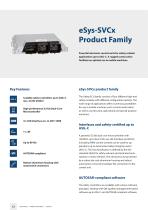
eSys-SVCx Product Family Powerful electronic control units for safety-related applications up to ASIL-C. A rugged construction f acilitate an optimal use in mobile machines. Key Features Scalable safety controllers up to ASIL-C (acc. to ISO 26262) High performance 32-bit Dual-Core Microcontroller 4× CAN interface acc. to ISO 11898 AUTOSAR compliant Robust aluminium housing with automotive connectors eSys-SVCx product family The Safety ECU family consists of four different high-end safety modules with different configuration options. The wide range of applications offers numerous possibilities...
Open the catalog to page 12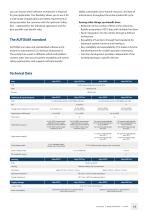
you can choose which software architecture is required for your application. This flexibility allows you to use it for a wide range of applications and safety requirements. It always provides the customer with the optimum Safety- ECU – optimized for the individual application and the best possible cost-benefit ratio. The AUTOSAR standard AUTOSAR is an open and standardized software architecture for automotive ECUs (without infotainment). The architecture scales to different vehicle and platform v ariants, takes into account system availability and ystem s safety requirements, and supports software...
Open the catalog to page 13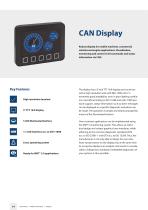
CAN Display Robust display for mobile machines, commercial vehicles and engine applications. Visualization, monitoring and control of all commands and status information via CAN. Key Features High resolution terminal Linux operating system Ready for MDT® 2.0 applications Automotive > Mobile Automation > Displays The display has a 5 inch TFT 16:9 display and onvinces c with a high resolution and with 800–1000 cd/m² a e xtremely good readability, even in poor lighting conditions. Via CAN according to ISO 11898 and with J1939 protocol support, status information such as alarm messages can be displayed...
Open the catalog to page 14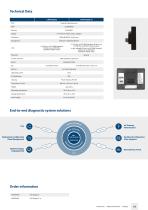
Technical Data CAN Display Freescale i.MX6 dual core 5" TFT 16:9, 16 million colors, antiglare 1000 cd/m² (50.000 h lifetime) 1× CAN acc. to ISO 11898 Standard, 50 Kbit/s up to 1000 Kbit/s (250 Kbit/s default value) 1× CAN acc. to ISO 11898 Standard, 50 Kbit/s up to 1000 Kbit/s (250 Kbit/s default value) 1× galv. isolated CAN acc. to ISO 11898 Standard, 50 Kbit/s up to 1000 Kbit/s (250 Kbit/s default value) Bluetooth Further protocols Operating system Plastic Housing PC-ABS Dimensions (l×w×h) Operating temperature Storage temperature Input voltage End-to-end diagnostic system solutions
Open the catalog to page 15
Ultrasonic Wind Sensor With CAN interface and J1939 protocol support Windspeed from 0–50 meter/s The ultrasonic wind sensor convinces by an extremely compact and robust construction. The sensor has no moving parts and therefore no mechanical wear. All e nvironmental data are measured and provided by ultrasonic technology. The data can be transmitted easily and q uickly via a CAN interface and J1939 protocol support. The sensor convinces with extremely fast data handling and can acquire up to 50 measurements per second. Wind speeds of 0–50 meters per second can be recorded. Further measurement...
Open the catalog to page 16All Sontheim Industrie Elektronik GmbH catalogs and technical brochures
 Visual CANopen
4 Pages
 COMfalcon
4 Pages
 PF_ePC
4 Pages
 PF_Super-IO
4 Pages
 PF_EC-DIO32
4 Pages
 PF_IPC-4_EN
5 Pages
 PF_DIO32-L_
6 Pages
 PF_Protocol_stacks
4 Pages
 PF_MDT
6 Pages
 PF_CAN-Explorer
5 Pages
 PF_CANUSB
4 Pages
 PF_CANfox
4 Pages
 PF_CANUSB_light_EN
4 Pages

Archived catalogs
 Product_Catalogue_2015
132 Pages