
- Catalogs
- Sonics + Materials, Inc.
- Probes and Boosters

Probes and Boosters

Probes and Boosters
- Solid Probes: Suitable for high-intensity applications, available in sizes ranging from 1/2" to 1" tip diameters.
- Threaded End Probes: Allow for replaceable tips and extenders, recommended for medium to low-intensity applications.
- High Gain Probes: Provide higher intensity for challenging applications.
- Probes with replaceable tips should not be used with organic solvents or low surface tension liquids.
- Probes are tuned to resonance, and their length may vary slightly due to titanium's modulus of elasticity.
Catalog excerpts
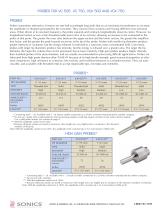
PROBES FOR VC 505, VC 750, VCX 500 AND VCX 750 PROBES Probes (sometimes referred to as horns) are one-half wavelength long tools that act as mechanical transformers to increase the amplitude of vibration generated by the converter. They consist of two sections each having different cross-sectional areas. When driven at its resonant frequency, the probe expands and contracts longitudinally about its center. However, no longitudinal motion occurs at the threaded nodal point (area of no activity), allowing accessories to be connected to the probe at that point. The greater the mass ratio between the upper section and the lower section, the greater the amplification factor, and the greater the peak-to-peak excursion at the tip of the probe. Probes with smaller tip diameters produce greater intensity of cavitation, but the energy released is restricted to a narrower, more concentrated field. Conversely, probes with larger tip diameters produce less intensity, but the energy is released over a greater area. The larger the tip diameter, the larger the volume that can be processed, but at lower intensity. High gain probes produce higher intensity than standard probes of the same diameter, and are usually recommended for processing difficult applications. Probes are fabricated from high grade titanium alloy Ti-6Al-4V because of its high tensile strength, good acoustical properties at ultrasonic frequencies, high resistance to corrosion, low toxicity, and excellent resistance to cavitation erosion. They are autoclavable, and available with threaded ends to accept replaceable tips, microtips and extenders. VOLUME (batch) AMPLITUDE*** micrometers inches LENGTH† * Connecting stud 1⁄2 - 20. Available with 3⁄8 - 24 stud to enable connection to a 20 kHz converter manufactured by another company. ** Do not use a probe with a replaceable tip when processing samples containing organic solvents or low surface tension liquids. Use a solid probe instead. See caution on page 8. *** With the amplitude control set at 100%. † Because ultrasonic probes are tuned to resonance, their length may vary slightly due to variations in the titanium’s modulus of elasticity. Note: With the amplitude control set at 100%, the amplitude at the converter tip is 16.5 micrometers (.0006 inch). HIGH GAIN PROBES* PART NO. VOLUME (batch) AMPLITUDE*** micrometers inches LENGTH† * Connecting stud 1⁄2 - 20. Available with 3⁄8 - 24 stud to enable connection to a 20 kHz converter manufactured by another company. ** Do not use with a booster. *** With the amplitude control set at 100%. † Because ultrasonic probes are tuned to resonance, their length may vary slightly due to variations in the titanium’s modulus of elasticity. Note: With the amplitude control set at 100%, the amplitude at the converter tip is 16.5 micrometers (.0006 inch). SONICS & MATERIALS, INC., 53 CHURCH HILL ROAD, NEWTOWN, CT 06470-1614 USA
Open the catalog to page 1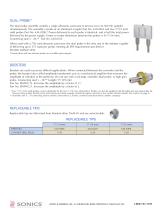
DUAL PROBE* The dual probe assembly enables a single ultrasonic processor to process two (25-500 ml) samples simultaneously. The assembly consists of an aluminum coupler Part No. 630-0562 and two 3⁄4" (19 mm) solid probes Part No. 630-0208.* Power delivered to each probe is identical, and is half the total power delivered by the power supply. Center to center dimension between the probes is 41⁄2" (114 mm). Connecting stud 1⁄2 - 20.** Part No. 630-0525 When used with a 750 watt ultrasonic processor, the dual probe is the only one in the industry capable of delivering up to 375 watts per probe,...
Open the catalog to page 2All Sonics + Materials, Inc. catalogs and technical brochures
 Plastics Assembly
8 Pages
 ULTRASONIC LIQUID PROCESSORS
31 Pages
 Tube Sealers
2 Pages
 Sonochemistry Equipment
1 Page
 Flow Cells & Cup Horn
1 Page
 Multi-Element Probes
1 Page
 Microtips & Extenders
1 Page
 Atomizers
3 Pages
 VCX 1500 HV (1500 watts)
1 Page
 VCX 1500 (1500 watts)
1 Page
 VCX130PB (130 watts)
1 Page
 VCX130 (130 watts)
1 Page
 Hot Plate Welders
2 Pages
 Vibration Welders
4 Pages
 Food Cutting
2 Pages
 Hand Held Welders
2 Pages
 e-Press
2 Pages
 40 kHz Ultrasonic Welder
2 Pages


Archived catalogs
 POWER SUPPLIES
1 Page
 Power Supplies_2008
2 Pages
- Welding system
- Automatic welding machine
- Welder
- Spray tip
- Liquid nozzle
- Resistance welding machine
- Full-cone nozzle
- Laboratory reactor
- Spot welding machine
- Ultrasonic sealer
- Process reactor
- Reactor for the pharmaceutical industry
- Rotary sealer
- Benchtop reactor
- Multipurpose reactor
- Ultrasonic reactor
- Ultrasonic welder
- Ultrasound nozzle