
- Catalogs
- SOMMER Messtechnik GmbH
- Tracersystem TQ-F


Tracersystem TQ-F

Tracersystem TQ-F
The TQ-Tracer system by Sommer GmbH is designed for mobile and easy measurement of water discharge using tracer dilution methods. It is suitable for high-velocity and turbulent streams, providing reliable results without needing cross-section profile information. The system is environmentally friendly and offers real-time visualization of results.
Features and Benefits
- Mobile and easy discharge measurement.
- Reliable results independent of cross-section profiles.
- Ideal for high-velocity, turbulent streams.
- Environmentally safe and harmless to water.
- Real-time visualization and Bluetooth data transmission.
- Simultaneous measurements with up to four probes.
- Compatible with conductivity or fluorescence probes.
- Compact and portable equipment.
Application
The tracer dilution method is applicable in waters where complete mixing occurs, especially in fast-flowing, turbulent waters with complex cross-sections. High turbulence and changing cross-sections enhance mixing and measurement accuracy.
Measurement Principle
The system uses the tracer dilution method with instantaneous feed. A known amount of tracer is added to the water, forming a cloud downstream where concentration is measured to calculate discharge. No cross-section profile information is needed.
Software: TQ-Commander
- Guides users through measurement sequences and probe calibration.
- Bluetooth connection for data transmission.
- Real-time visualization of measurement curves.
- Supports post-processing and report editing with data output in CSV or XML formats.
Tracer Types
- Salt Tracer TQ-S: Uses NaCl with conductivity probes, suitable for discharges up to 10 m³/s. Advantages include easy handling and low cost.
- Fluorescence Tracer TQ-F: Uses optical fluorescence probes, suitable for all discharge volumes, including sewage. Requires minimal tracer material.
Technical Data
- Measurement principle: Tracer dilution method.
- Data transfer via Bluetooth with a range up to 100 m.
- Working temperature: -20 to +60 °C.
- Energy supply: 3x 1.5 V batteries or NiMH battery.
- Operation time: 50 hrs for TQ-S, 25 hrs for TQ-F.
- Probes: Conductivity and fluorescence probes with specific measurement ranges and resolutions.
Accessories
- Includes pipettes, calibration solution bottles, measuring cups, volumetric flasks, USB memory stick, Bluetooth adapter, and recharger.
Conclusion
The TQ-Tracer system offers a comprehensive solution for measuring water discharge in various environments, providing accurate and reliable data with minimal environmental impact.
Catalog excerpts

Mobile system to measure the discharge with salt tracer (TQ-S) or fluorescence tracer (TQ-F) 9 Easy and mobile measuring of discharge 9 Reliable results independent of information about the cross section profile 9 Ideal application at high velocities and turbulent streams and rivers difficult to access 9 Ecologically compatible and harmless to the water 9 Realtime visualisation of measurement results and amount of discharge 9 Comfortable transmission of measurement values from sensor to receiving unit via bluetooth 9 Simultaneous measurements with up to four probes for an instant plausibility check 9 Device usable with conductivity or fluorescence probes (e.g. for fluorescein, rhodamine and others) 9 Comfortable and compact: whole equipment securely packed into tool cases
Open the catalog to page 1
Introduction Measurement Principle The measurement principle is based on the tracer dilution method with instantaneous feed. A known amount of tracer material is added to the water in a rapid pulse. The tracer is taken downstream, mixes with the water and forms an elongated cloud. At a certain point downstream the measuring devices record the tracer concentration with which the discharge can be calculated. No further information about the cross section profile of the body of water is needed for this calculation. Application The tracer dilution method is applicable for discharge measurements in...
Open the catalog to page 2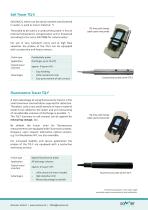
Salt (NaCI), which can be easily injected and dissolved in water, is used as tracer material. 1) The probe to be used is a conductivity probe. It has an internal temperature compensation and is linearised according to the norm EN27888 for natural water. For use in very turbulent rivers and at high flow velocities the probes of the TQ-S can be equipped with a protective and heavy armour. A main advantage of using fluorescence tracers is the small minimum concentration required for detection. Therefore, only a very small amount of tracer material needs to be added to the water and yet measureing of...
Open the catalog to page 3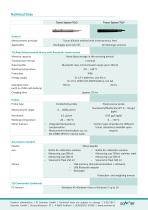
Tracer System TQ-S Tracer System TQ-F General Memory capacity None (data storage in the receiving device) Transmission interval 1 second Data transfer Bluetooth class 1 (transmission range up to 100 m) Energy supply Operation time (with 3x 2500 mAh battery) Charging time Probes Probe type Measurement range Resolution Working temperature Other features 3x 1.5 V batteries, size AA or 3x 1.5 V, 2500 mAh NiMH battery, size AA 50 hrs 25 hrs Conductivity probe Accessories included Pipette Jars Others TQ-Commander (Software) PC-Version Windows XP, Windows Vista or Windows 7 up to 10 Product...
Open the catalog to page 4All SOMMER Messtechnik GmbH catalogs and technical brochures
 SSR-2
SSR-22 Pages
 SSG-2
SSG-22 Pages
 MR2
MR22 Pages
 DP-10 2021
2 Pages
 RL-15/35
2 Pages
 RG-30
RG-304 Pages
 RQ-30d
4 Pages
 RQ-30ADMS
4 Pages
 RQ-30 / RQ-30a
2 Pages
 RP-30
RP-304 Pages
 SQ-Series
12 Pages
 Level Data Logger PD-3/4/5
4 Pages
 Snow Depth Sensor USH-8
4 Pages
 Snow Pack Analyser SPA
4 Pages
 Snow Scales SSG
4 Pages
 Snow Melt Analyser SMA
2 Pages
 Data Logger MDL 4/1
2 Pages
 Data Logger MDL
8 Pages
 Snow Scale Roof SSR
4 Pages
 Measured-Data-Server (MDS)
8 Pages
 DP-10 2017
2 Pages
 Data Logger MRL-6 Download
2 Pages
 ProductLeaflet_RQ-30L
4 Pages
 RQ-30 d
4 Pages
 ProductLeaflet_RQ-30
2 Pages


Archived catalogs

- SOMMER Messtechnik flow meter
- Temperature probe
- SOMMER Messtechnik volume flow meter
- SOMMER Messtechnik liquid flow meter
- Measuring device
- CMOS camera module
- Industrial camera module
- Data logger
- Resistance temperature sensor
- Liquids analyzer
- Measuring machine
- Monitoring camera system
- SOMMER Messtechnik waterproof flow meter
- Level probe
- Temperature datalogger
- Solids analyser
- Stainless steel flow monitor
- Liquid level sensor
- Industrial flow monitor
- Pressure probe