


RQ-30 d

RQ-30 d
- High accuracy discharge measurement for wide water bodies with inhomogeneous velocity distribution.
- Utilizes a single level measurement with multiple individual velocity measurements.
- Employs proven Sommer RQ radar technology for non-contact, maintenance-free, and flood-proof measurements.
- No structural work required in the water.
- Capable of recognizing flow direction and hysteresis effects, and measuring in tidal and backwater situations.
- Effective in environments with weed growth and high turbidity.
- Measuring range from +/-0.10 to +/-15 m/s, with optional analogue outputs from 4 to 20 mA.
The RQ-series radar sensors provide continuous, contact-free discharge measurements for rivers, streams, open channels, or canals. They combine radar measurement principles to determine surface flow velocity and water level, allowing accurate discharge calculations.
Installation and Measuring RangeSensors can be mounted on bridges or other structures above water, with a maximum installation height of 35 meters and a minimum distance of 0.5 meters from the water surface. The measurable flow velocity range is 0.10 to 15 m/s, and the system can measure in tidal waters and high turbidity conditions.
Fields of ApplicationThe RQ-30d offers increased accuracy, especially in rivers and streams with inhomogeneous flow velocity distribution. It measures multiple individual flow velocities across the water body width for precise discharge calculations.
Criteria for Measuring SiteThe riverbed should be stable, and the water surface should not be completely still. The sensor is sensitive to reflections from ripples as small as 3mm, but rocks, whirlpools, and stagnant waves should be avoided.
Measuring Principle- Surface Flow Velocity: Utilizes the Doppler frequency shift method with a 24 GHz radar signal to determine surface velocity, which is converted into mean velocity for discharge calculations.
- Water Level: Determined using travel time measurement with radar impulses, calculating the distance to the water surface.
- Water level measurement range: 0 to 15 m (standard), 0 to 35 m (optional), with accuracy of +/- 2 mm.
- Surface velocity measurement range: 0.10 to 15 m/s, with accuracy of +/- 0.01 m/s.
- Interface options include SDI-12 and RS 485, Modbus, with various ASCII-protocols.
- Device dimensions: Master - 338 x 333 x 154 mm; Slave - 175 x 154 x 246 mm.
- Material: Aluminium housing, powder coated, with IP 67 protection.
- Operating temperature range: -35° to 60° C.
Catalog excerpts

RQ-30d Reliable, accurate and non-contact discharge measurement especially for wide rivers and streams with inhomogeneous distribution of flow velocity. 99 Discharge measurement at high accuracy for very broad bodies of water and at inhomogeneous velocity distribution 99 Only one level measurement, but multiple individual velocity measurements 99 Proven Sommer RQ radar technology: non-contact measuring, maintenance free and flood-proof 99 No structural work is necessary in the water 99 Recognition of flow direction and hysteresis effects 99 Measurement in tidal waters 99 Measurement in backwater situations 99 Measures even where weed growth prevails and in waters with high turbidity 99 Measuring range from +/-0.10 to +/-15 m/s (depending on the flow conditions) 99 Optional: analogue outputs from 4 to 20 mA
Open the catalog to page 1
Sommer radar technology The radar sensors of the RQ-series measure continously and contact-free the discharge of rivers, streams, open channels or canals. For that two principles of radar measurement are combinded within the device, one to determine the surface flow velocity and one for the water level. Together with a known cross section profile the sensor can then calculate accurately the discharge Q of the water. Non-contact = failsafe = low maintenance Thanks to the non-contact measurement technology it is possible to install the sensor outside the body of water. Hence, the equipment is not...
Open the catalog to page 2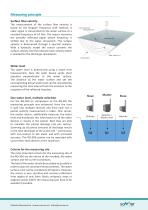
Measuring principle Surface flow velocity The measurement of the surface flow velocity is based on the Doppler frequency shift method: A radar signal is transmitted to the water surface at a constant frequency of 24 GHz. The sensor measures the partially reflected signal whose frequency is shifted due to the water movement. The surface velocity is determined through a spectral analysis. With a hydraulic model the sensor converts the surface velocity into the relevant mean velocity which is needed for the discharge calculations. Local velocity (vl) measuring point Mean velocity (vm) Cross section...
Open the catalog to page 3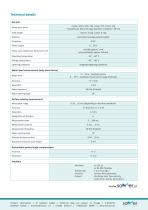
Technical details General Dimensions (mm) Total weight Material master: 338 x 333 x 154 | slave: 175 x 154 x 246 2 brackets per device for pipe diameter of of Ø 34 – 48 mm master: 5.4 kg | slave: 2.7 kg aluminium housing, powder coated Power supply Power consumption per device (at 12 V) 6 ... 30 V standby approx. 1 mA active operation approx. 140 mA Operating temperature Storage temperature Lightning protection integrated lightning protection Water level measurement (only slave device) Water level 0 ... 15 m - standard version 0 ... 35 m - extended measurement range (optional) Radar frequency...
Open the catalog to page 4All SOMMER Messtechnik GmbH catalogs and technical brochures
 SSR-2
SSR-22 Pages
 SSG-2
SSG-22 Pages
 MR2
MR22 Pages
 DP-10 2021
2 Pages
 RL-15/35
2 Pages
 RG-30
RG-304 Pages
 RQ-30d
4 Pages
 RQ-30ADMS
4 Pages
 RQ-30 / RQ-30a
2 Pages
 RP-30
RP-304 Pages
 SQ-Series
12 Pages
 Level Data Logger PD-3/4/5
4 Pages
 Tracersystem TQ-F
4 Pages
 Snow Depth Sensor USH-8
4 Pages
 Snow Pack Analyser SPA
4 Pages
 Snow Scales SSG
4 Pages
 Snow Melt Analyser SMA
2 Pages
 Data Logger MDL 4/1
2 Pages
 Data Logger MDL
8 Pages
 Snow Scale Roof SSR
4 Pages
 Measured-Data-Server (MDS)
8 Pages
 DP-10 2017
2 Pages
 Data Logger MRL-6 Download
2 Pages
 ProductLeaflet_RQ-30L
4 Pages
 ProductLeaflet_RQ-30
2 Pages


Archived catalogs

- SOMMER Messtechnik flow meter
- Temperature probe
- SOMMER Messtechnik volume flow meter
- SOMMER Messtechnik liquid flow meter
- Measuring device
- CMOS camera module
- Industrial camera module
- Data logger
- Resistance temperature sensor
- Liquids analyzer
- Measuring machine
- Monitoring camera system
- SOMMER Messtechnik waterproof flow meter
- Level probe
- Temperature datalogger
- Solids analyser
- Stainless steel flow monitor
- Liquid level sensor
- Industrial flow monitor
- Pressure probe
- VirtualExpo Group
- Our Partners
- Recruitment
- Testimonials