

SOMAI - Industrial vibrators

SOMAI - Industrial vibrators
This technical catalogue from SOMAI S.r.l. provides detailed information on various industrial vibrators, including electric, mechanical, pneumatic, and hydraulic types. It highlights their specifications, operational features, and applications.
- Electric Low Frequency Vibrators: Centrifugal force ranges from 0.3 to 200 KN.
- Electric High Frequency Vibrators: Centrifugal force ranges from 1 to 30 KN.
- Rotating Mechanical Vibrators: Centrifugal force ranges from 8 to 30 KN.
- Pneumatic Vibrators: Centrifugal force ranges from 3 to 60 KN.
- Hydraulic Vibrators: Centrifugal force ranges from 4 to 20 KN.
The catalogue notes that specifications are subject to change without notice and provides detailed technical characteristics for each vibrator type, including frequency, force, noise levels, and weight.
- External Hydraulic Vibrators: Feature variable frequency and centrifugal force, reversible rotation, and are extremely silent. Suitable for use where hydraulic power is available.
- Pneumatic Ball Vibrators: Known for long life and low noise, used for filter cleaning and material transport.
- Pneumatic Turbine Vibrators: Extremely silent with low air consumption, used for screens and sieves.
- Pneumatic Roll Vibrators: High power and amplitude, used for material compaction and concrete vibration.
- Striking-Piston Pneumatic Vibrators: Provide unidirectional vibration, used for cleaning large hoppers.
- Floating-Piston Pneumatic Vibrators: Compact and silent, suitable for limited space applications.
The document includes tables listing various vibrator models, detailing type, frequency, air consumption, centrifugal force, noise levels, weight, and price for comprehensive comparison.
- Unidirectional vibration with low frequency and high reciprocating force.
- Extremely silent operation with adjustable force and frequency.
A steel piston within an aluminum body moves in a reciprocating motion using compressed air, generating vibrations without striking the cylinder walls. An external counterweight allows for the adjustment of vibration force and frequency.
| Type | A | B | C | D | E | F | G |
|---|---|---|---|---|---|---|---|
| VPFE 100 | 115 | 38 | M10 | 1/8’’ | 1/8’’ | M10 | 50 |
| VPFE 700 | 110 | 38 | M10 | 1/4’’ | 1/4’’ | M10 | 60 |
| VPFE 1400 | 140 | 38 | M16 | 3/8’’ | 1/4’’ | M16 | 85 |
| VPFE 3700 | 122 | 54 | M20 | 3/8’’ | 3/8’’ | M20 | 160 |
These vibrators have adjustable masses and are constructed with robust metal structures, suitable for mounting on concrete finishing machines and other industrial applications.
The rotating mechanical vibrator generates a vibration force through unbalanced masses, powered by electric, hydraulic, or pneumatic motors, ensuring silent operation and durability.
- Metallic body made of high-resistance steel or aluminum.
- Extra-dimensioned roller bearings for silent and long-lasting operation.
- Oil lubrication for bearings.
- Adjustable steel masses.
- Drag pulley for various motor types.
- Concrete finishing machines, silo cleaning, material transport, and vibration resistance testing.
Designed for unidirectional vibration applications, suitable for securing to structures requiring strong vibration.
Plates and cradle vices secure vibrators to structures, ensuring total vibration transmission.
Catalog excerpts
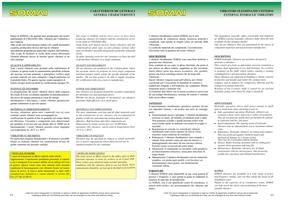
CARATTERISTICHE GENERALI VIBRATORI OLEODINAMICI ESTERNI GENERAL CHARACTERISTICS EXTERNAL HYDRAULIC VIBRATORS > I dati non sono impegnativi e lazienda si riserva il diritto di apportare modifiche senza alcun preavviso.Catalogue data are not binding and they can be changed at any time and without notice. I dati non sono impegnativi e lҒazienda si riserva il diritto di apportare modifiche senza alcun preavviso.Catalogue data are not binding and they can be changed at any time and without notice. 4/2 4/3 size="-1">
Open the catalog to page 2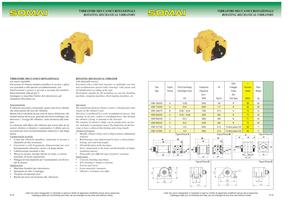
R VIBRA T ORE MECCANICO R O T AZION ALE O T A TING MECHANICAL VIBRA T OR con masse regolabili.Esecuzione in robusta struttura metallica in acciaio o ghisa con cuscinetti a rulli speciali sovradimensionati, con lubrificazione a grasso o ad olio a seconda del modello. Particolarmente indicati per il montaggio su macchine finitrici del calcestruzzo, per stampatrici blocchiere ecc. Funzionamento with adjustable masses.Execution with a solid steel structure or malleable cast-iron and overdimension special roller bearings, with grease and oil lubrification according of the type. Particularly suitable...
Open the catalog to page 8All SOMAI catalogs and technical brochures
 BEYOND THE VIBRATORS
32 Pages
 External pneumatic vibrators
20 Pages
 SOMAI - Electric vibrator
20 Pages
Archived catalogs
 ELECTRIC VIBRATORS FOR INDUSTRY
20 Pages

