


GAUGER 485

GAUGER 485
- Advanced ultrasonic performance with a tracking rate of up to 10 meters per minute.
- Measures distance, level, volume, open channel flow (OCF), and temperature.
- Automatic dual sensor temperature compensation.
- Direct installation with a 1.5” opening (50KHz: 2”).
- USB interface for cloning and firmware upgrades.
- Type: Mono-block ultrasonic level meter with loop powered and digital RS485 output.
- Maximum range: 8 meters for liquids, 5 meters for solids.
- Minimum range (dead zone): 15 cm.
- Measurement accuracy: ±1.5 mm / 0.3% of range / 0.2% of max range.
- Resolution: 1 mm.
- Reported measured values include distance, level, volume, temperature, and operating hours.
- RS485: One string record per second reporting distance, level, volume, flow, temperature.
- Additional interfaces: USB port for setup, cloning, and firmware upgrade.
- Temperature compensation: Automatic with internal and external sensors.
- Open channel flow: Supports 18 flumes/weirs and Manning flow formula.
- Volume calculation: Supports various tank shapes.
- Display: Graphic LCD 64X128, viewing window 50X25mm2.
- Sensor: 75 KHz, full PVDF material, 1.5” BSP / NPT threads.
- Power supply: 10.8 to 33VDC.
- Operating temperature: -30°C to +70°C (min with display: -20°C).
- Mechanical: Plastic PC/ABS+UV protection, weight 0.96 Kg, dimensions Ø105 X 28 cm2 + two glands.
- Certifications: CE EMC, CE Safety, FCC part 15, IP68 seal rating.
Catalog excerpts

Gauger485 Ultrasonic continuous level meter for liquids and solids with digital output Markets Water and wastewater Chemical processes Petrochemicals Food and beverage industries Applications • Liquid targets, solids (grains) and Open Channel Flow (OCF). • Storage vessels, process tanks and outdoor piles. • Wastewater, water desalination, water treatment plants. • Petrochemical, chemical, food and agriculture industries. • OEM models and kit parts are available to partners. Advanced ultrasonic performance • Tracking rate up to 10 meters per minute. • Measuring distance, level, volume, OCF and temperature. • Automatic, dual sensor temperature compensation. • Direct installation - 1.5” opening (50KHz: 2”). • USB interface for cloning and firmware upgrades. Gauger485 is a perfect solution for applications interfacing an external modem, PLC or laptop. The use of serial stringbased output is simple, reliable and more accurate than 420 analog interface. May be viewed directly on a PC or laptop, no custom software is required.
Open the catalog to page 1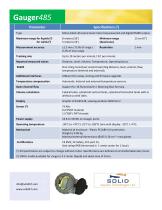
Parameter Type Mono-block ultrasonic level meter loop powered and digital RS485 output. Maximum range for liquids (2) for solids (2) Minimum range (dead zone) Measurement accuracy Tracking rate Up to 10 meters per minute / 33’ per minute. Reported measured values Distance, Level, Volume, Temperature, Operating hours. One string record per second reporting distance, level, volume, flow, temperature (internal and external). Additional interfaces USB port for setup, cloning and firmware upgrade. Temperature compensation Automatic. Internal and external temperature sensors . Open channel flow Support...
Open the catalog to page 2All Solidat Applied Technologies Ltd. catalogs and technical brochures
 MonoScan Data Sheet
2 Pages
 SMARTSCAN 50
2 Pages
 GAUGER GSM
2 Pages
 Gauger420 - User Manual
67 Pages
 GaugerGSM / 485 - User Manual
94 Pages
 Complete_Product_line_Brochure
13 Pages
 Diesel Tank Monitoring Solution
12 Pages
 Gauger Line Brochure
10 Pages
 Sewer monitoring system
1 Page
 OEM options for GaugerGSM
3 Pages
 GaugerGSM - product highlights
13 Pages
 GaugerGSM - Highlights
11 Pages
 Wireless solution Poster
1 Page
 General purpose Poster
1 Page
 SmartScan User Manual
145 Pages
 MicroScan User Manual
51 Pages
 MonoScan User Manual
88 Pages
 SmartScan
2 Pages
 MicroScan™
2 Pages


- Flowmeter
- Volume flow monitor
- Liquid flow monitor
- Gas flow monitor
- Level probe
- Liquid level sensor
- In-line flow meter
- Analog level sensor
- Level transmitter
- Liquid level transmitter
- Ultrasonic flow monitor
- Digital output level sensor
- Vessel level sensor
- Analog level transmitter
- Liquids level gauge
- Digital output level transmitter
- Storage tank level transmitter
- Explosion-proof level sensor
- Electronic level gauge
- Explosion-proof level transmitter