
- Catalogs
- SOLBERG Filtration
- Oil Mist Eliminators for Power Generation

Oil Mist Eliminators for Power Generation

Oil Mist Eliminators for Power Generation
Vacuum Assisted Oil Mist Eliminators are designed for reciprocating engines and turbines to ensure environmental compliance and protect workplaces from harmful oil mist emissions. These systems are applicable in various sectors including landfill gas to energy, standby power, prime power, and mechanical drive.
Key Features
- Eliminates visible oil mist emissions with high efficiency coalescing elements.
- Constructed from rugged carbon steel with industrial-grade powder coat finish.
- Equipped with control valves for precise pressure regulation and integrated vacuum relief for motor protection.
- Available in a wide range of motor options including explosion-proof and ATEX certified.
- Flow range from 1 to 1500 CFM, with higher flows available upon request.
- Pressure rating of 1 bar full vacuum for most models.
- Full automation compatible with PLC and DCS systems.
Applications
- Marine: Used in passenger ships, workboats, and military vessels to ensure safety and reliability.
- Power Generation: Suitable for peaking, nuclear, and base load power plants.
- Gas Compression: Protects equipment from condensate, oil, and particulate entrained in the gas stream.
Technical Specifications
- Efficiency: 99.97% for 0.3 micron oil mist and particulate.
- Construction: Stainless steel options for harsh environments, with custom coatings and colors available.
- Certifications: ASME Section VIII or PED pressure certifications, with options for explosive environments (ATEX, Class I Div. 1).
- Operating Temperature: Continuous operation from 68°F (20°C) to 180°F (80°C).
Environmental Compliance
In line with the 2013 U.S. EPA’s RICE NESHAP ruling, stationary engines over 300HP should be equipped with a crankcase ventilation system to reduce harmful emissions. Solberg partners with plant operators to update equipment and lessen environmental impact.
Closed Crankcase Ventilation Systems
- Captures hazardous oil mist and particulate emissions from crankcases, achieving 99.97% efficiency for 0.3 micron oil mist.
- Protects turbochargers, intercoolers, and exhaust catalysts from contamination and damage.
- Maintains required crankcase vacuum via integrated self-regulating valve.
- Recovers expensive lube oil lost during the venting process, reducing maintenance costs.
Conclusion
Solberg’s Vacuum Assisted Oil Mist Eliminators and Closed Crankcase Ventilation Systems offer high efficiency and reliability for various industrial applications, ensuring environmental compliance and operational efficiency.
Catalog excerpts

Vacuum Assisted Oil Mist Eliminators Reciprocating Engines and Turbines Our Vacuum Assisted Oil Mist Eliminators are designed for field upgrades and new reciprocating engines and turbine installations around the world. Our high efficiency filtration systems eliminate vented oil mist emissions while controlling engine pressure in crankcases and turbine lube oil reservoirs. We offer either vapor extractor and static options based on application requirements. Series Specific Applications Reciprocating Engines: Stationary • Crankcase ventilation systems ensure environmental compliance and protect surrounding workplace from harmful oil mist emissions • Open and closed system designs • Prevents engine intake system contamination and seal leakage • Improves engine performance • Controls crankcase pressure • Applications: landfill gas to energy, standby power, prime power, and mechanical drive Gas & Steam Turbines • Retrofits and upgrades to replace outdated and inefficient vapor extractors for lube oil systems • Typical systems include: high efficiency coalescing element, vacuum / pressure controls and integrated bypass device to simply maintenance and reduce operating costs • Applications: peaking, nuclear, and base load power plants Air/Oil Separators Reciprocating Engines: Marine • Crankcase ventilation systems ensure safety and reliability • Unique piping configuration for easy installation, self regulation and seal leak prevention • Captures vented oil mist emissions and reduces breathing and slipping hazards • Applications: passenger ships, workboats, military vessels www.solbergmfg.com • [email protected] • Sales: 630.773.1363 • Fax: 630.773.0727
Open the catalog to page 1
Vacuum Assisted Oil Mist Eliminators 1 - 1500 CFM High Efficiency Oil Coalescing Filter Vacuum Source • Eliminates visible oil mist emissions • High efficiency and long las ng replaceable coalescing elements • Rugged carbon steel construc on • Industrial grade powder coat finish • Drain ports for oil recovery • Control valves for precise pressure regula on • Large assortment of motor op ons (Explosion proof, ATEX, etc.) • Integrated vacuum relief for motor protec on • Contact factory for specific flow ra ngs and sizes. System Outlet Bypass Connec on Control Box Drain Port • 0.3 micron media; 99.97%...
Open the catalog to page 2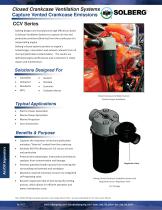
Closed Crankcase Ventilation Systems Capture Vented Crankcase Emissions CCV Series Solberg designs and manufactures high efficiency Closed Crankcase Ventilation Systems to capture oil mist and particulate emissions (blow-by) from the crankcases of a reciprocating engine. Solberg's closed systems protect an engine's turbocharger, intercoolers and exhaust catalysts from oil mist and particulate contamination. The results are optimized engine performance and a reduction in costly repairs and maintenance. Solutions Designed For • Guascor • Wartsila • Cummins • Fairbanks Morse • Caterpillar • Jenbacher •...
Open the catalog to page 3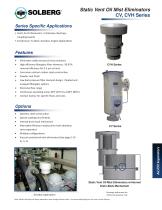
Static Vent Oil Mist Eliminators CV, CVH Series Series Specific Applications • Vents for Oil Reservoirs, Crankcases, Bearings, Coupling Guards • Compressor, Turbine, Gearbox, Engine Applications Features • Eliminates visible vented oil mist emissions • High efficiency fiberglass filter elements: 99.97% removal efficiency for 0.3 pm oil mist • Corrosive resistant carbon steel construction • Powder coat finish • Low back pressure filter element design: Pleated and wrapped fiberglass options • Extensive flow range • Continuous operating temp: 68°F (20°C) to 180°F (80°C) • Contact factory for...
Open the catalog to page 4
Static Vent Oil Mist Eliminators CVB Series Features • Eliminates visible vented oil mist emissions • Carbon steel construction with powder coat finish • Low back pressure wrapped filter element design • External drain-back Series Specific Applications • Air/Oil Separation Vents for oil reservoirs, crankcases, bearings, coupling guards • Compressors, turbines, gearboxes, and engines Technical Specifications • 0.3 micron media; 99.97% efficiency; • Typically 5 PPM or less (Consult factory for challenge) • Continuous operating temp: 68°F (20°C) to 180°F (80°C) Options • Stainless steel construction...
Open the catalog to page 5
Natural Gas Filtration Oil Separators Note: Drawings are for reference purposes only. Series Specific Applications • Landfill and Bio-Gas recovery • Fuel gas purity for - Reciproca ng Engines - Gen-Sets - Turbines • Gas compression • Oil sealed screw compressor discharge • Gas pipeline boos ng ATEX Available Air/Oil Separators • Protects equipment from condensate, oil, and par culate entrained in the gas stream • Mul -stage separa on - 316 SS vane pack and/or demister pad for heavy condensate and oil removal - 99.97% efficient at 0.3 micron separator for oil mist • Corrosive resistent carbon steel...
Open the catalog to page 6All SOLBERG Filtration catalogs and technical brochures
 CT
CT1 Page
 SLCR-SLCRT
1 Page
 MBFS
MBFS1 Page
 Vacuum Pump Oil Mist Filters
14 Pages
 LQB Series
1 Page
 FS Series
1 Page
 QB DN80 DN150
1 Page
 Inlet Vacuum Filters
20 Pages
 Sumo Class / Multibarrel
1 Page
 FS Series 6” to 14” FLG
1 Page
 WP series
1 Page
 EFS series
1 Page
 2G series
2 Pages
 ST series
1 Page


- Liquid filter
- Filter with cartridge
- Filter cartridge
- Industrial use filter
- Stainless steel pre-filter
- Centrifugal classifier
- Industrial filter cartridge
- Liquids separator
- Fine filter cartridge
- Filter housing
- Cartridge filter housing
- Water filter cartridge
- Plastic filter cartridge
- Liquid filter housing
- General purpose filter cartridge
- Process separator
- Compact pre-filter
- Metal filter housing
- In-line filter