

Overcurrent Protection

Overcurrent Protection
Overcurrent protection for 600 Volt class transformers is guided by NEC 450-3(b) and NEC 240-3. Primary protection is required for single-phase transformers with two-wire secondaries, while both primary and secondary protection are needed for transformers with more than two wires on the secondary circuit. The protection ratings vary based on the primary current, with specific percentages for different current ranges. Standard ampere ratings for fuses and circuit breakers are provided, with allowances for nonstandard ratings.
Fuse sizes are recommended based on primary voltage and VA ratings, with specific guidelines for different voltage levels. The recommendations align with UL 508 and NEC standards, ensuring appropriate protection and minimizing nuisance tripping.
Secondary fuses are recommended based on secondary voltage and VA ratings. The use of dual element slow-blow fuses is advised to handle transformer inrush currents, similar to motor applications.
The Energy Policy Act of 2005 mandates specific energy efficiency requirements for distribution transformers manufactured after January 1, 2007. These transformers must meet certain voltage and capacity criteria, with several types of transformers excluded from these standards. Increasing energy efficiency reduces waste and the need for new power generation.
Transformers are used to adjust voltage levels for specific electrical circuits. They can be located close to the load, reducing the need for extensive feeder lines. Applications include motors, lighting, and heating. SolaHD offers various transformer types, including general purpose, low temperature rise, K-factor, and copper wound transformers, each designed for specific efficiency and reliability needs.
Catalog excerpts
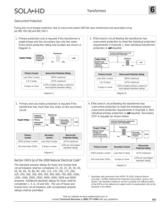
Primary CurrentOvercurrent Protection Rating Primary CurrentOvercurrent Protection Rating Less than 2 amps 300% maximum2 to 9 amps 167% maximum9 amps or more 125% of rated primary current (or next highest standard rating) Less than 2 amps300% maximum2 to 9 amps167% maximum9 amps or more125% of rated primary current (or next highest standard rating) Diagram A Diagram B > Primary CurrentSecondary CurrentOvercurrentProtection Rating 250% primary currentLess than 9 amps 167% maximumNot more than 250%9 amps or more 125% (or next higher standard rating) Primary CurrentSecondary CurrentOvercurrentProtection Rating Diagram C 250% primary currentLess than 9 amps 167% maximumNot more than 250%9 amps or more 125% (or next higher standard rating) > Diagram D * Reprinted with permission from NFPA 70-2005, National Electri-cal Code > , Ω2008, National Fire Protection As sociation, Quincy, MA 02269. This reprinted material is not the com plete and of cial position of the NFPA on the ref er enced subject which is represented only by the standard in its entirety. >
Open the catalog to page 1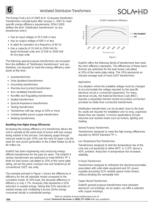
Applications Any situation where the available voltage must be changed to accommodate the voltage required by the speci c electrical circuit or connected equipment. For many electrical circuits, the National Electrical Code (NEC) requires a separately derived neutral secondary connection provided by Delta-Wye connected transformers.Distribution transformers can be located close to the load. No vaults are required for installation and no long, ex pensivefeeder lines are needed. Common ap plications include inductive and re sistive loads such as motors, lighting and heating. General Purpose Transformers...
Open the catalog to page 4All SolaHD catalogs and technical brochures
 ETP Ceiling Fan Box
4 Pages
 INDUSTRIAL POWER SOLUTIONS
36 Pages
 STFE Elite Series Brochure
6 Pages
 Power Quality Guidebook
20 Pages
 surge protection and filtering
28 Pages
 K-Factor Transformers
5 Pages
 General Purpose Transformers
15 Pages
 Transformers Selection Steps
2 Pages
 Power Supply Catalog Section
58 Pages


Archived catalogs


- Power supply unit
- DC power supply
- AC/DC power supply
- Dry transformer
- Surge protector
- Switched-mode power supply
- Class II surge protector
- DC-DC converter
- Current transformer
- Compact power supply
- Encapsulated transformer
- Power transformer
- DIN rail power supply
- Low-voltage lightning arrester
- Isolation transformer
- On-line UPS
- Three-phase transformer
- AC surge arrester